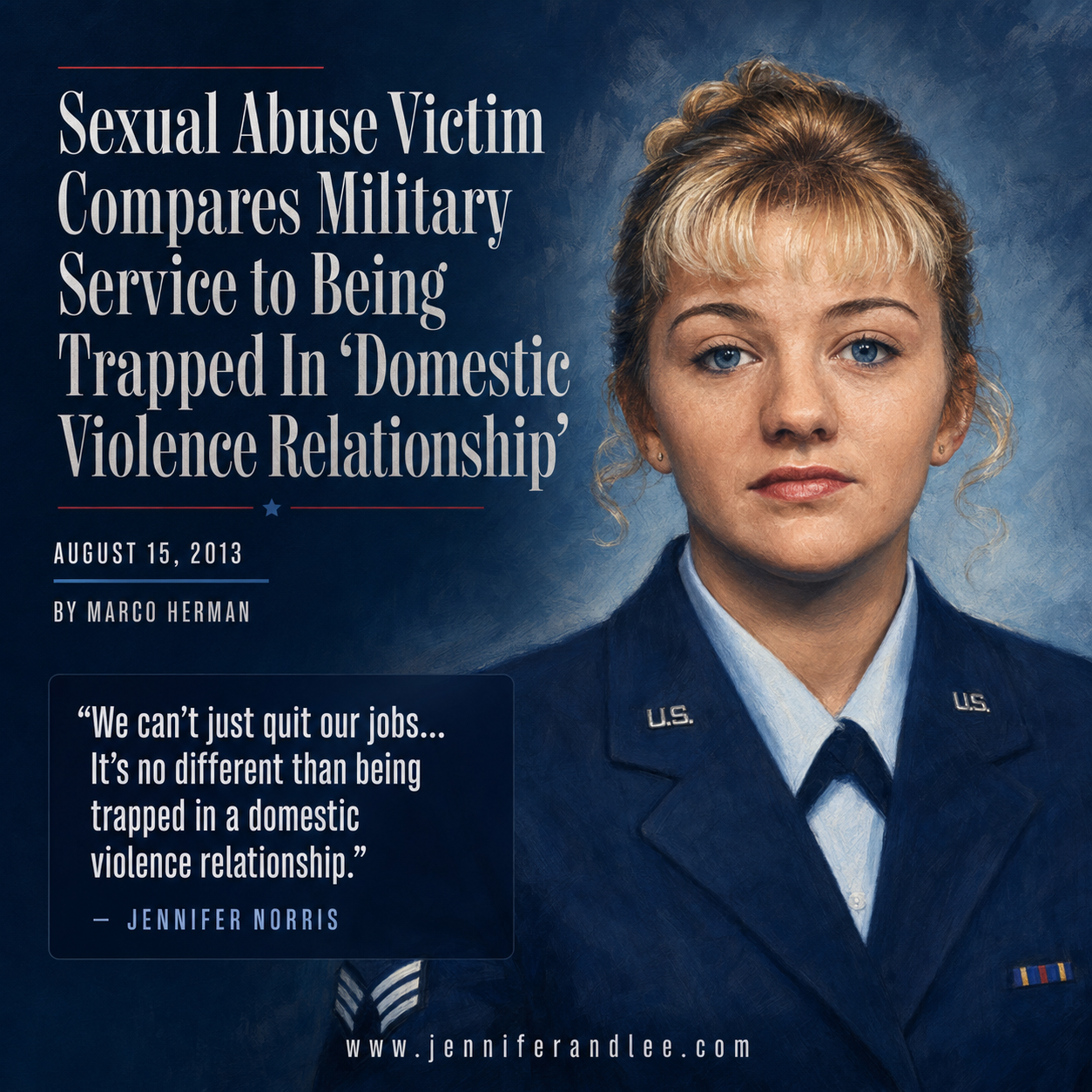
Sexual Abuse Victim Compares Military Service to Being Trapped In ‘Domestic Violence Relationship’
Copyrighted By Jennifer Norris, USAF Retired
Editorial note: The current written version of The World’s article says my problems began in 2006. The original embedded audio says 1996, which is correct. Also the article says I am a Protect Our Offenders Advocacy Committee member which was not true. I was gang bullied by Nancy Parrish’s advocates. They started before and after my testimony to the House Armed Services Committee in January 2013. When I told Nancy Parrish about all the on-line abuse in June 2013, she said, “Maybe you need to take a break,” protected the bullies, and then launched all the abusers in the political stratosphere. She used her institutional power to bury the original vulnerable survivors who fought for the Military Justice Improvement Act, a bill she did not want and sabotaged in favor of her long time confidant Jackie Speier‘s sexual assault only bill.
In 2013, the United States military was facing a public reckoning over sexual assault within its ranks. The Pentagon estimated that approximately 26,000 service members had experienced unwanted sexual contact during the previous year, while only a fraction of those incidents entered the formal reporting system. The Department of Defense received 3,374 reports of sexual assault in fiscal year 2012 involving 2,949 service-member victims.
That gap was not difficult for survivors to understand. We knew exactly why people stayed silent. We knew what could happen to a military career when someone reported a perpetrator who held more rank, credibility, access, or institutional power.
After survivors introduced the Military Justice Improvement Act on May 16, 2013, President Barack Obama met with senior military and national-security leaders about the crisis. He described sexual assault as a crime that damaged trust, weakened military effectiveness, and threatened national security.
During that same period on March 7, 2013 while I was in Albuquerque, New Mexico, I spoke with Marco Werman of The World about my experience in the United States Air Force and why military service had eventually felt like being trapped in an abusive relationship I could not escape.
The interview was personal, but the institutional patterns I described were much larger than my story.
The Assault Happened Before My Career Had Even Begun
I enlisted in the Air Force at age 24. Shortly afterward, the recruiter who signed me into the military invited me to what I believed was a squadron-sponsored function for new recruits.
It was not what he represented it to be.
The gathering was held at his home, and there were no other new recruits there. He immediately began pressuring me to consume alcohol through drinking games. I repeatedly refused because I had a long drive home and would not drink and drive.
When I eventually stood up, I realized I was dizzy. I now believe I had been drugged. At the time, I did not understand what was happening to my body. I became incapacitated and could not move. That was how he was able to assault me.
“I’d just started the Air Force.”
My career had not even begun. I had not yet left for basic training, and I was already facing the possibility of telling a commander that the recruiter representing the Air Force had assaulted me.
People sometimes ask why survivors do not immediately report. That question assumes the reporting system feels safe. It assumes the survivor and the accused enter the process with equal credibility and equal power. They often do not.
I was still trying to understand what had happened. I also knew that reporting could define me before I ever had a chance to serve. I wanted an Air Force career, not a reputation as the new female recruit making an allegation against a senior enlisted recruiter.
So I “soldiered on.”

After medical retirement, I went to New Mexico to interview for a documentary, I was also asked to do an interview for The World about my experiences in the military. It was an interview coordinated by both Protect Our Offenders and Michael Matthews. When this interview actually published in August 2013, Michael Matthews was accusing me of being a “media whore” and Protect Our Offenders was promoting abusers in the political stratosphere which emboldened them.
“I Just Want to Disappear”: The End Result of a Lifetime of Dehumanization and Abuse (2024)
High Performance Can Hide Profound Trauma
I went to basic training. I completed technical training, earned security clearances, learned my job, and continued building my military career.
From the outside, I was functioning. On the inside, I was carrying trauma I had never been given the safety or space to process.
The abuse did not end with the recruiter. I later experienced additional assaults involving military superiors. I kept working, performing, and trying to preserve the career I had worked so hard to build. Eventually, however, the strain began showing.
Someone noticed that I had changed. I had gone from being a superior performer who wanted to retire from the military to someone who appeared to no longer care. When I was confronted with that change, the floodgates opened. I began crying and disclosed what I had endured. He was now forced to make a mandated report.
I begged the person I told not to notify anyone. He explained that, as a noncommissioned officer, he had a duty to report illegal activity to the commander. I understood his obligation, but I also understood the likely consequences for me. I hoped I could transfer and begin again somewhere else without my career becoming permanently attached to the assaults.
That choice was taken out of my hands.
Why Military Service Felt Like an Inescapable Domestic-Violence Relationship
During the interview, I explained the sense of entrapment this way:
“It was like being in a domestic violence relationship that you can’t get a divorce from.”
The comparison was not about claiming that military service and an intimate relationship are identical. It was about coercive power, dependency, fear, and the absence of a safe exit.
In an abusive military environment, the institution controls nearly everything that determines a service member’s future: assignments, evaluations, promotions, training, discipline, reputation, and continued employment. The people connected to the alleged perpetrator may also control the reporting process.
A service member cannot simply ignore an order, stop reporting for duty, or quietly walk away without consequences. When the alleged offender is protected by rank or relationships, the survivor may feel forced to choose between personal safety and the career they worked to earn.
That is what made the situation feel so much like an abusive relationship. The system that was supposed to protect me also controlled whether I would be believed, whether my report would be investigated, and whether my career would survive the disclosure.
When the Commander Is Both Gatekeeper and Insider
One of the central questions in the interview concerned whether sexual-assault cases should remain under the authority of the military chain of command.
I supported removing those decisions from commanders because I had lived through the conflict built into that structure.
Once a report moved through the chain of command, it did not remain private. Leaders throughout the chain became aware of the situation because the commander had to manage the investigation and its effects on the unit.
I was terrified to approach a commander when one of the men I needed to report was frequently in that commander’s office. They were close. I saw them talking and laughing together. From my perspective, I was being asked to accuse a trusted member of the commander’s team and then depend on that same commander to protect me and respond impartially.
I was removed from the squadron while the men I had accused remained behind. That gave them time, access, and proximity to shape the narrative while I was isolated from the people with whom I had served.
This is one of the most damaging features of institutional betrayal: removing the person who reported harm can make the survivor look like the disruption while leaving the alleged perpetrators inside the social structure that controls the story.
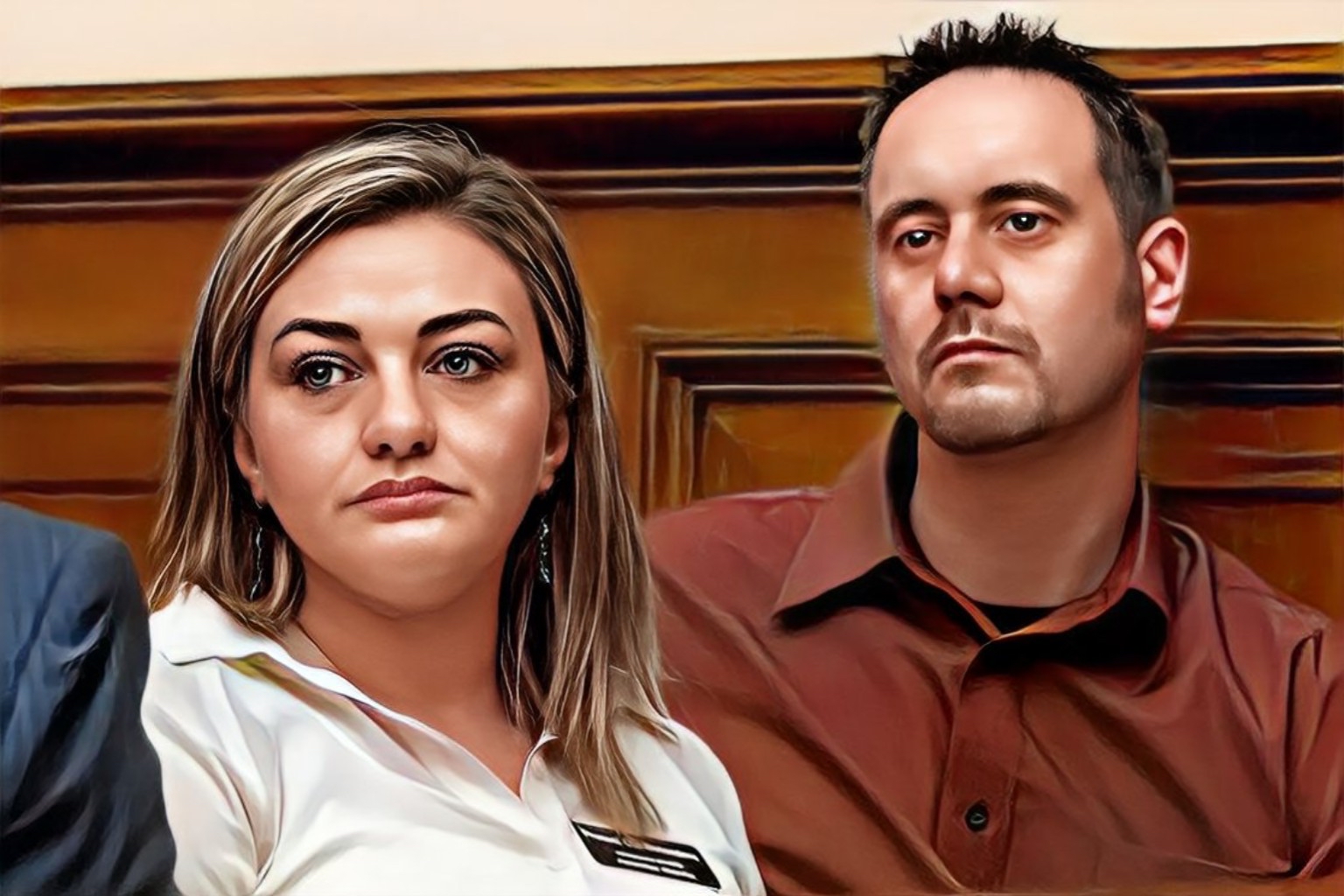
Why Independent Oversight Mattered
At the time of the interview, lawmakers were debating whether decisions involving serious crimes such as sexual assault should be taken away from the accused person’s immediate chain of command and assigned to independent, trained military prosecutors.
That proposed reform directly addressed the fear I described.
The problem was never simply that every commander was corrupt or uncaring. The problem was that the structure created an inherent conflict. A commander was responsible for the unit’s discipline, reputation, readiness, personnel, and mission while also being expected to make impartial decisions about an allegation involving members of that same unit.
Even a well-intentioned commander could be influenced by personal familiarity, a trusted subordinate’s reputation, concern for the unit, or incomplete information supplied by people closest to the accused.
Survivors needed a reporting and justice process that did not require them to gamble their safety on relationships they could not see and loyalties they could not control.
Senator Kirsten Gillibrand introduced the Military Justice Improvement Act in May 2013. The proposal sought to professionalize decisions about prosecuting serious crimes and reduce the systemic fear that survivors described when deciding whether to report. The legislation reflected a truth survivors had been repeating for years: justice cannot depend on whether a commander is willing to act against someone inside the commander’s own circle.
Sending Women Into Greater Danger Without Fixing the Danger Within
The interview also addressed the expanding role of women in combat.
My concern was not that women lacked the ability, courage, or strength to serve in combat positions. Women had already demonstrated those qualities across generations of service.
My concern was that the military was expanding women’s exposure to dangerous and isolated environments without first solving the sexual-violence crisis inside its own ranks.
Service members deployed overseas are deeply dependent on their chain of command. They cannot simply leave the workplace, contact ordinary civilian authorities, or remove themselves from an unsafe unit. The more isolated the environment, the more dangerous an abusive or compromised chain of command can become.
Before placing more women in those environments, the military had an obligation to create a system that protected them from predators serving beside them and responded fairly when they reported abuse.
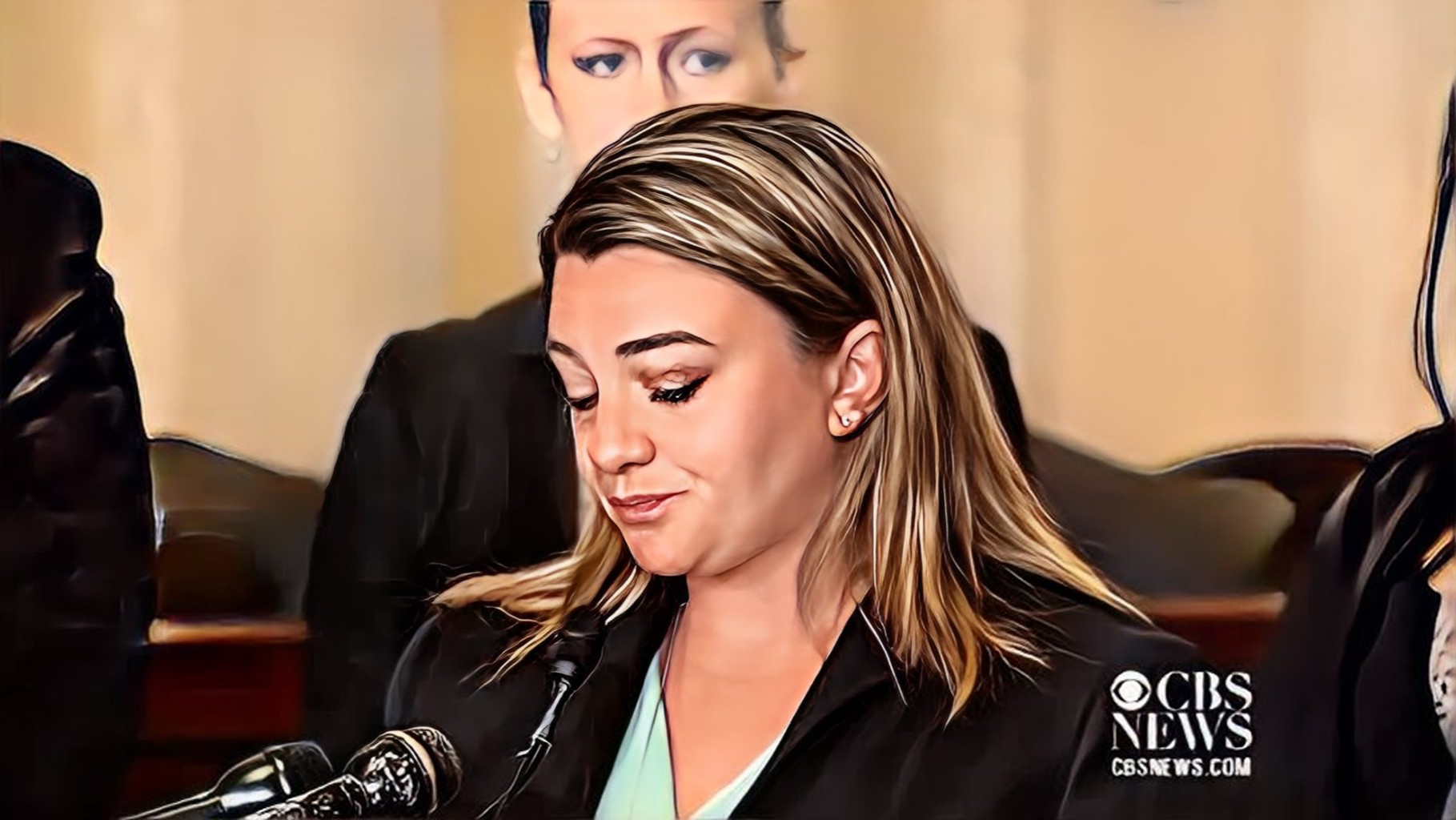
Why I Continued Speaking
After reporting, I experienced shame, silence, isolation, and the destruction of the career I had worked hard to build. I could not speak openly about the sexual assaults because I had to keep my game face on if I was going to survive a post 9/11 stop loss order. I continue serving and surviving what happened.
After my medical retirement from the Air Force, anger motivated me to start researching military sexual assault. What I discovered was not a collection of rare or unrelated incidents. I found repeating patterns: abuse of rank, retaliation, career destruction, disbelief, manipulated investigations, command conflicts, and survivors driven out while accused perpetrators remained protected.
I realized I was not alone.
When Marco Werman asked whether I would advise a young woman to join the military, my answer at that time was no—not yet. That answer did not come from hatred of the military. It came from wanting the institution to become worthy of the people volunteering to serve.
I wanted a future in which our daughters could enlist without fearing rape, sexual harassment, retaliation, or career destruction. I wanted the military to become the best institution it claimed it could be.
But getting there required outside accountability. The military had been given years to solve the problem internally. Survivors continued to demonstrate that the same structure accused of failing them could not be the only structure permitted to investigate itself.
The Crime Was the First Betrayal—The Institution Added Another
This interview was about more than the actions of one recruiter or several military superiors. It was about what happens when an institution combines enormous control with inadequate accountability.
The original sexual assault caused profound trauma. The institutional response compounded it.
When reporting jeopardizes the survivor’s career, reputation, security clearance, relationships, and future, silence should never be mistaken for evidence that the crime did not happen. Silence may be evidence that the survivor accurately understood the danger of the system around them.
I spoke publicly because service members deserve better than a choice between enduring abuse and losing everything they worked for. Rank should never provide camouflage for predatory behavior. A chain of command should never become a cage. And protecting the mission must never mean sacrificing the people who make that mission possible.
The interview preserved what survivors were telling the country in 2013: sexual assault in the military was not only a criminal problem. It was a leadership problem, a justice problem, a readiness problem, and an institutional-betrayal problem.
That truth deserved to be heard then.
It still deserves to be heard now.
Sources
- Sexual Abuse Victim Compares Military Service to Being Trapped in a “Domestic Violence Relationship” — The World
- Original PRX Audio: Jennifer Norris Interview
- Statement by TSgt Jennifer Norris, USAF Retired, Before the House Armed Services Committee
- Remarks by President Barack Obama After Meeting on Sexual Assault in the Military
- Department of Defense Annual Report on Sexual Assault in the Military, Fiscal Year 2012
- Department of Defense Sexual Assault Prevention and Response Reports
- Military Justice Improvement Act — Senator Kirsten Gillibrand
- Jennifer Norris’s Story as Prepared for Her January 23, 2013 House Armed Services Committee Testimony
- Bloomberg: Sexual Assaults Plague Military After Decades of Reform (July 27, 2012)
Message for Protect Our Offenders:
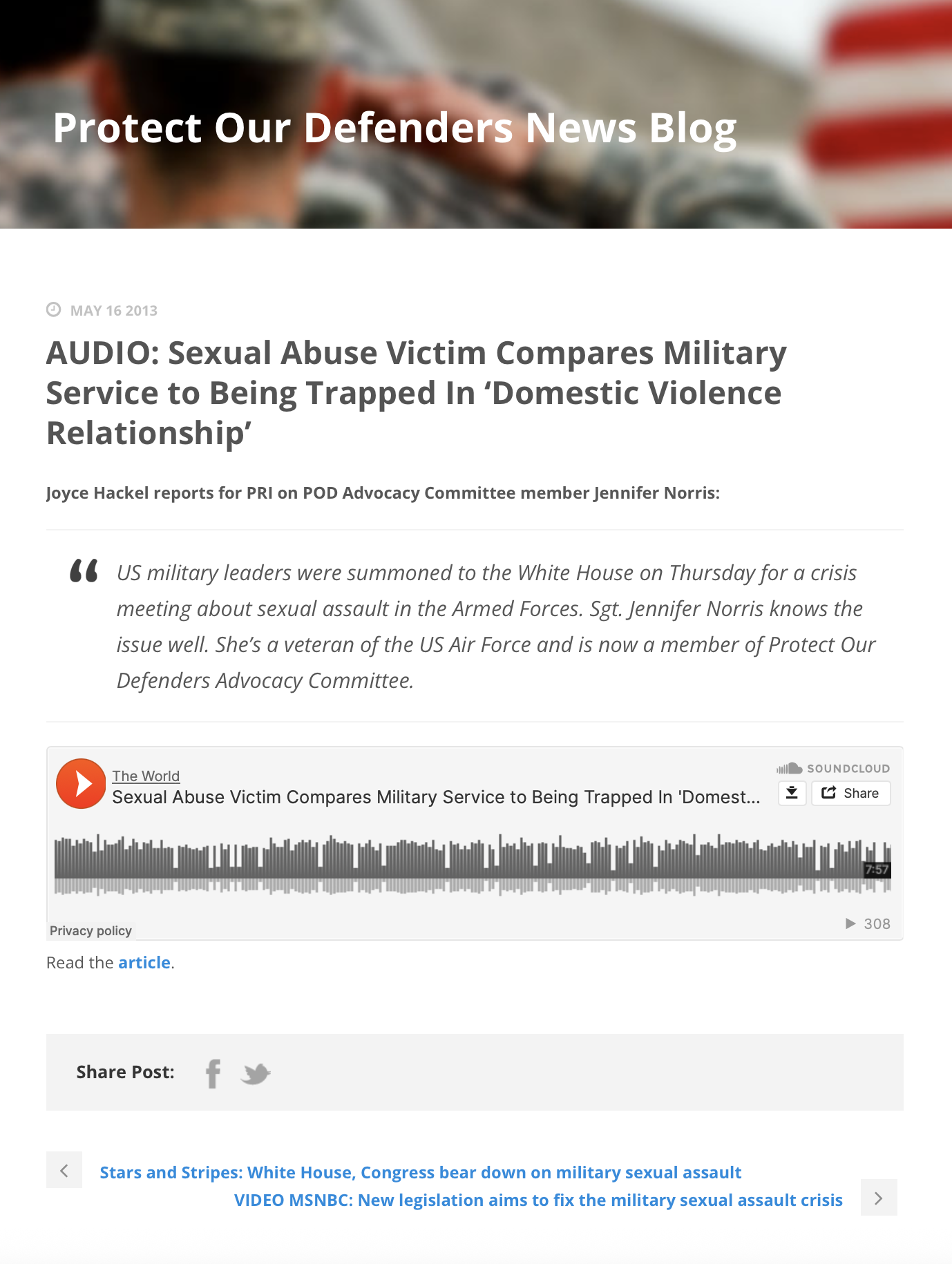
Dear Nancy Parrish, please remove this article from your site. I do not want to be affiliated with an organization who did not believe me when I told them I was being abused by their advocacy board members. Instead you promoted them so they could continue abusing others in the name of “MST Advocacy” to help you stay on top. Sincerely, Jennifer Norris


14 thoughts on “Trapped in an Abusive Chain of Command: What I Told ‘The World’ About Sexual Assault in the Military (August 15, 2013)”