
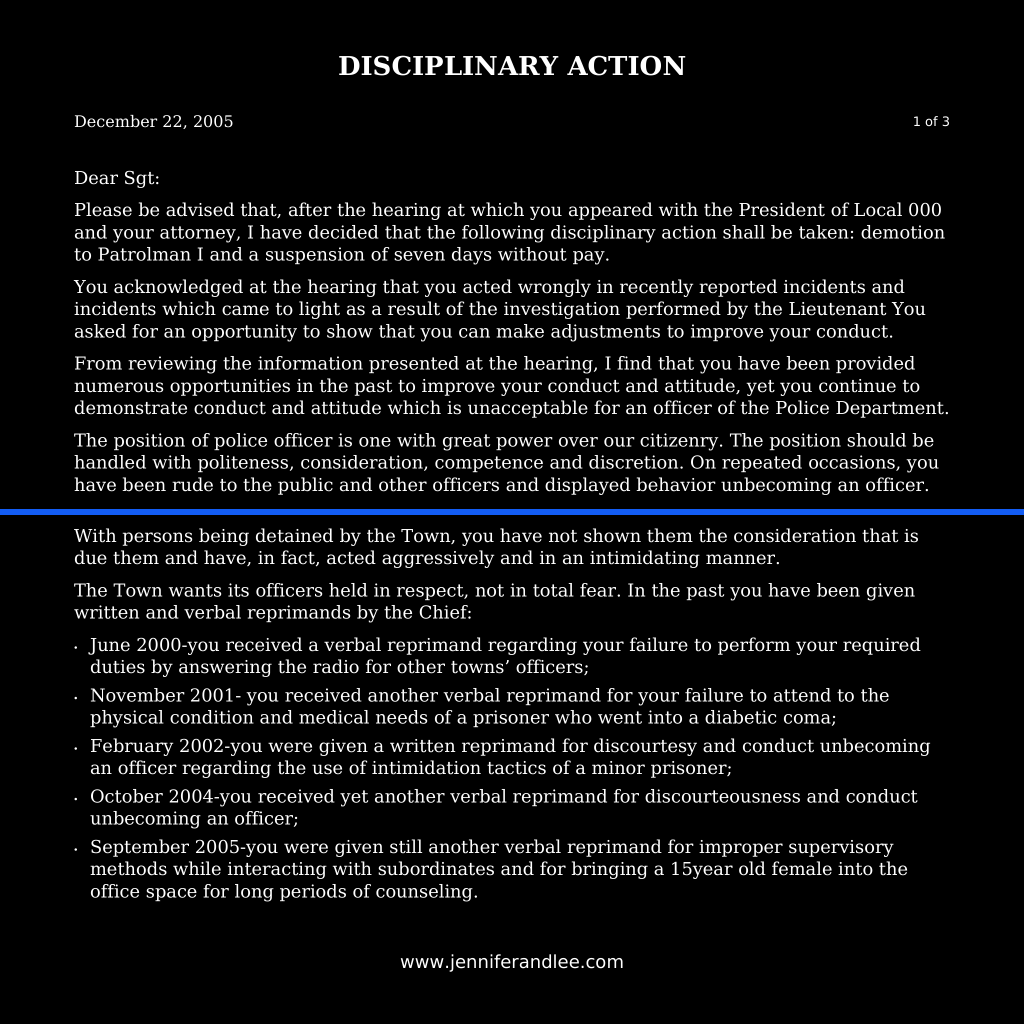
The Tracey Higley disciplinary record was not merely a personnel problem. It was an institutional risk warning.
What should responsible municipal leadership do when it learns that a police officer entrusted with the power to detain, arrest and use force has accumulated repeated complaints involving intimidation, judgment, supervision, vulnerable people, professional boundaries and fear of retaliation?
That question matters because Rumford was not operating without warning.
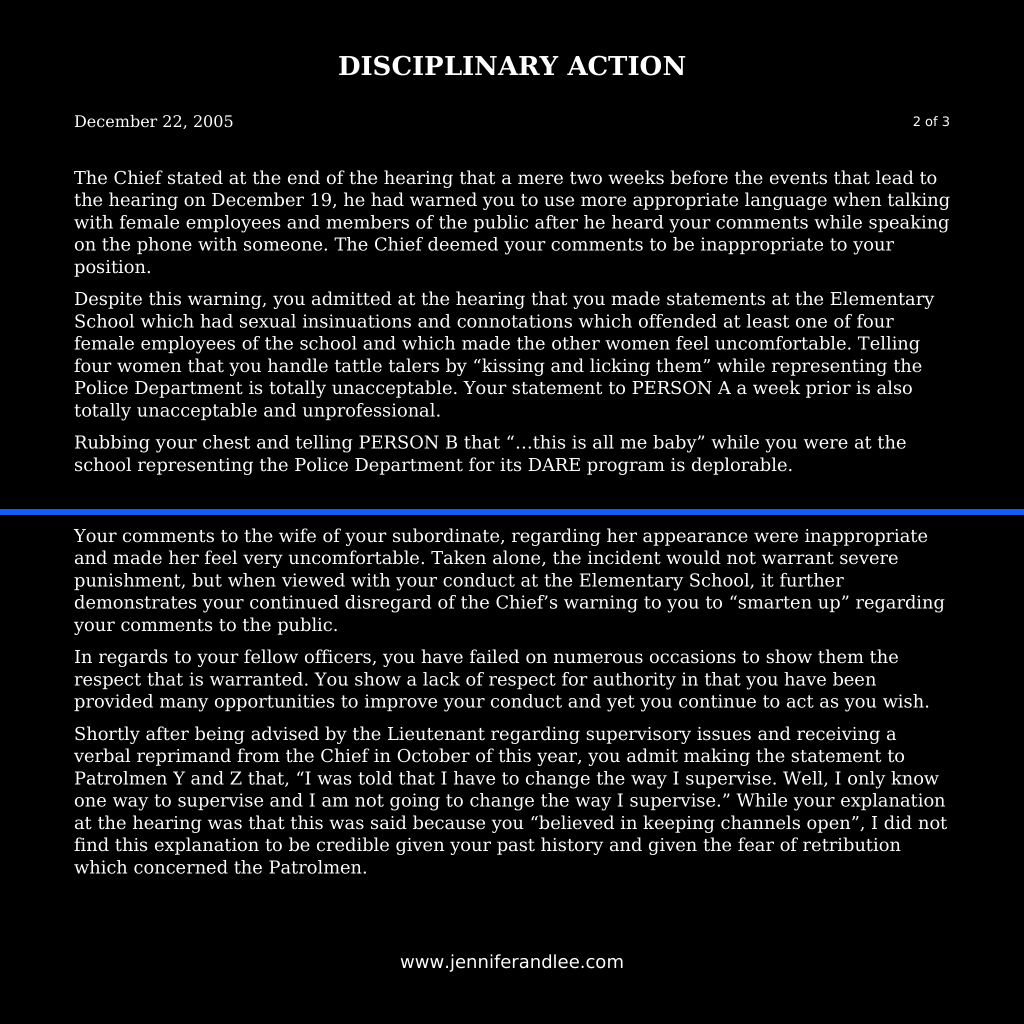
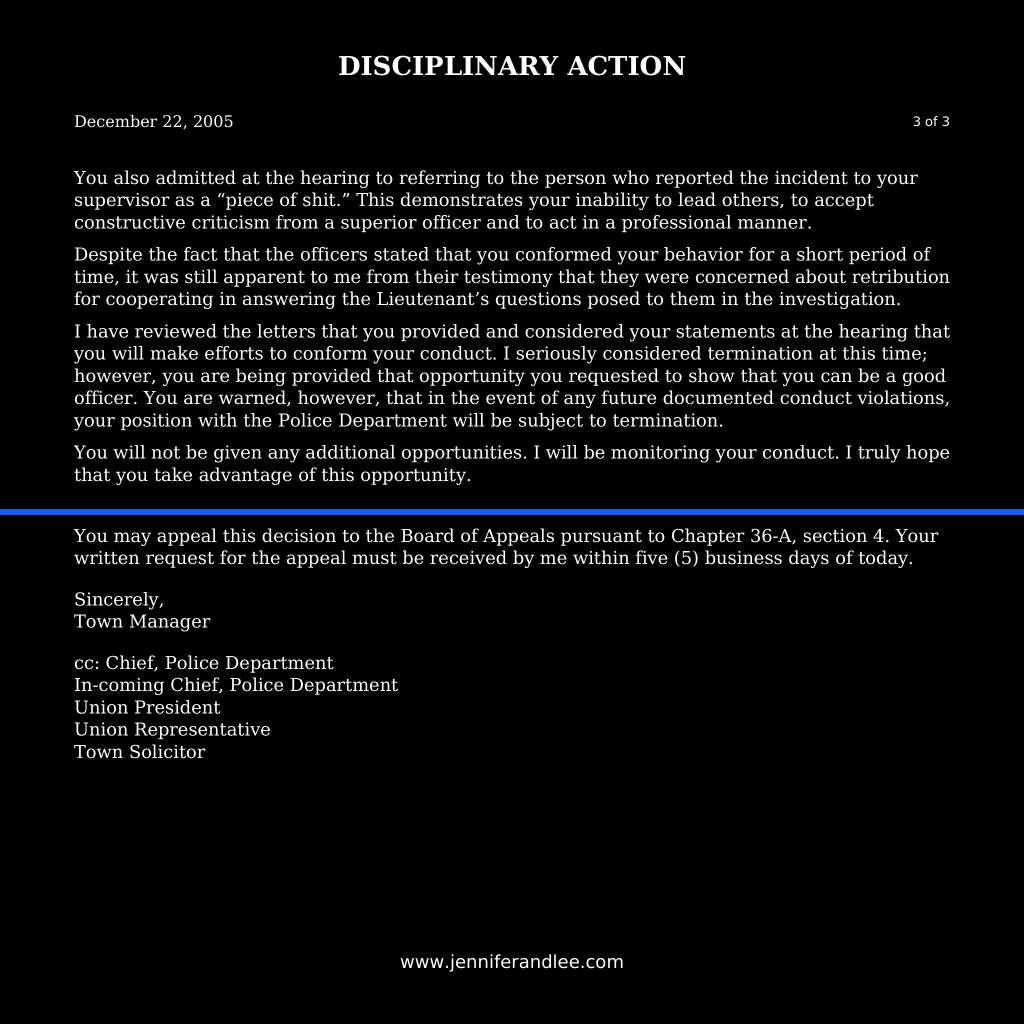
The disciplinary record published on our website describes a pattern rather than a single bad day. Town Manager Steve Eldridge imposed a demotion to Patrolman I and seven days without pay after describing repeated misconduct despite previous opportunities to improve. The record references unanswered radio calls; failure to attend adequately to a prisoner’s medical needs before the prisoner entered a diabetic coma; intimidation of a juvenile prisoner; discourtesy; improper supervision; questionable boundaries involving a 15-year-old girl; sexually suggestive comments to women; inappropriate remarks involving a subordinate’s wife; and concern among officers about retaliation. Eldridge wrote that termination had been seriously considered.
Those are not all the same kind of problem.
Together, they touch virtually every category a competent police-risk manager should care about: custodial safety, vulnerable people, public treatment, sexual and professional boundaries, supervision, judgment, workplace retaliation and the willingness of subordinates to report misconduct.
That makes the 2005 letter far more significant than an old personnel dispute.
It was a risk assessment hiding in plain sight.

The timing makes the management question even more important
Rumford Police Department’s own historical account says that on December 1, 2005, Town Manager Eldridge announced that Lt. Stacy Carter would succeed retiring Chief Timothy Bourassa. Carter assumed command on December 23. The major Higley disciplinary action occurred in that same late-December period. The Higley matter was being decided at virtually the same moment a new police chief was taking command. A change in command is precisely when management should ask whether one employee’s misconduct exposes something larger.
Who knew about the previous incidents?
Who supervised him?
Were complaints investigated consistently?
Why had earlier corrective measures apparently failed?
Were supervisors tolerating conduct they should have stopped?
Did employees fear retaliation only from Higley, or were they afraid of the institution around him?
Was anyone attempting to package the problem neatly as “Higley” so that command could emerge looking clean?
Those questions should have been investigated independently of both Higley and the officers whose careers could benefit from portraying the problem as belonging solely to him.

Would You Hire Him? Tracey Higley and the Cost of Ignoring Red Flags in Rumford, Maine (2026)
If I were Rumford’s town manager in 2005, this is what I would have done
- Immediately remove Higley from supervisory authority while the matter was resolved. If the evidence justified administrative leave, I would use it. At minimum, an officer accused of intimidating subordinates should not continue exercising authority over potential witnesses.
- Bring in an investigator from outside the Rumford Police Department. The investigation would examine both Higley’s conduct and the supervisory chain above him. The police chief—or incoming chief—would provide records, not control the investigation.
- Audit the entire pattern, not simply the newest complaint. I would pull every citizen complaint, internal complaint, use-of-force report, juvenile interaction, prisoner medical event, radio-response problem, disciplinary action, counseling record and allegation of retaliation involving the officer for at least the previous five years.
- Interview officers privately and protect them from retaliation. If employees were already afraid of professional consequences for cooperating, that fact itself would become a management problem requiring intervention.
- Build a case that can withstand the union grievance process. A police union has a legitimate responsibility to protect contractual rights and due process. It does not get to determine who is fit to carry governmental authority. Every allegation would be documented, investigated consistently and supported with evidence so that discipline could survive arbitration rather than collapsing because management handled it carelessly.
- Seriously evaluate termination. If the sustained record was substantially as described in Eldridge’s decision, I would not consider demotion alone an adequate long-term risk-control strategy. If termination could not legally be sustained, retention would require a written last-chance agreement, removal from supervision, explicit behavioral conditions, retraining, monitoring and automatic escalation for further sustained misconduct.
- Determine whether the conduct required notification to the Maine Criminal Justice Academy or review of the officer’s certification. Maine law today expressly requires a chief administrative officer who knows of conduct capable of supporting certificate suspension or revocation to notify the Academy within 30 days. The statute has roots predating this controversy and was amended in 2005. Whatever precise requirements applied to each allegation then, certification consequences should have been examined rather than treating everything solely as an internal personnel problem.
- Create an early-intervention system for the entire department. Complaints, force, disciplinary events, prisoner injuries, lawsuits, recurring citizen disputes and supervisory concerns should be tracked together. The U.S. Department of Justice describes early-intervention systems as forward-looking management tools designed to detect negative patterns before they become more serious misconduct.
- Create an external complaint route. Residents and police employees who feared retaliation should have been able to communicate directly with the town manager, an independent investigator or another civilian authority instead of having every complaint travel back through the same department.
- Require a written command-transition plan. Because a new police chief was taking over at almost exactly the time this discipline occurred, I would require the outgoing and incoming command structures to document unresolved personnel risks, corrective actions, follow-up dates and responsibility for monitoring them.
That last step may be the most important.
A warning sitting inside a personnel file in the town attorney’s office accomplishes very little if nobody is allowed to see it.
Do not let the “bad apple” save the barrel
This is where the scapegoat question becomes legitimate management analysis.
Suppose a department really does have a particularly problematic officer. Removing that officer is appropriate. But suppose command also finds it convenient to blame that officer for everything wrong with the culture. Then disciplining him can paradoxically protect the institution from scrutiny.
The town manager’s responsibility is therefore not to ask merely, “What did Higley do?” It is to ask, “What did management know, what did supervisors tolerate, what did fellow officers report, what did command correct, and what did command fail to correct?”
The incoming chief should have been required to answer those questions.
That is especially significant in hindsight because Stacy Carter did not disappear from municipal government. After decades with the Rumford Police Department and years as chief, he ultimately became Rumford’s town manager, serving about four and a half years before retiring in June 2024.
Again, Carter’s later advancement does not prove that he concealed misconduct in 2005 but it demonstrates something structural.
In a small town, the people responsible for supervising an institution can eventually become the people running the institution.
That is exactly why independent oversight matters.
The stronger someone’s local relationships, institutional knowledge and political standing become, the less a municipality should depend on informal accountability.
This was not the only warning coming out of the regional law-enforcement culture
Oxford County’s subsequent history makes that lesson difficult to dismiss.
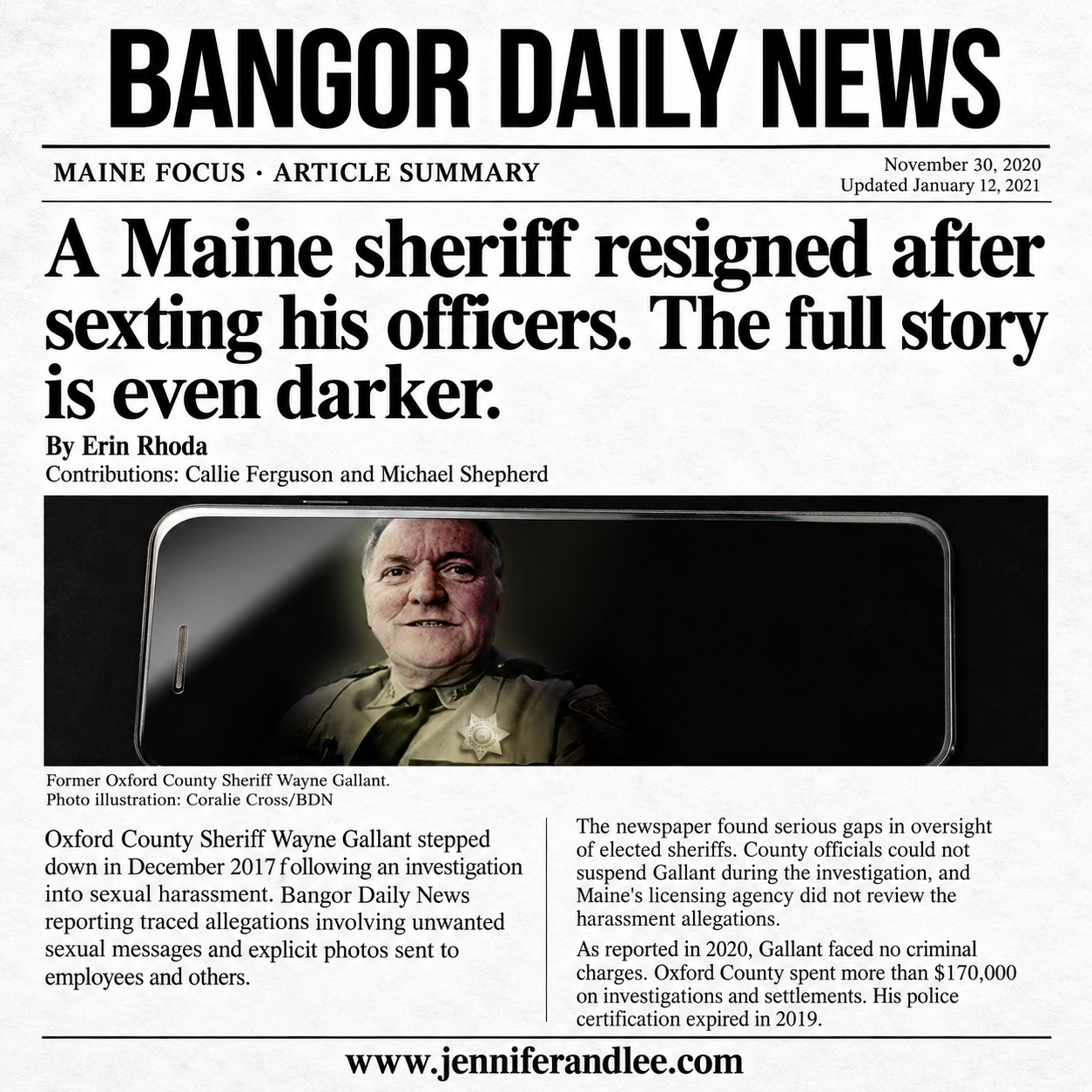
Wayne Gallant worked for the Rumford Police Department for over twenty-five years. Public reporting revealed a 1996 Rumford disciplinary matter in which the Board of Selectmen concluded that statements Gallant made about then-Chief Timothy Bourassa were motivated by a longstanding feud and a desire for the chief’s job; Gallant received a week’s suspension without pay.
Gallant later became Oxford County sheriff.
In 2017, he admitted sending a sexually explicit photograph of himself while in uniform and stepped down as president of the Maine Sheriffs’ Association. County commissioners subsequently sought his removal amid additional sexual-misconduct allegations involving employees; Gallant denied sexually harassing employees and threatening their jobs, but ultimately resigned as sheriff in December 2017.
That history does not prove every Rumford or Oxford County officer participated in a toxic culture. It does demonstrate why management cannot afford to assume that rank, longevity, union status, awards or political success automatically equal sound professional judgment.
Similar governance questions resurfaced with Oxford County Sheriff Christopher Wainwright. In 2024, all three county commissioners petitioned Gov. Janet Mills to remove him, citing controversies involving a request that a deputy show leniency on a traffic ticket, disposal of firearms from the evidence room without normal county financial oversight, and school resource officers whose law-enforcement certifications had expired.
Mills ultimately declined to remove Wainwright. That outcome matters and should not be omitted. She concluded that the evidence did not satisfy the high standard required to remove an elected sheriff. But she also said the decision should not be viewed as vindication, described Wainwright as having made mistakes and acted intemperately, and characterized his handling of the ticket incident as unprofessional and a serious error in judgment.
The accountability dispute has not disappeared. In August 2026, three Oxford County deputies filed Maine Whistleblowers’ Protection Act complaints alleging retaliation after reporting misconduct and cooperating with investigations. Wainwright denies retaliation and says the disciplinary measures involved accountability. Those allegations are pending and should be treated as allegations unless and until they are resolved.
That distinction is important.
Accountability requires believing neither management nor employees automatically.
It requires independent fact-finding.
Even today’s deadly-force review process is exposing accountability gaps
A more recent Rumford case illustrates why independent post-incident review matters.
After the October 30, 2023 fatal police shooting of Sean Dyment in Rumford, Maine’s Deadly Force Review Panel examined the incident separately from the Attorney General’s criminal-law determination. The panel noted that Oxford County deputies did not have cruiser or body cameras. It also reported that, despite multiple requests, the Oxford County Sheriff’s Office did not provide its Incident Review Team report because it remained incomplete. The panel again recommended that law-enforcement agencies obtain and use cruiser and body-worn cameras.
That is the kind of review Maine did not have when Jessica Byrn-Francisco was shot in 2014.
The distinction matters enormously.

Jessica Byrn-Francisco demonstrates why “justified” does not answer every question
On March 18, 2014, Tracey Higley shot and wounded 25-year-old Jessica Byrn-Francisco during a mental-health crisis.
The Attorney General’s report describes Byrn-Francisco reporting that she had ingested medication in an attempt to die, officers searching for her, her production of a knife, unsuccessful Taser attempts, her advance toward Higley and Higley’s retreat through deep snow before firing two shots. Attorney General Janet Mills concluded that Higley’s use of deadly force was legally justified in self-defense.
That legal conclusion should be reported accurately. But so should something else contained in the very same Attorney General report.
The office expressly said its sole purpose was determining whether the facts generated self-defense sufficient to preclude criminal prosecution. The report specifically stated that it did not analyze potential civil liability, whether administrative action was warranted, or whether the use of deadly force could have been averted. That sentence changes the discussion.
A finding that Higley lawfully defended himself in the final seconds of an encounter does not retroactively answer whether keeping him employed after the 2005 disciplinary history was a wise personnel decision. It does not determine whether different crisis-response strategies could have changed the encounter. It does not determine whether previous complaints should have triggered closer supervision. And it certainly does not erase the management responsibility that existed nine years earlier.
Would firing Higley in 2005 have guaranteed that Jessica would never have been shot?
No responsible analysis can promise that. Another officer could have encountered the same threat and reached the same lawful decision.
But termination would unquestionably have removed this particular officer from that encounter. More broadly, decisive intervention in 2005 could also have changed the department’s expectations surrounding supervision, intimidation, complaint handling and accountability.
But, “Were there reasonable interventions available when the warning signs first appeared?”
The answer is yes.

False Narratives with National Consequences: How Our Traumatic Past Was Weaponized Against Us (2024)
Our experience demonstrates why one officer was never the entire problem
By 2010, we had our own deeply damaging encounter with the Rumford Police Department after I had served on the town Finance Committee and challenged police spending.
We needed mental health help during a custody crisis with an abuser and instead became targets of a police narrative that still follows us to this day. The department disputed the allegation that we were being targeted. That is precisely why an independent complaint process would have mattered.
A citizen alleging retaliation by the police should not have to persuade the police to investigate whether the police retaliated. A finance committee member scrutinizing a police budget should not have to wonder whether future emergency calls will be affected by political hostility.
A person reporting domestic violence or a mental-health crisis should not emerge wondering whether asking for help made the situation more dangerous. And an officer with a documented history involving intimidation and retaliation should not be placed in the middle of those situations without management being able to demonstrate that earlier problems were actually corrected.
In our experience, Higley’s behavior remained extraordinarily cruel. But even if someone rejects every disputed aspect of our personal account, the official 2005 disciplinary record still exists.
That is why this analysis does not have to rest solely on believing us.
The town’s own paperwork had already raised the alarm.

Father of injured 9-year-old disputes Rumford police report (Sun Journal, June 19, 2014)
Other later disputes should have triggered cumulative review
In June 2014, the father of a 9-year-old boy who suffered a fractured skull in a bicycle-versus-truck collision publicly disputed Higley’s accident report and its conclusion that the child had failed to yield. The father was not at the scene, and the driver provided an account supporting the conclusion that the child entered the roadway suddenly. Now it’s a pattern; two unrelated people are accusing Higley of falsifying a report.
But good risk management does not ask whether every complaint independently proves misconduct. It asks whether patterns of contested interactions, previous discipline and repeated public distrust deserve supervisory review. That is what an early-intervention system is for.
The remarkable thing about Higley’s career is therefore not simply that complaints existed. Police officers inevitably generate complaints because they exercise coercive authority.
The remarkable question is whether anyone above him was continuously connecting the dots.
Police unions: due process must never become institutional paralysis
Police unions exist to negotiate working conditions and defend members’ contractual rights. Officers are entitled to due process just like anyone else.
The management failure occurs when municipal officials become so intimidated by grievances, arbitration or political pressure that they stop managing.
By 2020, Higley was identified publicly as a vice president of the Maine Association of Police while the organization was establishing a legal-defense program for officers facing disciplinary, civil or criminal proceedings. That union role after all his wrongdoing in his short lived career in Rumford is suspect.
Municipalities need competent labor counsel and airtight disciplinary processes. A strong union should be met by strong professional management, not by weak documentation followed by complaints that employees are impossible to discipline.
A town manager should respect representation rights, bargain what the law requires, investigate impartially and then act decisively when evidence supports discipline.
Due process and accountability are not opposites.

Gang Bullying Behaviors: Seven Patterns That Reveal How Group Abuse Works (August 21, 2026)
Rumford’s town-manager history shows why continuity matters
Since the 2005 Higley discipline, public records identify at least seven people who have occupied the town-manager or interim-town-manager role: Steve Eldridge, Carlo Puiia, John Madigan, Linda-Jean Briggs, Scott Cole, Stacy Carter and George O’Keefe.
Seven managers or interims across roughly two decades does not, by itself, prove dysfunction. But the circumstances surrounding some of those transitions are more instructive.
In 2006, Eldridge’s contract extension itself became entangled in a charter dispute, with two selectmen abstaining and one citing a request for an Attorney General investigation into a potentially improper executive session.
Carlo Puiia resigned in 2013 citing personal reasons, after which Rumford and neighboring Mexico shared John Madigan as interim manager. Thanks for selling us out to dirty cops Carlo.
Then came the Linda-Jean Briggs episode. Briggs was suspended and terminated “without cause” in early 2019. A federal judge subsequently concluded that the town lacked authority to terminate its town manager without cause under the arrangement it had attempted to use. Rumford ultimately agreed to a $250,000 settlement of Briggs’ wrongful-termination claim.
That is not an abstract governance mistake. That is a quarter-million-dollar lesson in what happens when municipal officials exercise power without sufficiently understanding the limits placed on that power.
Leadership instability also affected ordinary municipal projects. In 2019, interim Town Manager Scott Cole told residents that changing town managers probably contributed to problems with Rumford’s downtown infrastructure project, which required voters to consider another $2.9 million after design issues and unexpected conditions drove costs upward. At one point the total project was estimated at $8.6 million.
Those examples reveal something important about institutional continuity.
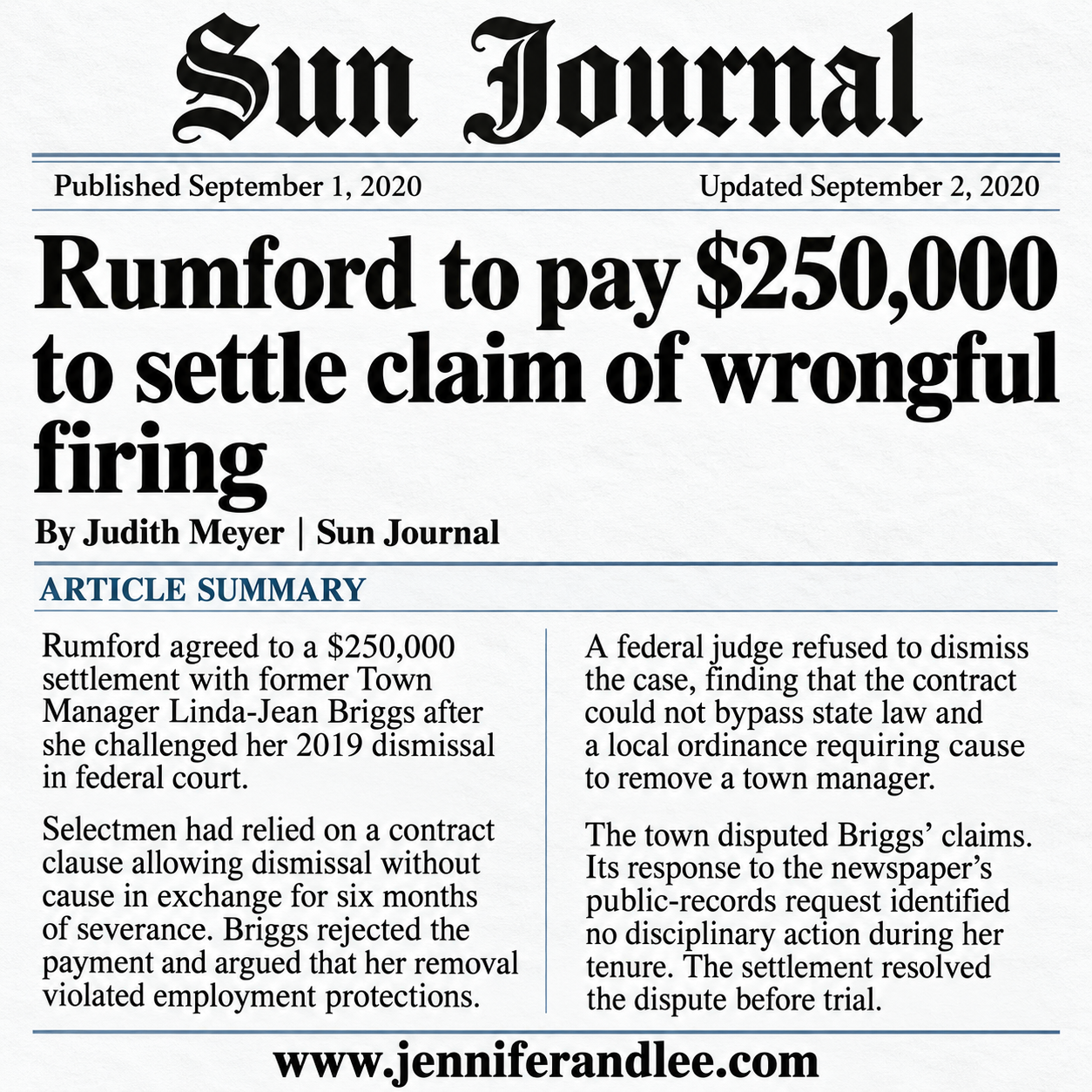
Rumford to pay $250,000 to settle claim of wrongful firing (Sun Journal, September 2, 2020)
Police departments can outlast town managers.
Officers and command staff may remain for decades while civilian administrators rotate through the building. When that happens, the permanent institution can accumulate more practical power and institutional memory than the officials supposedly overseeing it.
That makes written policies, independent oversight and durable accountability systems essential. Otherwise, every new town manager inherits stories. A competent system inherits records.
Rumford cannot separate police governance from its economic reality
There is another reason all of this matters: Rumford has limited room for expensive governmental mistakes.
The town has historically been extraordinarily dependent on its paper mill. In 2011, when NewPage faced possible bankruptcy, Town Manager Carlo Puiia told the Sun Journal that the mill was responsible for 46 percent of Rumford’s property-tax liability. He warned that major changes at the mill would affect virtually every part of the local economy.
That is dangerous fiscal concentration. A community heavily dependent on one industrial taxpayer has less flexibility when that taxpayer contracts, depreciates, restructures or closes equipment. Meanwhile, Rumford’s residents are not an endlessly expandable tax base.
Current Census estimates place the population at about 6,025. Approximately 27.2 percent of residents are 65 or older, median household income is about $38,403, and 22.6 percent of residents live below the poverty line.
For older residents specifically, a 2025 Maine Healthy Aging Community Profile estimated median household income for households headed by someone 65 or older at $35,706, with 31 percent below $20,000 annually.
Those numbers make property-tax decisions intensely consequential.
Rumford’s published mill rate continued to climb every single year until 2024; the nominal rate fell from $22.18 to $16.62 per $1,000 after a market-value adjustment. But the residential burden still increased.
Residential and commercial assessments rose, producing an average 4.85 percent increase in taxes due while industrial properties—already assessed at full value—saw their taxes decline. Town officials explicitly acknowledged that a larger share of the burden was moving toward residential and commercial property.
Then the 2025-26 mill rate increased from $16.62 to $18.73.
Town Manager George O’Keefe said two-thirds of the town-budget increase was going toward Police Department wages. A property with $100,000 in taxable value would pay about $211 more for the year; a $200,000 property about $422 more.
Earlier that year, town officials asked voters to support a roughly $2 million Police Department budget as part of a proposed $12.47 million municipal budget, itself roughly 10 percent higher than the prior year’s figure. Nearly two-thirds of that proposed municipal increase was attributed to police spending.
None of that establishes misconduct by today’s Police Department or its union. It establishes something much more basic: Police management is fiscal policy.
When a substantial share of new municipal spending goes to policing in a town where more than a quarter of residents are seniors, poverty exceeds 20 percent and one industrial complex has historically carried an enormous share of the tax base, taxpayers deserve exceptional management in return.
That means excellent officers should be compensated. It also means persistently problematic officers should not become expensive permanent liabilities simply because disciplining them is uncomfortable.

Misconduct costs poor towns twice
Bad municipal management carries costs that rarely appear under a budget line called “institutional failure.”
There are legal bills. Insurance costs. Settlements. Overtime. Administrative investigations. Employee turnover. Recruitment problems. Lost productivity. Workers afraid to report supervisors. Residents afraid to call police. People who stop volunteering for municipal boards because public service becomes personally dangerous. Businesses and professionals who decide they do not want to live in an environment perceived as politically vindictive. And residents whose trust in government becomes so damaged that every subsequent event is interpreted through suspicion.
A town with a wealthy and diverse tax base can absorb some inefficiency. A struggling former industrial center cannot afford to repeatedly turn preventable governance problems into taxpayer obligations. We could not stomach paying increasing taxes for services we were being denied.
What could actually have been prevented?
No historical analysis can honestly say that one personnel decision in 2005 would have prevented everything that came afterward. But we can identify intervention points.
Had the town terminated an officer whose sustained conduct justified termination, that officer would no longer have been policing residents years later.
Had the town required independent investigation of the command structure, it might have learned whether the problem extended beyond one individual.
Had employees been protected from retaliation, more information might have surfaced earlier.
Had citizen complaints been tracked cumulatively, later incidents could have been evaluated against an established history rather than treated as isolated disputes.
Had every incoming manager and chief inherited a formal risk register instead of institutional folklore, warning signs would have been harder to bury through turnover.
Had mental-health encounters received independent after-action analysis, the question would not have ended with whether the final trigger pull was legally justified.
And had Maine possessed its current type of Deadly Force Review Panel in 2014, an entity separate from the Attorney General’s criminal-law determination could have examined accepted best practices and possible systemic improvements. That is precisely the role the modern panel now performs.
None of these reforms require hatred of police; they require competent government.

The lesson of 2005
The most important sentence in Steve Eldridge’s disciplinary record may still be his observation that Rumford wanted its police officers held in respect rather than fear. That distinction describes the entire management problem. Fear can produce short-term compliance but respect produces legitimacy.
When employees fear retaliation, citizens fear calling for help, critics fear questioning budgets and municipal leaders fear confronting a union or powerful department, the institution begins organizing itself around fear rather than accountability. And once that happens, one officer is no longer the whole story. The larger failure becomes the system that keeps restoring authority without demonstrating that the underlying problem has been fixed.
That is how I would evaluate what happened to us. It is how I would evaluate what happened to Jessica Byrn-Francisco. It is how I would evaluate the residents who have publicly questioned Rumford policing over the years.bAnd it is how I would evaluate later controversies throughout Oxford County.
Not every allegation is proven. Not every disputed arrest is misconduct. Not every police shooting is unlawful. Not every union defense is corruption. Not every administrator who made a poor decision was participating in a conspiracy. We do not need any of those sweeping claims to reach the central conclusion.
Rumford had notice.
The 2005 disciplinary record was not a prophecy. It was an opportunity to intervene.
A competent institution does not merely punish an employee and return him to the same system. It asks what allowed the pattern to develop, what prevented earlier correction, whether supervisors failed, whether employees were afraid to speak, whether outsiders can report safely, and how management will know if the behavior returns. Then it documents the answers.
The tragedy of ignored red flags is that hindsight eventually makes them look obvious. But in Rumford, many of these red flags were already written down. Someone simply had to treat them as seriously as the authority attached to the badge. That was the opportunity in 2005. And that is the lesson municipalities should learn from it now.

Mill Town Book Review and the Questions Every Maine Family Should Ask (October 4, 2026)
Sources, Public Records & Further Reading
- Rumford Police Misconduct: The Documented Warnings That Preceded Our Police Encounters in Western Maine — December 22, 2005 — Jennifer and Lee. Reproduces the Town Manager’s disciplinary decision describing prior reprimands, intimidation concerns, inappropriate conduct, fear of retaliation among officers, demotion, suspension, and the warning that future violations could result in termination. Read the disciplinary record
- New Town Attorney Informs Rumford Leadership They Must Release the Officer’s 2005 Disciplinary Action Letter — April 29, 2010 — Jennifer and Lee. Includes Town Attorney Thomas S. Carey’s determination that the disciplinary decision qualified as a final written decision that had to be released under Maine law. Read the town attorney correspondence
- Rumford Police Department Historical Blog — Bourassa Retires, Carter Named New Chief — Rumford Police Department. Records that Town Manager Stephen Eldridge announced Stacy Carter as the next chief on December 1, 2005, and that Carter assumed command on December 23, 2005, placing the Higley disciplinary matter directly within the department’s command transition. Rumford Police Department history
- Rumford Police Department — Our History — Rumford Police Department. Department photographs and historical information document the careers and ranks of numerous Rumford officers, including Tracey Higley, Stacy Carter, Wayne Gallant, Tony Milligan and others over multiple decades. Rumford Police Department historical archive
- Report of the Attorney General on the Use of Deadly Force by Rumford Police Sergeant — March 18, 2014— Maine Attorney General’s Office, July 29, 2014. Official report concerning Sgt. Tracey Higley’s shooting of Jessica Byrn-Francisco. The Attorney General concluded that Higley’s use of deadly force was legally justified in self-defense, while expressly stating that the review did not determine civil liability, administrative consequences, or whether the shooting could have been avoided. Read the Maine Attorney General report
- October 30, 2023 — Rumford Use of Deadly Force Incident: Sean Dyment — Maine Deadly Force Review Panel. Provides an example of Maine’s newer system for independently reviewing whether accepted law-enforcement practices were followed and whether policies, training or procedures should be improved. Read the Deadly Force Review Panel report
- 2025 Annual Report of the Maine Deadly Force Review Panel — Maine Attorney General’s Office, January 2026. Includes the panel’s review of the Sean Dyment shooting and explains the panel’s broader role in examining law-enforcement best practices beyond the Attorney General’s criminal-law determination. Read the annual report
- Maine Revised Statutes, Title 25 §2807 — Reports of Conviction or Misconduct by Certificate Holder — Maine Legislature. Establishes reporting requirements involving conduct that could result in suspension or revocation of a law-enforcement officer’s certification. Read Maine statute §2807
- Father of Injured 9-Year-Old Disputes Rumford Police Report — Sun Journal, June 19, 2014. Reports a father’s disagreement with Sgt. Higley’s conclusions concerning a serious bicycle-versus-vehicle accident involving his 9-year-old son. Read the Sun Journal report
- Oxford County Sheriff Solicited Sex With Employees, Sent Explicit Photos, Union Official Says — Portland Press Herald, November 22, 2017. Covers allegations involving then-Sheriff Wayne Gallant and also documents Gallant’s earlier career with Rumford Police and his 1996 disciplinary history involving his conflict with Police Chief Timothy Bourassa. Read the Portland Press Herald investigation
- Oxford County Sheriff Steps Down in Wake of Sexual Harassment Allegations — Portland Press Herald, December 6, 2017. Reports Gallant’s resignation following an outside investigation and the county commissioners’ effort to have him removed from office. Read the report on Gallant’s resignation
- Gov. Mills Receives Complaint Seeking Oxford County Sheriff Christopher Wainwright’s Removal — Portland Press Herald/Sun Journal, February 7, 2024. Details commissioners’ concerns involving evidence-room firearms, expired law-enforcement certifications and a traffic-ticket controversy. Read the commissioners’ allegations
- Oxford County Sheriff’s Fate in Gov. Mills’ Hands After Commissioners Called for His Removal — Portland Press Herald, April 24, 2024. Details testimony and evidence concerning the county commissioners’ effort to remove Sheriff Christopher Wainwright. Read the removal-hearing coverage
- Mills Decides Against Removing Oxford County Sheriff — Portland Press Herald, May 13, 2024. Reports Gov. Janet Mills’ decision not to remove Wainwright while also documenting her findings concerning mistakes, professionalism and judgment. Read Gov. Mills’ decision coverage
- Oxford County Deputies File Retaliation Complaints Against Sheriff Under Maine Whistleblowers’ Protection Act — Portland Press Herald, September 25, 2026. Reports allegations by three veteran deputies that they faced retaliation after reporting alleged misconduct and cooperating with investigations. Sheriff Wainwright denied the retaliation allegations. Read the 2026 whistleblower report
- Briggs v. Town of Rumford — Decision and Order on Motion to Dismiss — U.S. District Court for the District of Maine, September 30, 2019. Federal court decision concluding that Rumford lacked authority to terminate its town manager without cause under the governing municipal framework discussed by the court. Read the federal court decision
- Rumford and Its Former Town Manager Prepare to Face Off in Federal Court — Sun Journal, November 16, 2019. Covers the Linda-Jean Briggs termination dispute and provides useful background on the town’s management turmoil and transition to Stacy Carter as interim town manager. Read the Sun Journal report
- Rumford Board to Present Citizens of the Year Award — December 19, 2013 — Sun Journal. Documents Carlo Puiia’s departure as town manager and John Madigan’s appointment as shared interim manager for Rumford and Mexico. Read the 2013 town-management report
- Rumford Voters Asked to Spend Another $2.9 Million on Downtown Project — Sun Journal, April 16, 2019. Reports cost overruns and interim Town Manager Scott Cole’s observation that changes in town management probably contributed to problems with the project. Read the downtown-project report
- George O’Keefe Named Rumford Town Manager — Sun Journal, June 13, 2024. Documents Stacy Carter’s retirement after approximately four and a half years as town manager and O’Keefe’s appointment as his successor. Read the town-manager transition report
- Chapter 11 a Possibility for NewPage — Sun Journal, August 18, 2011. Reports that Rumford’s paper mill was responsible for approximately 46 percent of the town’s property-tax liability, illustrating the town’s extraordinary historic dependence on one industrial taxpayer. Read the NewPage report
- 40 Percent Market Adjustment Jumps Rumford Tax Rate — Sun Journal, November 12, 2024. Explains Rumford’s property reassessment, the shift in tax burden toward residential and commercial taxpayers, and the reduction experienced by some industrial properties. Read the 2024 tax report
- Rumford Tax Increase Necessary to Save Police Force, Officials Say — Sun Journal, May 29, 2025. Reports the proposed roughly $2 million police budget, the $12.47 million municipal budget and the substantial share of the municipal increase attributable to police spending. Read the police-budget report
- Rumford Increases Tax Rate for 2026 — Sun Journal, October 20, 2025. Reports the increase from $16.62 to $18.73 per $1,000 of assessed value and Town Manager George O’Keefe’s statement that two-thirds of the town-budget increase was going toward Police Department wages. Read the 2026 tax-rate report
- U.S. Census Bureau QuickFacts — Rumford Town, Oxford County, Maine — U.S. Census Bureau. Provides current population, age, income and poverty statistics for Rumford, including the unusually large share of residents age 65 and older. View Rumford Census data
- 2025 Maine Healthy Aging Community Profile — Rumford, Oxford County — Healthy Aging Data Reports. Provides demographic and economic information specifically concerning Rumford’s older population. Read the Rumford Healthy Aging profile
- Best Practices in Early Intervention System Implementation and Use in Law Enforcement Agencies — U.S. Department of Justice. Discusses law-enforcement early-intervention systems used to identify recurring behavioral or performance problems before they develop into more serious misconduct. Read the DOJ material on early-intervention systems
- Police Merger Sorted Out in River Valley — Sun Journal, November 11, 2005. Contemporary reporting on Rumford, Mexico and Dixfield examining regional police consolidation, staffing, union membership, compensation and department structure during the same period as the Higley disciplinary matter. Read the 2005 regional-policing article
- Would You Hire Him? Tracey Higley and the Cost of Ignoring Red Flags in Rumford, Maine — Jennifer and Lee, October 5, 2026. Your earlier analysis collecting the disciplinary history, subsequent incidents and questions surrounding Rumford’s response to the warning signs. Read the October 5 analysis
- Rumford’s Warning Signs Were Already on Paper: Why Maine Needs Independent Police Shooting Reviews— Jennifer and Lee, October 3, 2026. Connects Rumford’s historical personnel records with the case for independent review of police shootings and other serious uses of force. Read the independent-review analysis


