
Five of these police officers abused me by either participating in the gang bullying of a Finance Committee member or they covered for each other and happily scapegoated me, Lee, and our family. This is the definition of institutional betrayal.
Copyright © Jennifer and Lee Norris. All rights reserved.
Imagine reviewing an applicant for a customer-service position. You need someone who can handle complaints, respect boundaries, recognize distress, and accept correction. Then you encounter a record of repeated intimidation, inappropriate remarks, and resistance to supervision. Would you put that person in front of your customers?
Based on the record discussed here, I would not hire Tracey Higley for that role without convincing evidence of sustained change. That is my assessment of professional judgment and public trust. The responsibility becomes even greater when the job includes the power to detain people, arrest them, and use a firearm.
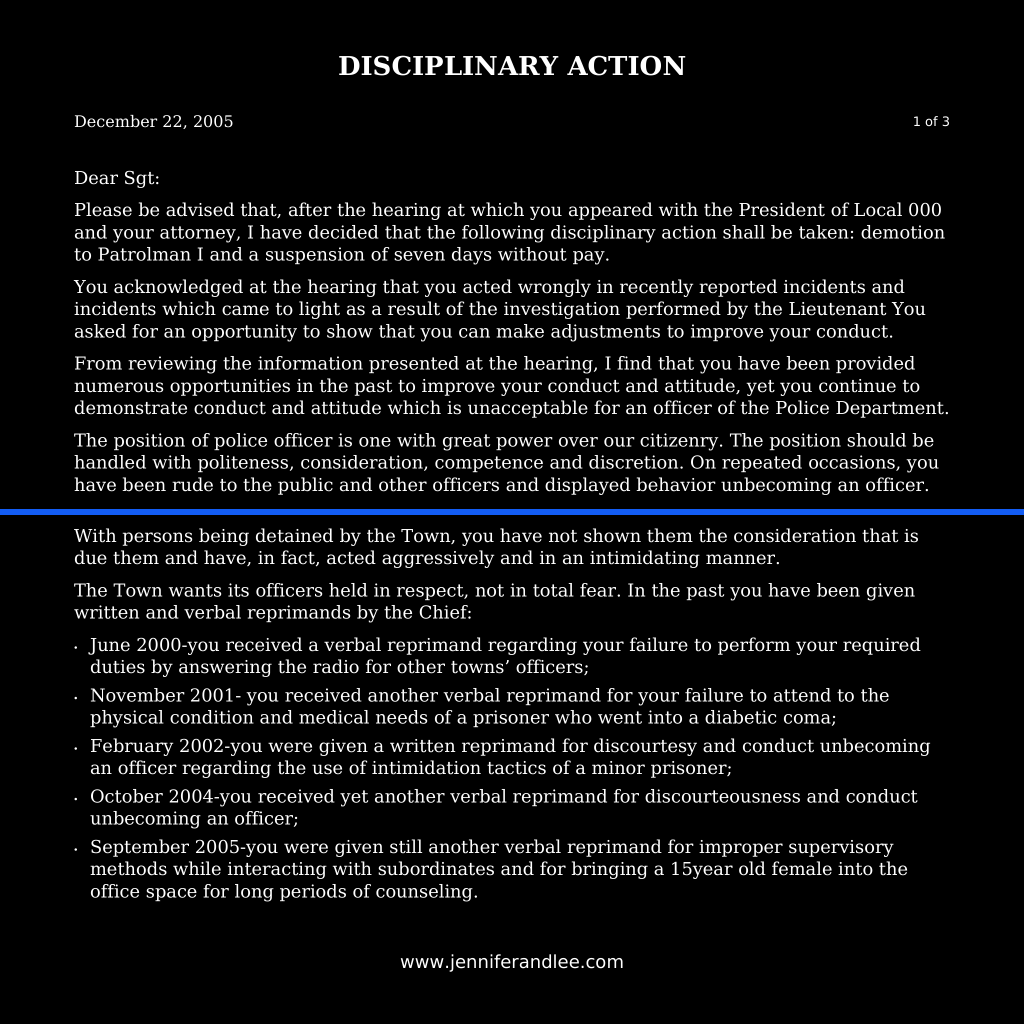
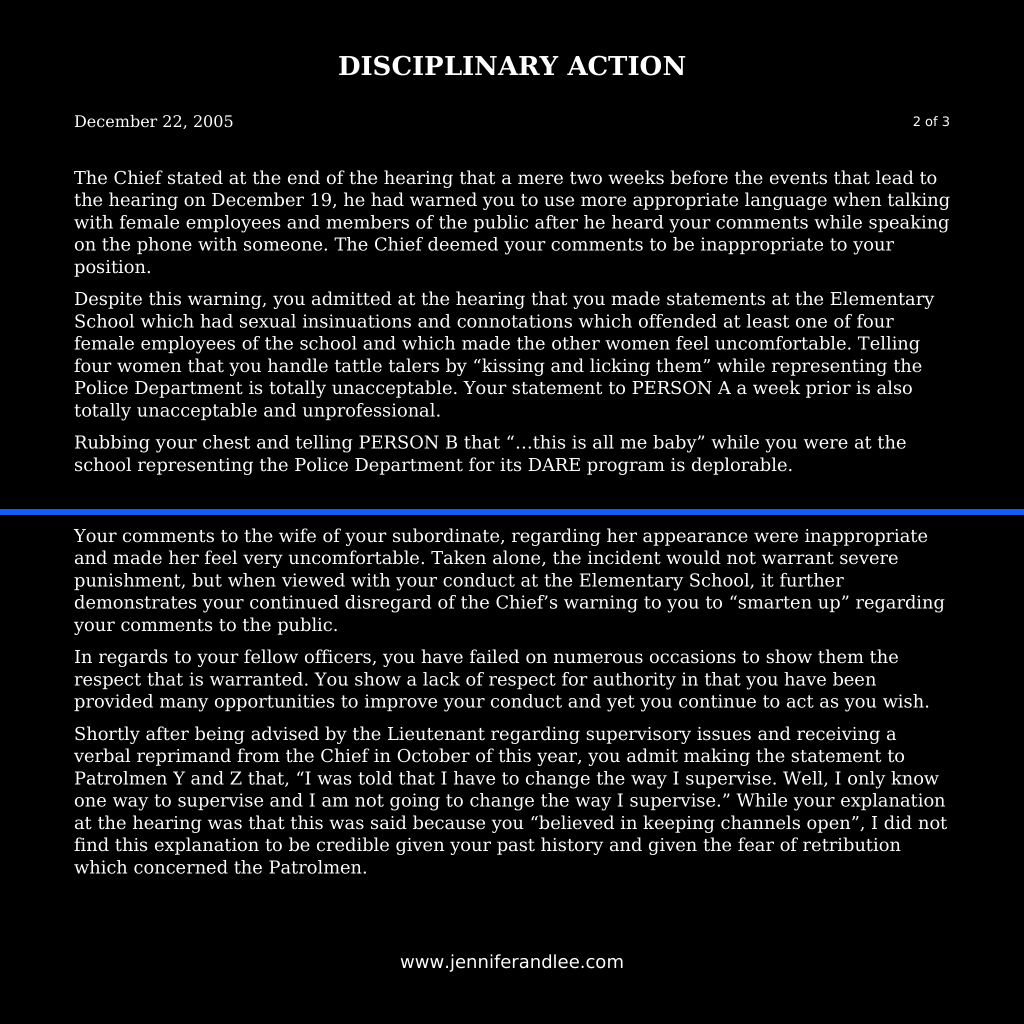
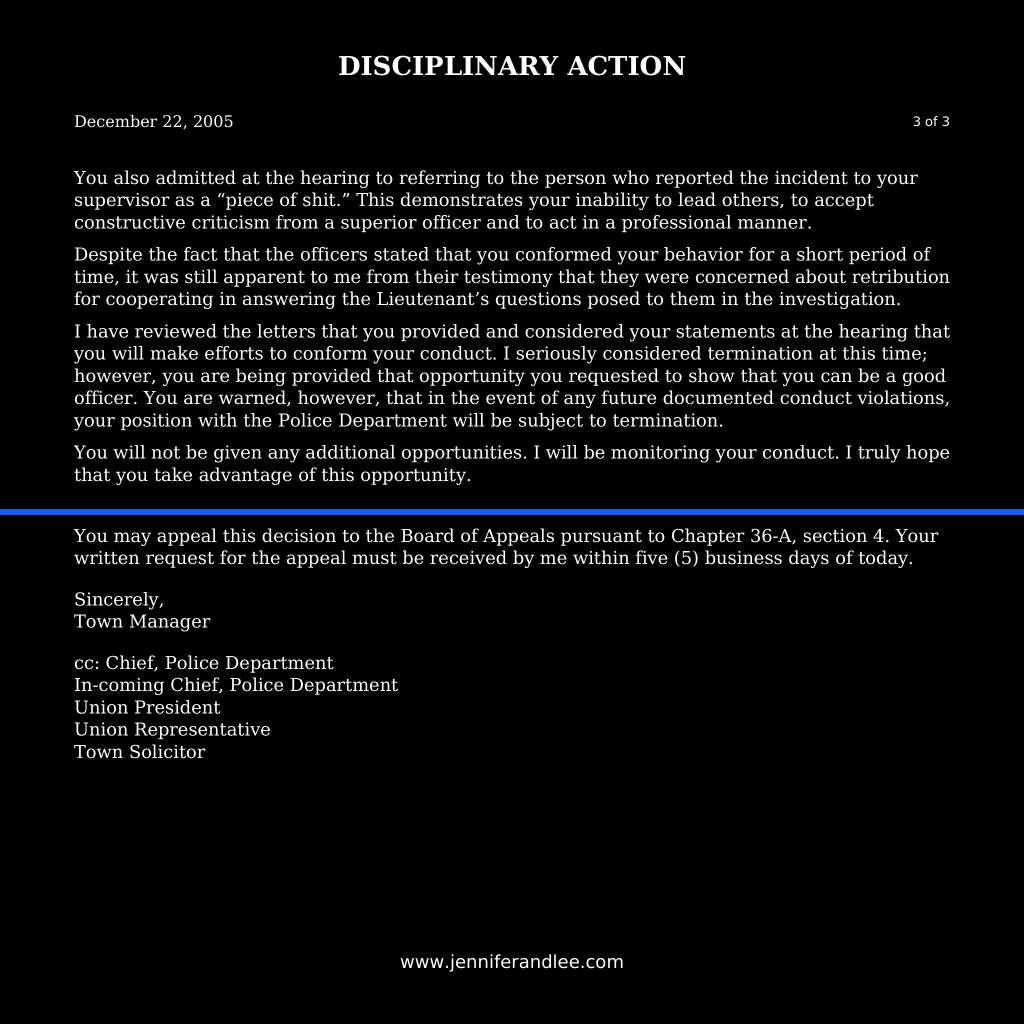
The December 22, 2005 disciplinary letter on our website ordered demotion to Patrolman I and seven days without pay. The copy is redacted but we are identifying Higley as the officer involved. The town manager described repeated misconduct despite earlier opportunities to improve, considered termination, and warned that future documented violations could result in dismissal.
The letter lists reprimands involving unanswered police radio calls; failure to attend to a prisoner’s medical needs when the prisoner entered a diabetic coma; intimidation of a minor prisoner; discourtesy; improper supervision; and lengthy office counseling of a 15-year-old girl. It also describes sexually suggestive remarks to female elementary-school employees, inappropriate comments to a subordinate’s wife, an admitted insult toward someone who reported misconduct, and subordinates’ fear of retribution.
One sentence captures the standard the town itself articulated:
“The Town wants its officers held in respect, not in total fear.” -Steve Eldridge
A responsible employer should examine how an employee responds when someone challenges them. Can they listen without humiliating the person? Can they follow instructions when they disagree? Can staff raise concerns safely? Those are practical measures of fitness for public service. An employee’s authority should never substitute for an ability to earn trust.
We obtained the disciplinary material through the new and temporary town attorney. A separate April 29, 2010 letter documents town attorney Thomas Carey’s conclusion that the final written decision had to be released and that the reasons offered for withholding it did not justify refusal. Access to that record mattered: citizens needed information to evaluate an officer’s conduct.
By the time we encountered Higley, I had served on Rumford’s Finance Committee and advocated reducing two vacant police positions. That work made me a target of hostility. Lee was struggling with PTSD and a custody conflict. When I called for help in 2010, I wanted assistance getting him to the hospital. From Tennessee, Lee’s ex-wife used Higley and other Maine officers to push false domestic violence allegations against him to retain full custody.
Parental Alienation: I Watched What Happened to My Father Happen to My Husband & It Broke Me (2024)
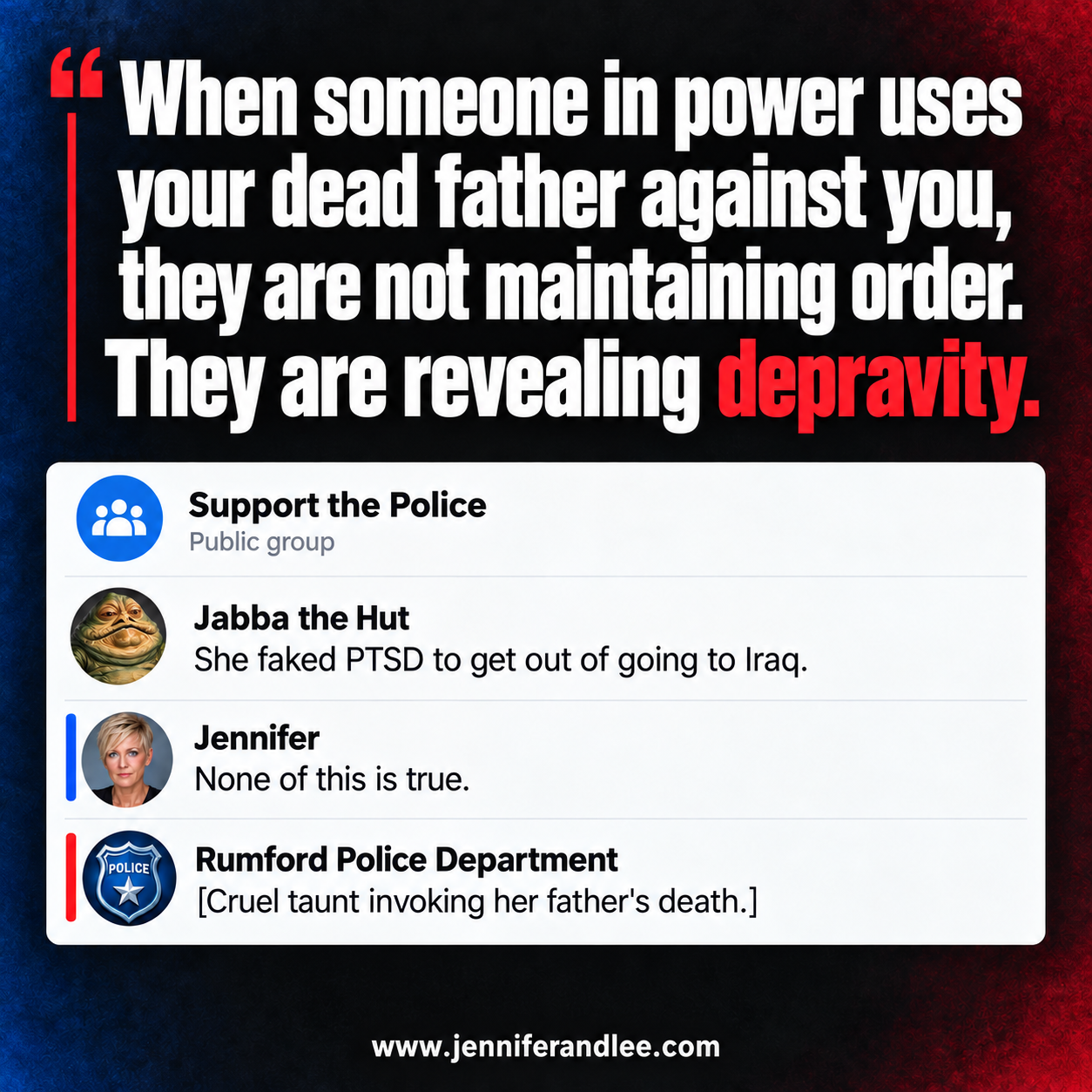
Higley and Lee’s ex-wife have a history. They were using a public “Support the Police” page to bully me. She had already weaponized the police department to get Lee arrested for “abusing” me. But that wasn’t good enough. She had to harm my reputation as well to hurt Lee and any chances for shared custody. The ex-wife told the group that I faked PTSD to get out of going to Iraq. I found out about it from the community and responded by telling her none of it was true.
Higley responded with: “Why don’t you go k*ll yourself, like your father did.”
The Sun Journal’s February 24, 2010 article reported a different police account: a domestic altercation, Lee’s pending domestic violence charges, and an alcohol-related summons against me. Sgt. David Bean issued the summons with Higley while I was nursing an unrelated wound (but they didn’t know that). Higley entered our home as if we had zero constitutional rights, conducted interviews with everyone except the homeowners, and turned the encounter against me.
Of course, the department denied targeting me.
Even accepting the department’s version for the sake of examination, a serious question remains: if officers believed I was a domestic-violence victim calling for help, how did my safety and account of events become secondary to an alcohol charge? Investigating another allegation does not remove the obligation to hear and protect a person who may be in danger.
We both faced false felony charges and both cases were dismissed. The 2010 article currently available online does not report those outcomes. An arrest or summons is an allegation; readers need the disposition to understand what happened. But the Sun Journal is part of the authoritative regime.
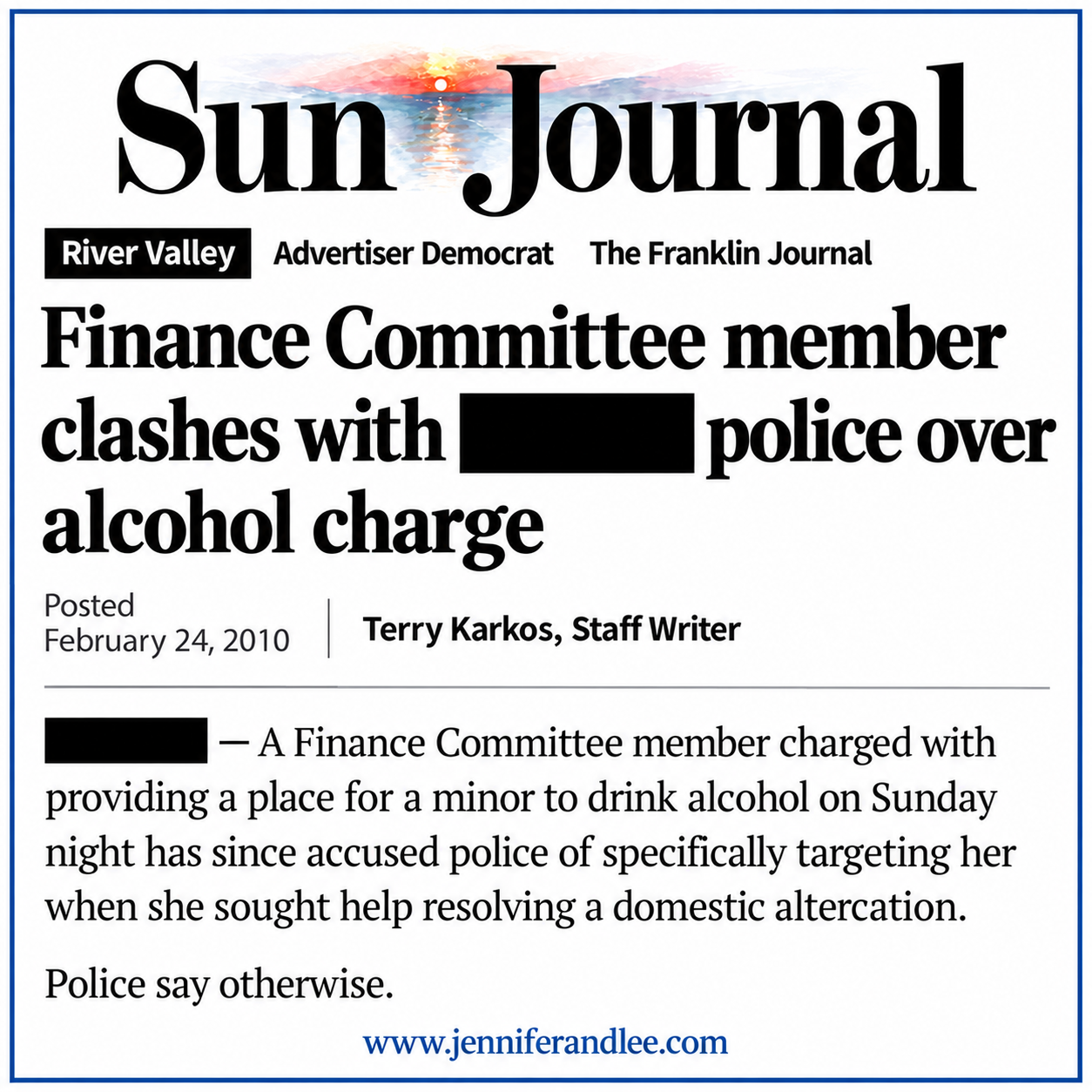
We tried to answer the coverage publicly. We wrote a letter to the editor, which I have said the Rumford Falls Times printed while the Sun Journal did not publish it. We wrote a letter to CopBlock explaining the circumstances. We also asked that our address be removed because I am a sexual-assault survivor. For us, the harm extended beyond embarrassment: the story affected how other people understood our family and whether we felt safe seeking help.
The original story includes my objections, but a few quoted objections cannot resolve a disputed account or replace a follow-up about dismissed charges. I believe the police narrative supplied to the newspaper unfairly portrayed our crisis as criminality. A searchable article can outlive the proceeding it describes and keep influencing people who never see the outcome.
People in veteran-advocacy circles reused that coverage to discredit us. Then we experienced an armed police response at our home on March 5, 2014. Lee was letting our service dog outside when officers confronted him with guns drawn. I was required to go to the hospital for a suicide assessment and quickly released. A false emergency report was used to bring armed officers to our home. These predators knew that earlier encounters with this police department had already damaged our trust, therefore the Sun Journal article literally puts us in danger in Rumford, Maine.
They couldn’t get me leave my own bill so they forced my absence when the bill was voted on the next day. It didn’t work and the Military Justice Improvement Act cloture vote took place on March 6, 2014, the day after the swatting. Thirteen days after that response, on March 18, Higley shot and wounded 25-year-old Jessica Byrn-Francisco in Rumford. It was over for me. I was in danger in Rumford, Maine because the newspaper article reveals my vulnerability to predators. I “clash” with these abusive cops therefore they can be weaponized against me.

According to the Attorney General’s report, Jessica told her counselor she had taken medication in an attempt to kill herself. Officer Brad Gallant found her beneath a deck and tried to pull her to her feet. She subsequently displayed a knife. The report describes unsuccessful Taser attempts, her advance toward Higley with the knife, and his retreat through deep snow before firing twice. She needed an ambulance, not two shots from a police officer who should have been fired prior to 2005.
On July 29, 2014, Attorney General Janet Mills concluded that Higley’s use of deadly force was legally justified in self-defense. The same report explicitly limits its review: it did not assess civil liability, administrative discipline, or whether the shooting could have been averted. That leaves questions about prevention and departmental accountability beyond the criminal-law conclusion.
The Press Herald also reported friends’ shock at the shooting and their description of a woman they had not known to be violent. Their reactions show why a victim impact statement is necessary and why the public deserves an explanation of how a call for help ended with two gunshot wounds.
For us, the proximity of these events was frightening. We had just experienced the armed response at our home. A woman in crisis was then shot by the officer whose conduct had already made us afraid to ask for help. We also realized we were sitting ducks in Rumford, Maine.
After the shooting, we contacted news outlets about our experience and supplied the disciplinary history. Our April 11, 2014 complaint to the Attorney General includes our concerns about intimidation, the damage to our trust, and our willingness to testify. We sent emails to television outlets and contacted a Press Herald reporter that did not lead to the follow-up we sought.
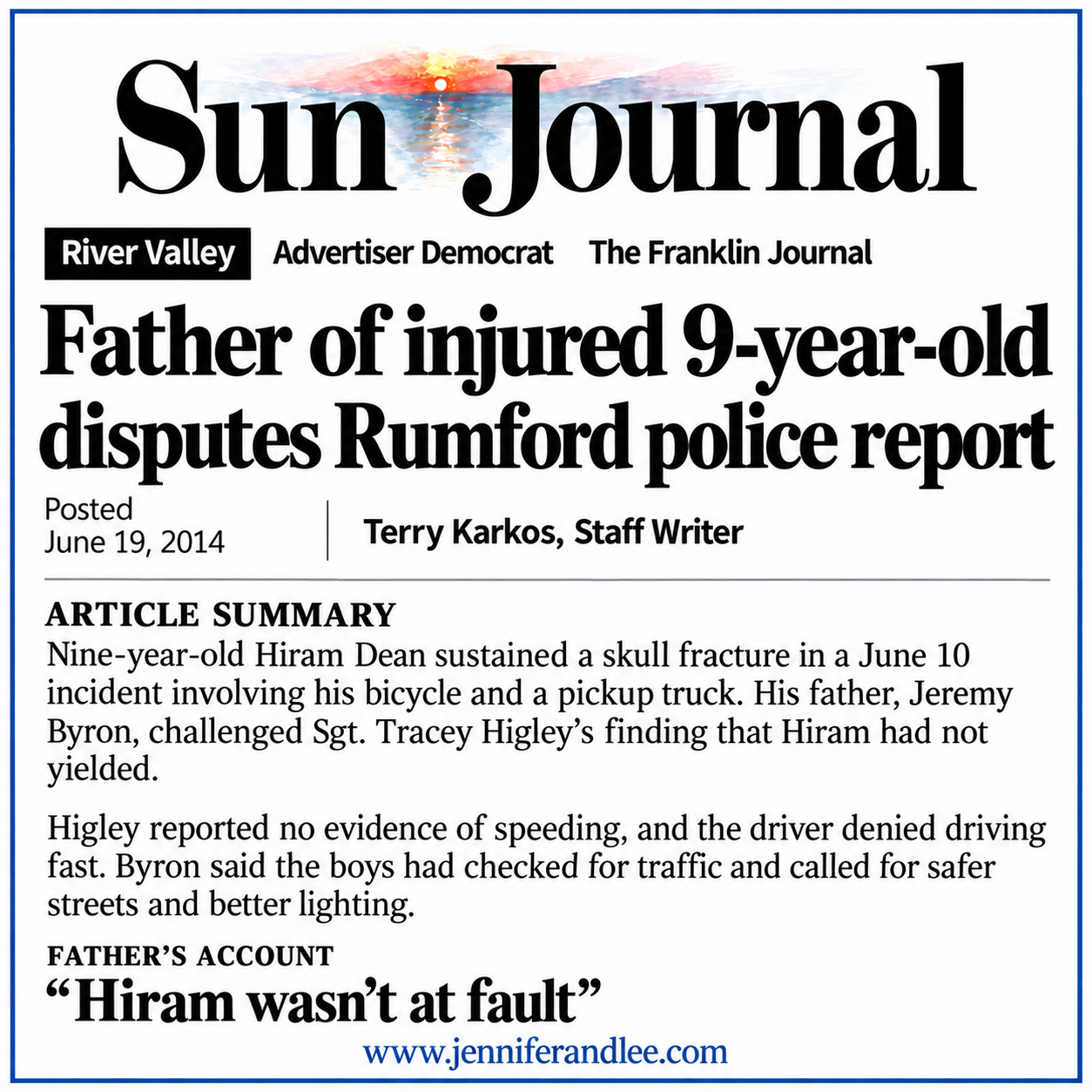
Father of injured 9-year-old disputes Rumford police report (Sun Journal, June 19, 2014)
In June 2014, the Sun Journal reported that the father of a nine-year-old boy with a fractured skull disputed Higley’s account of a bicycle-and-truck collision. Higley concluded that the contributing factor was the children’s failure to yield; the father said the children stopped and looked. Of course, the newspaper noted that the father was not at the scene. This documents a pattern: now two citizens are saying he falsified a report.
A clearer concern about public communication appears in the July 6, 2016 coverage of Rumford’s fireworks scare. Higley claimed a police officer in another jurisdiction reported suspicious “Muslim-looking folks” who bought pizza and asked about local events. A mass-shooting rumor spread, and police said up to 100 people left the July 4th celebration. Higley acknowledged that nothing had been substantiated and that there was no credible threat.
In my view, “Muslim-looking” is profiling language. Appearance does not establish a person’s religion, and buying pizza or asking about community events does not establish a plan to attack anyone. An employer should expect public representatives to explain the evidence for concern without turning perceived identity into suspicion.
The public record also includes recognition of Higley’s work. Maine’s Senate honored his 2013 Officer of the Year award and cited his involvement with Special Olympics and Keeping Kids Safe. In December 2020, the Press Herald described him as a police sergeant, a Maine Association of Police vice president, and a trainer of a new officer; it also reported his frustration with criticism following the 2014 shooting. This award and his assignments are inappropriate given Higley’s past.

My hiring standard would be straightforward: respectful treatment, sound judgment under stress, clear professional boundaries, and accountability when concerns are raised. I would require evidence that those standards were being met. The public deserves the same seriousness from the officials who hire, supervise, and retain police officers.
We asked for help. We are still explaining what happened and answering for Higley’s narrative that follows us far beyond Rumford, Maine. That is why the hiring question matters. If this record would make you hesitate to trust someone with a customer’s complaint, it should make you demand even greater scrutiny before trusting that person with a citizen’s freedom.
A badge and a gun should raise the standard.
Source
1. Disciplinary letter, December 22, 2005 (redacted reproduction, Jennifer and Lee).
4. Jennifer Norris’s citizen complaint, November 2, 2011 (Jennifer and Lee).
7. U.S. Senate, roll-call vote 59 on cloture for S.1752, March 6, 2014.


