
Summary
A concerned mother contacted us after receiving a video of an encounter involving her 20-year-old son and the Rumford Police Department. She says police were initially dealing with other young people—not her son. What allegedly began with her son asking why his 17-year-old friend was being restrained ended with the young man on the ground, charged with assault on an officer and disorderly conduct. An 18-year-old young woman who recorded the encounter was reportedly charged with obstructing government administration.
We don’t have every fact, and we are not excusing the son’s reported attempt to strike an officer. His mother agrees that response was wrong and officers were justified in restraining him at that point. The unanswered question is whether officers could have avoided the confrontation before it reached that point—and whether the force allegedly used after he was taken down remained necessary and proportionate. When this video is considered alongside Rumford’s documented history, other citizen footage, regional deadly-force cases, and Maine’s unusual record of never finding an officer-involved shooting legally unjustified, this family’s concerns deserve to be considered.
Copyright © Jennifer Norris. All rights reserved.
Editor’s Note
The mother identified August 24, 2026 as the date of the encounter. This article is based on the mother’s written account and a video she provided to Jennifer and Lee. We have not reviewed the complete police report, all available recordings, dispatch audio, witness statements, medical records, or court file. The charges described below are allegations and should not be treated as proof of guilt. Rumford Police and the officers involved should have an opportunity to provide their account, identify the legal basis for their actions, and release supporting records where permitted by law.
A Question Became a Police Encounter
According to the mother, Rumford police were not initially there for her son. Officers were dealing with his 17-year-old friend and the friend’s 18-year-old girlfriend. Her son reportedly asked why his friend was being placed in handcuffs and what was happening. The mother says officers told him to leave the situation and warned that he would also be placed in handcuffs if he did not walk away.
Her account identifies what may have been the encounter’s critical turning point: she says her son began walking away as directed, but an officer grabbed him. She reports that her son then attempted to strike the officer. The mother does not excuse that response. She agrees that trying to hit an officer was wrong and that the officer had a legitimate reason to physically restrain her son at that point.
What she disputes is what allegedly happened next. She says an officer body-slammed her son, grabbed him by the hair, and struck or drove his face against the sidewalk twice. Whether the video captures the entire sequence, what happened immediately before each use of force, and whether her son was still actively resisting are essential questions. Those facts should be examined through every available recording and record, not decided solely from a charge sheet, an officer’s report, or a short video clip.
The mother says her son ultimately faced charges of assault on an officer and disorderly conduct. She also says the 18-year-old woman recording the encounter was charged with obstructing government administration after she refused an order to stop recording. The mother says her son “did his time.”
The Human Result: Fear, Nightmares, and Lost Trust
The mother says her son is now afraid of police and has nightmares. His girlfriend is also frightened because of what she witnessed. Their family is struggling to understand how an encounter that did not begin with her son could have ended with him injured, prosecuted, and traumatized.
Those effects are not erased because the young man reportedly made a poor and dangerous decision during the encounter. Acknowledging his responsibility for attempting to strike an officer and questioning the officer’s subsequent force are not contradictory positions. Both citizen conduct and police conduct can—and should—be evaluated honestly.
Police officers routinely meet people when they are confused, frightened, angry, intoxicated, mentally unwell, or overwhelmed. That is precisely why emotional control is part of professional policing. Officers cannot guarantee that another person will remain calm, but they can avoid unnecessary physical contact, give clear and consistent instructions, recognize when someone begins complying, explain where bystanders may safely stand, and stop applying force once the need for it has ended.
What De-Escalation Could Have Looked Like
If the mother’s account is accurate—if her son was not the subject of the original police action and was beginning to comply with the instruction to leave—the least escalatory option may have been to let him continue walking away. Officers could have told him that his friend would receive an explanation when legally appropriate, directed him to a specific safe observation point, and assigned one officer to communicate with the bystanders. A clear boundary such as “Stand on that corner, keep your hands visible, and do not approach” would have been more specific than a threat followed by physical contact.
There is also an important difference between asking a question, verbally objecting, physically interfering, and assaulting an officer. Treating every question as defiance can create the very resistance officers say they are trying to prevent. A frightened young person may move into fight, flight, freeze, or fawn mode when unexpectedly grabbed. That trauma response does not legally excuse striking an officer, but professional de-escalation is intended to keep an encounter from reaching that dangerous point.
Once the son allegedly tried to strike the officer, the situation changed. Maine law permits an officer to use a reasonable degree of non-deadly force when and to the extent the officer reasonably believes it is necessary to make an arrest or defend against imminent unlawful force. The central question is not whether some restraint was warranted. It is whether every later use of force remained necessary after officers were gaining control.
Reportedly grabbing a person’s hair and driving his face into pavement—particularly if he was already down, restrained, or no longer presenting an immediate threat—deserves careful and independent review. Head and facial impacts carry a serious risk of injury. Investigators should determine exactly when each impact occurred, what the son was doing at that moment, whether his hands were controlled, what commands were given, what injuries were documented, and whether officers requested a medical assessment.
Recording Police Is Not Automatically Obstruction
The reported charge against the 18-year-old woman also requires facts beyond the statement that she refused to stop recording. The U.S. Court of Appeals for the First Circuit, whose decisions apply in Maine, has recognized a First Amendment right to record police performing public duties, subject to reasonable restrictions based on legitimate safety needs.
A bystander may be ordered to move, maintain distance, or disperse when circumstances reasonably require it. The right to record does not permit someone to enter an active arrest scene, physically interfere, threaten officers, or obstruct emergency work. But an order establishing a safe distance is different from an order aimed specifically at stopping documentation.
Maine’s obstructing-government-administration statute requires intentional interference by force, violence, intimidation, or a physical act. Whether the young woman did anything beyond recording and refusing to stop cannot be determined from the information currently available. But it was obvious from the video footage that it was upsetting and traumatic to see her boyfriend harmed in that way by small town police. Her location, distance, movements, statements, and any safety instructions do matter but recording alone does not establish obstruction.

Maine Police Shootings of Individuals with Mental Illness: Recent Incidents and Concerns (2024)
Rumford’s Own Records Show That These Concerns Are Not New
This family’s story lands against a local history that cannot responsibly be ignored. In 2005, the Rumford Town Manager issued a disciplinary letter concerning an officer identified as Sgt. Tracey Higley. The letter imposed a demotion to Patrolman I and a seven-day suspension without pay. It stated that the officer had acknowledged acting wrongly and had already been given numerous opportunities to improve.
The document said the officer had repeatedly been rude to members of the public and other officers and had treated people detained by the town “aggressively and in an intimidating manner.” It listed earlier reprimands involving a failure to attend to the medical needs of a prisoner who entered a diabetic coma, intimidation tactics involving a minor prisoner, discourteous conduct, improper supervisory methods, and inappropriate comments to women while representing the department at an elementary school. The Town Manager wrote that termination had been seriously considered and warned that future documented violations could place the officer’s job at risk.
One sentence from that official record remains especially relevant: the town wanted its officers held in respect, “not in total fear.” That distinction reaches directly into what this mother says her family is experiencing now.
Jennifer learned of the disciplinary record and did a FOIA request. According to her documented account, a town attorney later informed Rumford leadership that the record had to be released. Whatever one’s view of the later disputes, the underlying disciplinary letter is not rumor. It is an employment action created by the Town Manager’s office describing a sustained history of conduct concerns.
Our 2010 Experience: Calling for Help and Becoming the Target
In 2010, Jennifer called Rumford police because Lee, a medically retiring Air Force veteran with complex PTSD, was in crisis and needed help getting to a hospital. Jennifer has consistently stated that she was not reporting domestic violence and was not asking for her husband to be arrested. According to her account, officers spoke with others in the home but did not first ask her—the caller—why she needed help. Instead, Jennifer received a felony-level summons from Officer Tracey Higley related to alcohol consumed by a young guest who was stressed by the situation and turning 21 in a couple weeks.
Both Jennifer’s charge and Lee’s domestic-violence case were later dropped but the initial police and newspaper narrative remained online and caused lasting damage. Jennifer had been serving on the Rumford Finance Committee and had supported eliminating two vacant police positions. She believed the encounter and the publicity that followed were influenced by local political hostility toward those budget recommendations.
Jennifer later received menacing anonymous letters during the same period. The author of those letters has not been established, and we do not claim police wrote them. Their timing nevertheless deepened her fear and sense of being targeted. In a 2011 citizen complaint, she described what it felt like to call a department for help during a family mental-health crisis and leave the encounter believing the system had turned her request against her.
That experience is one reason this mother’s description feels familiar. The recurring concern is not simply that police arrest people who break the law. It is that an officer can arrive during confusion, interpret distress or questions as hostility, escalate the contact, and then use the citizen’s resulting fight-or-flight response as the justification for everything that follows.

Portland Press Herald Reported “Friends of Maine Woman Left Confused by Police Shooting” (2014)
The 2014 Shooting of a Suicidal Rumford Woman
Four years after Jennifer’s encounter, Officer Tracey Higley shot and seriously wounded 25-year-old Jessica Byrn-Francisco during a mental-health crisis. The Maine Attorney General’s report states that Byrn-Francisco had reported taking medication in a suicide attempt, fled through a window, displayed a knife after an officer tried to pull her from beneath a deck, and later moved toward Sgt. Higley with the knife.
Attorney General Janet Mills concluded that Higley’s use of deadly force was legally justified.
Friends and family members publicly expressed confusion. They described a woman with significant anxiety and mental-health struggles and questioned whether the encounter could have ended without gunfire. The Portland Press Herald reported that mental-health problems were involved in a substantial share of Maine police shootings reviewed during that period.
The 2005 disciplinary history does not, by itself, prove that the 2014 shooting was unlawful. The Attorney General reached the opposite legal conclusion. But an officer’s documented history of aggressive and intimidating treatment is relevant when the public asks whether warning signs were taken seriously, whether supervision was adequate, and whether crisis encounters were handled with all reasonable efforts to slow the situation down.
Rumford-Connected Incidents Since 2020
The years since 2020 have produced additional incidents that keep these questions alive. The agencies and facts were not identical, and it would be inaccurate to attribute every event to Rumford Police. Some involved Maine State Police or Oxford County sheriff’s deputies. They are connected through Rumford residents, Rumford families, events occurring in Rumford, or the broader rural Western Maine system.
In December 2022, Drew McKenna died after being shot by his brother, Shay McKenna, in Rumford. Shay was charged with manslaughter, while the family maintained that the shooting was accidental and that Shay was devastated by his brother’s death. In September 2023, while Shay was out on bail and living in a van in the woods, a Maine State Police tactical team attempted to arrest him in Rangeley Plantation. Police said he emerged wearing body armor and carrying a rifle. A trooper shot and killed him. The Attorney General found the shooting justified. Shay’s parents strongly disputed the state’s account of necessity and said their grieving son feared police would find and kill him.
On October 30, 2023, Oxford County sheriff’s deputies fatally shot 23-year-old Sean Dyment outside the Rumford Police Department. Authorities said Dyment threatened officers and pointed an AR-style rifle toward them. The Attorney General again found the use of deadly force legally justified.
The later Deadly Force Review Panel examination did not reverse that conclusion; the panel is not authorized to do so. It did, however, identify serious documentation and accountability gaps. The panel noted that the Oxford County deputies did not have body or dash cameras, that another responding officer did not activate a body camera until after deadly force was used, and that the Oxford County Sheriff’s Office did not provide an internal incident review despite multiple requests. The panel recommended body and cruiser cameras and immediate activation when officers arrive.
The broader Oxford County record adds context without proving anything about the present video. In 2022, officers in neighboring Mexico shot two men in separate encounters within roughly six weeks. The Attorney General found both shootings justified, but the Deadly Force Review Panel later examined the incidents and issued recommendations. The Mexico Police Department closed in 2024, and the Oxford County Sheriff’s Office assumed coverage. These events demonstrate how policing, crisis response, and oversight in rural Western Maine often involve an interconnected network of small municipal departments, sheriff’s deputies, state police, prosecutors, and the Attorney General’s Office.
In January 2024, police in Fryeburg shot and killed Kenneth Ellis, a 52-year-old Massachusetts man whose family described a history of mental illness. Police said Ellis had a knife following a vehicle chase and crash. His former partner told reporters that doorbell-camera audio appeared to capture silence followed by eight shots, leading her to dispute the assertion that officers repeatedly ordered him to drop the knife. The official record and the family’s interpretation sharply diverged. Although that encounter involved a different town and agency, it reflects the same regional concern: people in mental-health crisis can reach the final, lethal moment of a police confrontation before the public ever learns what de-escalation was attempted.
In 2025, we published another citizen video involving Rumford police. That encounter reportedly began as a taillight stop. The driver said officers escalated while he was attempting to produce paperwork, pulled him from his vehicle, took him to the ground, and ultimately charged him with obstructing government administration. That account also deserves to be evaluated against the complete police and court record, but the footage raised the same basic question: was there a reasonable opportunity to slow the encounter down before it became physical?
The current mother’s video now becomes another data point. It does not prove every prior allegation, and prior incidents do not prove what happened in this one. Together, however, these events justify a public demand for complete records, transparent review, meaningful de-escalation, and an oversight process that families can trust.
Maine’s Unbroken Record of Finding Police Shootings Justified
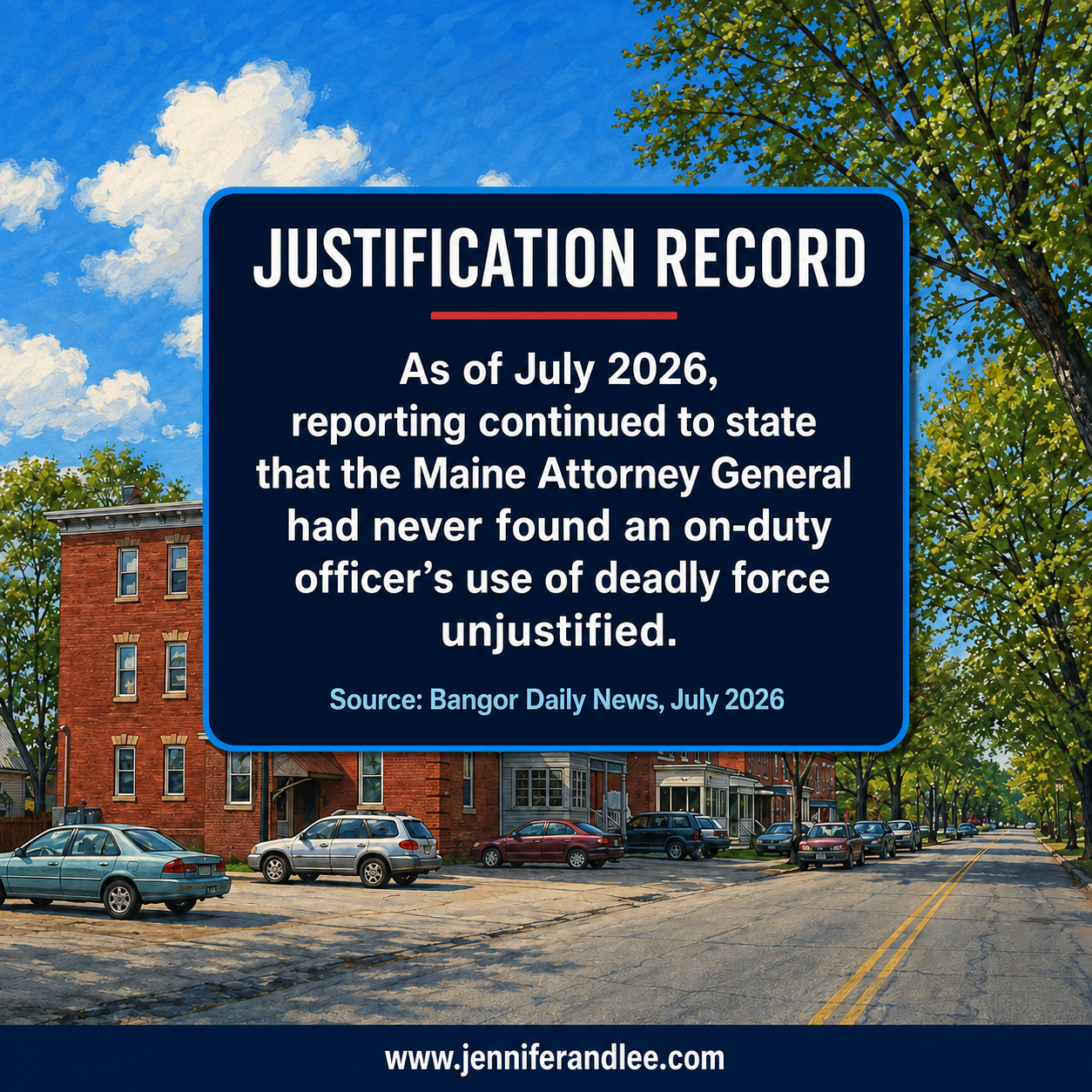
Maine’s Attorney General has a remarkable record in deadly-force cases. Maine Public reported in 2021 that the office had never found a police shooting unjustified since it began conducting these reviews in 1990. WGME repeated the same point in 2022. We located no later published decision breaking that record. Put plainly: in the public record reviewed for this article, no Maine officer-involved shooting has ever been declared legally unjustified by the Attorney General.
That does not automatically mean each conclusion was wrong. Legal justification is judged under a demanding, fact-specific standard focused on what an officer reasonably perceived at the moment force was used. But a perfect record favoring officers over more than three decades is legitimate grounds for public scrutiny—especially when families, witnesses, videos, or later review panels raise questions the original legal analysis did not answer.
The Attorney General’s review is also limited in scope. Maine Public reported that the office decides whether deadly force was legally justified; it does not decide whether the confrontation could have been avoided. That distinction matters. A shooting can satisfy the narrow legal test at the final second while earlier tactical choices, inadequate crisis intervention, poor communication, missing cameras, or failed supervision remain deeply troubling.
The Attorney General’s Connection to the Law-Enforcement Community
Maine’s Attorney General is not an outside civilian auditor. The office describes the Attorney General as the state’s “chief law enforcement officer.” Its Criminal Division prosecutes homicides and advises agencies within the Department of Public Safety, including the Maine State Police and Maine Criminal Justice Academy. The Investigations Division investigates police uses of deadly force, provides training to police chiefs and sheriffs, and identifies its chief as the Attorney General’s liaison to Maine’s law-enforcement community.
The office says the detectives who conduct deadly-force investigations are independent of every other law-enforcement agency. That is an important safeguard and should be acknowledged. At the same time, organizational independence is not the same as structural distance or public confidence. The same Attorney General’s Office that works closely with law enforcement, advises public-safety agencies, and represents the state also controls the criminal investigation into whether an officer’s use of deadly force was justified.
The Deadly Force Review Panel adds a broader examination of policy and best practices, but it exists within the Attorney General’s Office and cannot conduct a new legal review or overturn the Attorney General’s justification decision. Its 15-member structure includes public-safety officials, a police chief, a sheriff, a law-enforcement union representative, and a prosecutor, along with civil-rights representatives, attorneys, a mental-health professional, and three citizens who have never been sworn officers. Most appointed positions are selected by the Attorney General.
None of those facts proves dishonesty or a predetermined result. They do explain why some citizens question whether Maine’s system is sufficiently independent in both reality and appearance. Oversight must not only be fair; families should be able to understand why it is fair and see evidence that investigators challenged, rather than merely adopted, the official narrative.
Accountability Is More Than Deciding Whether Force Was Criminal
The mother’s family deserves a review based on the complete record. That should include preservation and release, to the extent permitted by law, of body-camera and dash-camera footage, dispatch communications, arrest and incident reports, use-of-force reports, medical evaluations, witness statements, officer training records relevant to the techniques used, and final court dispositions.
Any review should separately evaluate:
- Why officers engaged the son when he reportedly was not the original subject.
- Whether he had begun complying with the order to leave before an officer grabbed him.
- What the officer reasonably perceived when the son allegedly attempted to strike.
- Whether the takedown was performed according to training and policy.
- Whether the son was resisting when his hair was allegedly grabbed and his face struck the pavement.
- Whether force stopped promptly after he was controlled.
- Whether medical care was offered after reported head or facial impacts.
- Whether the young woman was physically interfering or merely recording.
- Whether the stated basis for each charge matches the video and other evidence.
- Whether supervisors conducted and documented a meaningful use-of-force review.
This article does not ask readers to pretend the son did nothing wrong. His mother herself says he should not have attempted to hit an officer. It asks a different and equally necessary question: did the officers make reasonable efforts to prevent the confrontation, and did they stop using force when the threat was under control?
A badge carries authority, but it also carries a higher duty of restraint. Young people should not leave an encounter believing that asking a question made them a target. Families should not have to accept nightmares, fear, and possible head injury as the unavoidable price of police contact. Rumford’s citizens deserve officers who can distinguish concern from physical interference, compliance from defiance, and necessary restraint from punishment.
Sources:
The Mother’s Account and Governing Law
- Mother’s written account and video provided privately to Jennifer and Lee.
- Maine Revised Statutes, Title 17-A, §107: Physical force in law enforcement
- Maine Revised Statutes, Title 17-A, §751: Obstructing government administration
- Maine Revised Statutes, Title 17-A, §752-A: Assault on an officer
- Maine Revised Statutes, Title 17-A, §501-A: Disorderly conduct
- Gericke v. Begin, U.S. Court of Appeals for the First Circuit (2014)
- Maine Legislature, Law Enforcement in Maine in 2020
Rumford History and Jennifer and Lee’s Documented Accounts
- “Red Flags: Disciplinary History for ‘Aggressive, Intimidating’ Maine Police Officer”
- “Town Attorney Informs Town of Rumford Leadership They Must Release the 2005 Disciplinary Action Letter”
- “Finance Committee Member Receives First Menacing Anonymous Letter”
- “Citizen Complaint to Cop Block: Finance Committee Member Targeted During a Family Mental-Health Crisis”
- “Maine Newspaper and Police Department Leaders Assist Abusive Police Officer in Dehumanization of Disabled Veterans”
- “Rumford Police Department Roughs Up Citizen After Traffic Stop for Taillight Out”
Police Shootings, Mental Health, and Recent Rumford-Connected Incidents
- Maine Attorney General: Report on the March 18, 2014 use of deadly force by a Rumford police sergeant
- “Friends of Maine Woman Left Confused by Police Shooting”
- “Woman Shot by Police Accused of Threatening Authorities With a Knife”
- “Maine Police Shootings of Individuals With Mental Illness: Recent Incidents and Concerns”
- “‘They Murdered My Son’: Maine Family Devastated After Police Shoot Man Accused of Manslaughter”
- “‘They Murdered My Son in Cold Blood’: Parents Upset After Police Shooting Ruled Justified”
- Maine Deadly Force Review Panel: October 30, 2023 Rumford incident involving Sean Dyment
- WGME: State recommends body and dash cameras after deadly police shooting in Rumford
- “Maine Deadly Force Review Panel Scrutinizes Police Shootings in Rural Maine”
Oversight and the Attorney General
- Maine Attorney General: About the Office
- Maine Attorney General: Investigation Division
- Maine Attorney General: Criminal Division
- Maine Revised Statutes, Title 5, §200-K: Deadly Force Review Panel
- Maine Public: “Since 2015, Maine Has Had Highest Rate of Fatal Police Shootings in New England”
- WGME: “Three Police Shootings in Maine Ruled ‘Justified’”


4 thoughts on “A Mother’s Account Raises New Questions About Escalation, Use of Force, and Police Accountability in Rumford, Maine (September 2, 2026)”