
Edmund Muskie Was Right: Clean Air, Clean Water, and Our Right to Demand Answers (August 20, 2026)
Copyright © Jennifer Norris. All rights reserved.
Maine needs officer-involved shooting reviews that operate outside the Attorney General’s Office, with appointments, staff, and funding that the Attorney General does not control. Lee and I learned in Rumford how frightening public authority can become when you need help and have already questioned the people holding the power. Our experience, the town’s disciplinary records, and later state shooting reviews make a case for oversight that can examine the entire encounter, demand evidence, and require a public response to its findings.
Rumford’s documented problems existed before we became part of the story. I began volunteering on the Finance Committee in 2007. After comparing police staffing with other communities, I recommended eliminating two vacant positions. The committee and town voters approved the reduction. I believed I was doing the work a finance committee member was supposed to do: examining how public money was spent and making a recommendation without putting an existing employee out of a job. We learned the hard way that questioning the police budget came with consequences.
Years before that budget dispute, the town had already documented serious conduct concerns involving an officer we would later encounter. A December 2005 disciplinary letter imposed a demotion to a Patrolman and seven days of unpaid suspension. It described repeated aggression and intimidation toward detained people, inappropriate comments to women, mistreatment of coworkers, and fear of retaliation among officers who cooperated with an investigation. Earlier reprimands included failure to attend to the medical needs of a prisoner who entered a diabetic coma and intimidation of a minor prisoner. The Town Manager had considered termination after previous opportunities to improve had failed.
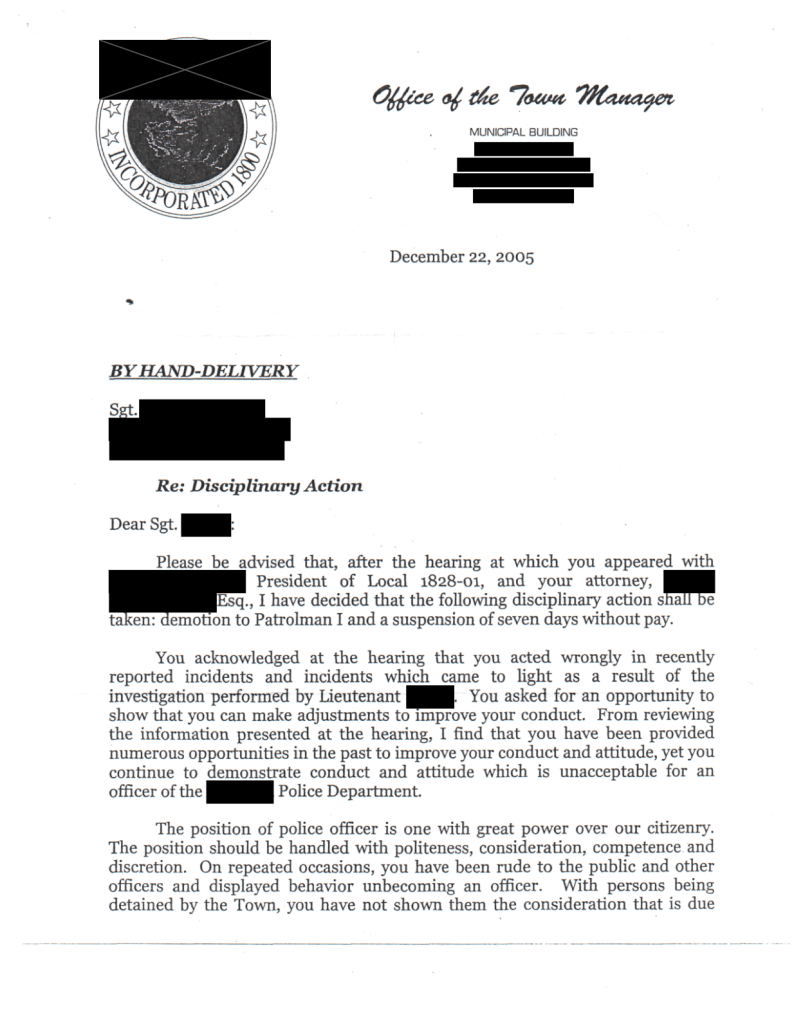
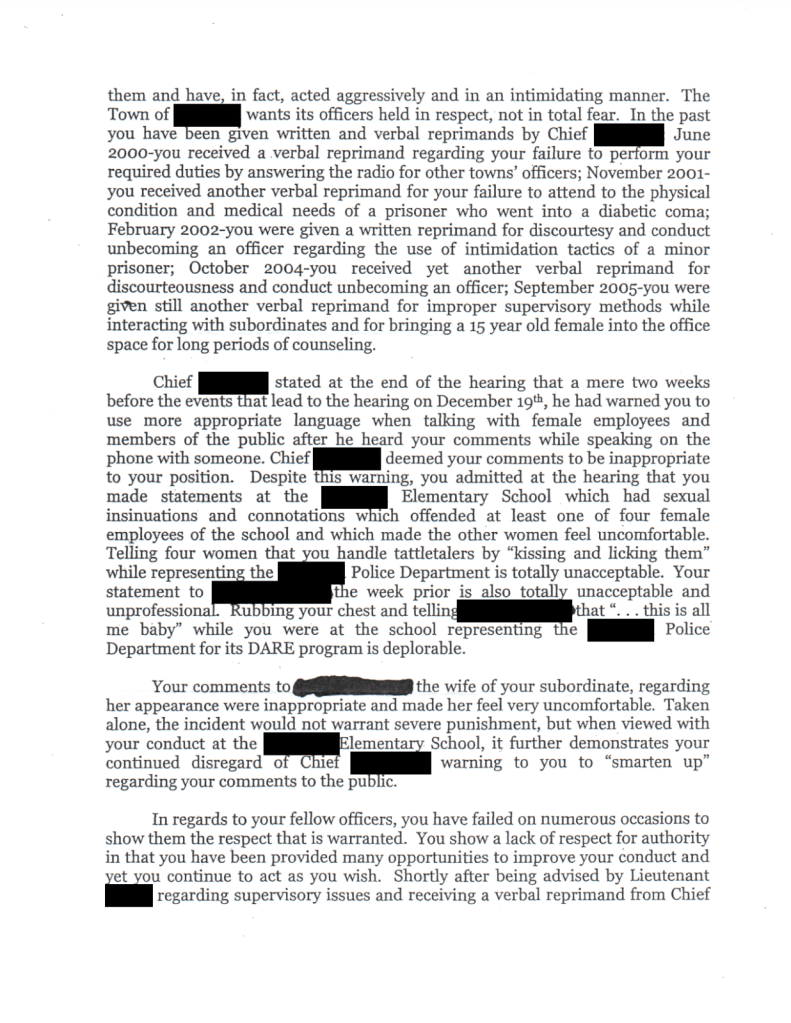
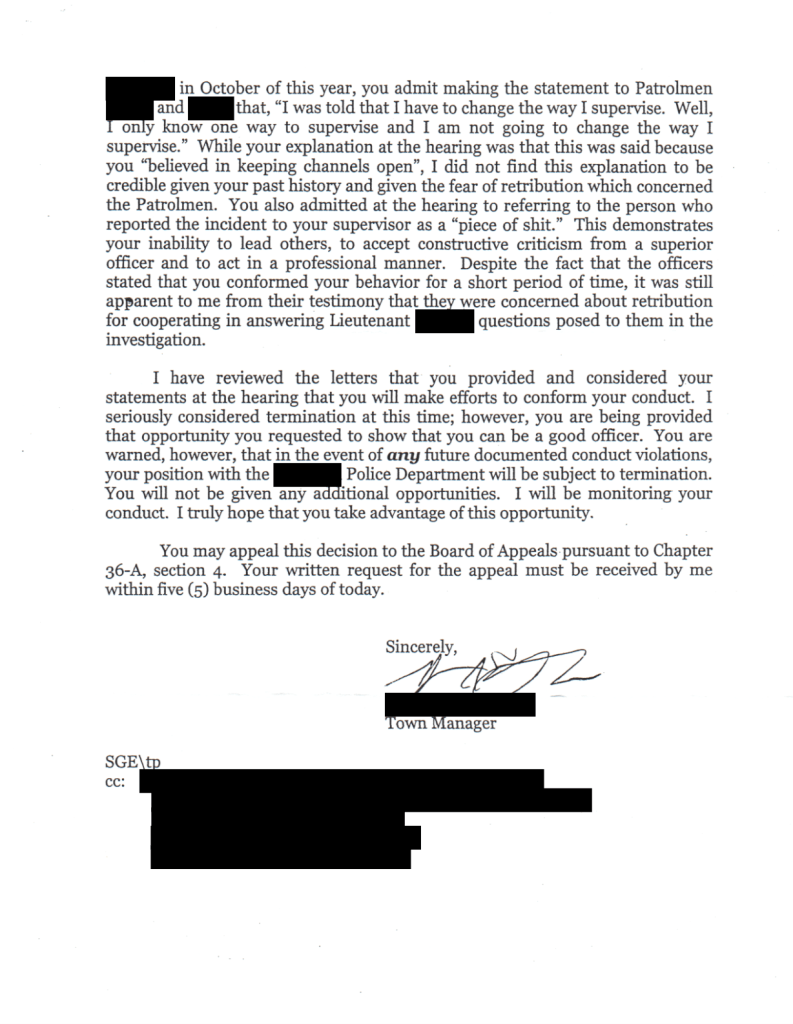
The incidents listed in that letter went back to 2000. Rumford wanted its officers respected, the Town Manager wrote, “not in total fear.” Those concerns were already on paper before my Finance Committee service and before our family’s encounters with the department. They raise a question the town should be able to answer: how did it verify that the conduct had changed?
Obtaining the record became another struggle. An April 29, 2010 letter from town attorney Thomas S. Carey concluded that the disciplinary decision had to be released and that there was no basis for refusing production. This history matters because residents should be able to learn about documented misconduct by people entrusted with power over them, instead the current Town Attorney is helping to bury it.
Lee and I were medically retiring Air Force veterans dealing with disabilities and serious distress. We needed help. Both of us were falsely charged with felonies, and both cases were later dropped. Lee’s case arose from domestic-violence allegations from an out-of-state psychopath who made our life a living hell by alienating the kids from us. My felony alcohol-related case followed a call I made because Lee was in crisis and needed help getting to a hospital because he was losing his kids. The cases came from separate encounters. What connected them for us was the experience of needing support and becoming the subjects of accusations that damaged our family, reputations, and sense of safety.
An accusation can keep damaging someone after a court case ends. An employer, neighbor, family member, or stranger can find the headline without knowing the outcome. For us, that public narrative became something other people used against us. I believe the political context and the treatment we received help explain why this happened. The Town of Rumford cared about all the other victims of Tracey Higley but backed him up when it came to us.

We have also described a false out-of-state report claiming I was suicidal, followed by officers arriving at our home with guns drawn and taking me for an emergency evaluation. I was quickly released after explaining what happened. That encounter deepened our fear of what could happen if we needed help again. Two weeks after the swatting incident, Tracey Higley shot a young woman with mental health issues who was suicidal on this particular night.
In a small town, a resident may depend on the same institutions they need to question. Kerri Arsenault’s Mill Town examines that dependence through the paper industry and the communities of Mexico and Rumford. The connection I draw is the pressure to tolerate harm from an institution considered essential to the community’s survival. A struggling town needs residents who can question its budgets, demand environmental answers, and report mistreatment without fearing the consequences.
The later shootings make these questions about supervision and crisis response even more urgent. On March 18, 2014, Rumford Sgt. Tracey Higley shot and wounded Jessica Byrn-Francisco during a mental-health crisis. The Attorney General’s report describes her advancing toward him with a knife after unsuccessful Taser attempts and repeated commands to drop it. Attorney General Janet Mills found the shooting legally justified. The report expressly excluded whether the shooting could have been averted, whether administrative action was warranted, and potential civil liability.
That limited scope leaves important public-safety questions unanswered. An officer’s disciplinary history, supervision, communication, and decisions before a confrontation becomes immediately dangerous deserve examination. A legal determination about the moment shots were fired cannot tell a community everything it needs to know about preventing the next shooting.

The August 31, 2022 shooting of Brandon Dearborn in neighboring Mexico illustrates why broader review matters. Mexico and Rumford officers responded to reports of a man threatening residents with a handgun. Dearborn was shot and survived. The Deadly Force Review Panel identified a lack of clear command, a dangerous approach to an armed and heavily impaired person, risks to residents in the building behind him, and shortcomings in Rumford’s internal review. It concluded that, once he was located and contained, there was little or no need to rush the response.
Six weeks later, Mexico Officer Dustin Broughton shot and seriously injured Daniel Tibbetts after reports that he had threatened others with a machete. Rumford officers also responded. The panel acknowledged the reported urgency while identifying inadequate coordination, problems with body cameras, and the absence of less-lethal options. These are specific findings about planning and equipment that agencies can act on.
In September 2023, Maine State Police shot and killed Shay McKenna, a Rumford man, while attempting to execute warrants in Rangeley Plantation. The state’s account describes him emerging armed with a rifle. His parents disputed the necessity of the shooting. The panel later discussed the absence of video and recommended recording drone footage to improve transparency.
On October 30, 2023, Oxford County sheriff’s deputies fatally shot Sean Dyment outside the Rumford Police Department after, according to the official account, he threatened officers and pointed a rifle toward them. The Attorney General found the shooting justified. The panel reported that the deputies lacked cruiser and body cameras, although Rumford footage helped its review. Despite repeated requests, the sheriff’s office did not provide its internal incident review, citing that it was incomplete.

Maine Police Shootings of Individuals with Mental Illness: Recent Incidents and Concerns (2024)
The January 2024 fatal shooting of Kenneth Ellis in Fryeburg exposed further recording failures. The official account describes a dangerous vehicle pursuit followed by Ellis approaching an officer with a knife. The panel found that cruiser equipment stopped recording when the siren was turned off and that the body camera did not record the encounter. Potentially recoverable footage was overwritten because retrieval was not initiated promptly. The panel recommended better equipment oversight and participation by all involved agencies in internal reviews.
These incidents involved different agencies, people, threats, and circumstances. Their shared relevance lies in the recurring questions about preparation, evidence preservation, crisis response, and whether departments learn from their own reviews. Our more recent Rumford coverage, including a 2025 taillight stop and a mother’s account of an August 2026 encounter involving her son, raises additional questions about escalation and recording.
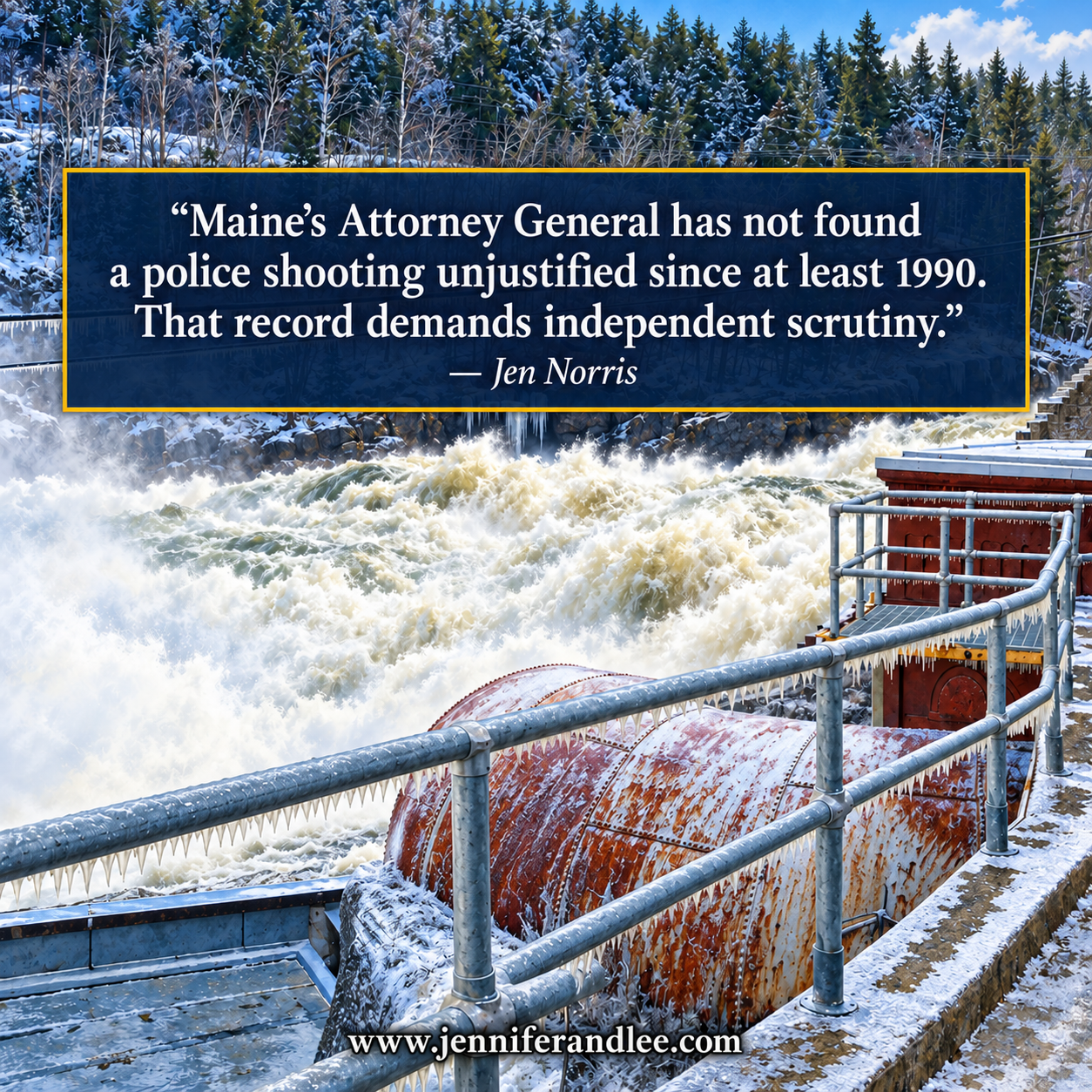
The concern extends across Maine. A 2021 Maine Public and Bangor Daily News report stated that the Attorney General’s Office had never found a police shooting unjustified since it began investigating them in 1990. That is a historical finding, and it cannot establish that every decision was wrong. It does help explain why residents want scrutiny from people who are institutionally separate from the office making those decisions.
Maine already has a Deadly Force Review Panel, and its critical findings deserve attention. However, state law creates the panel within the Attorney General’s Office. The Attorney General appoints eleven of its fifteen statutory seats, and the office’s director of investigations occupies another seat by virtue of that position. Members elect their own chair, but the appointment structure places substantial influence in the office whose criminal investigations come first. A separate statute gives the Attorney General exclusive direction and control of criminal investigations into on-duty officers’ uses of deadly force.
The panel’s proceedings and records are confidential under the statute, and its review begins after the Attorney General’s investigation is completed. Its reports explain that it does not reconsider the Attorney General’s legal determination from scratch. Members can exercise independent judgment within that framework. Institutional independence requires a structure in which another office cannot dominate appointments, resources, or the route to review. Maine needs checks and balances.
The panel’s 2025 annual report, published in 2026, also reported that it had operated with eleven members for a significant period. Vacancies included the attorney representing civil-rights plaintiffs and two of the three citizen seats. These positions were created to bring additional perspectives into the process. Leaving them unfilled weakens that design. The same report described members and staff serving without compensation or reimbursement.
We want Maine to establish an independent statewide review office with separate case panels and these protections:
- Appointments distributed across institutions. Use multiple appointing authorities, public selection criteria, fixed terms, and deadlines for filling vacancies. Include substantial civilian representation and expertise in civil rights, disability, mental health, and use of force. Require public conflict disclosures and meaningful recusals.
- Staff and funding outside the Attorney General’s control. Provide a separate appropriation, independent investigators, and an executive director accountable to the review body. Compensate participation so that serving is realistic for residents without institutional backing or substantial personal resources.
- Enforceable access to evidence. Existing law already requires necessary and relevant records to be supplied. Give that requirement clear production deadlines and a court-enforceable process. Preserve dispatch recordings, camera footage, relevant disciplinary records, and internal reviews immediately after an incident.
- A mandate to examine the whole encounter. Review planning, communication, supervision, opportunities to slow events down, access to clinical help, and decisions before force was used. Allow review of deadly-force incidents that cause no injury, as well as a defined route for examining serious nonfatal force and alleged retaliatory enforcement.
- Public findings and participation by affected people. Give survivors, families, witnesses, and involved officers a reliable way to submit evidence and respond to factual disputes. Publish reasoned findings, disclose missing evidence and unresolved questions, and explain redactions while protecting sensitive medical information.
- Required responses and verified corrective action. Turn requests for departmental feedback into deadlines established by law. Require agencies to state what they accepted, rejected, or changed, with reasons. Audit implementation and publicly identify repeated failures to respond or comply.
- A lawful route for further action. Provide referrals to certification authorities and appropriate disciplinary bodies. Where evidence raises criminal concerns or a prosecutorial conflict, create a mechanism for an independent prosecutor to assess it. A review panel should support accountable legal decisions while preserving everyone’s due-process rights.
These changes require the Legislature to amend Maine’s existing framework and fund a separate review body. A new name alone would leave the underlying dependence intact.

Maine should also fund crisis services and reliable recording equipment, then verify that both work when needed. The panel’s own annual report recommends mandatory cruiser or body cameras statewide and better coordination of internal reviews. Effective civilian oversight should be able to examine successful crisis responses too, so agencies learn how dangerous situations were resolved peacefully.
Public communications need accountability as well. Departments should issue accurate updates when charges are dismissed or allegations change materially. Newsrooms should make case outcomes easy to find alongside their original coverage. Residents should not have to spend years explaining that an accusation preserved in a searchable headline did not become a conviction.
Our experience taught us why budget oversight matters. Police staffing and spending should be supported by evidence, public needs, and transparent review. Residents who question those choices deserve a fair hearing. A volunteer finance committee member should be able to examine public money without wondering whether the next request for help will be used against her.
Rumford’s warning signs were documented before we became targets. Later state reports identified further failures in planning, recording, and review across Western Maine. The Legislature should give independent reviewers the authority and resources to follow those problems through to corrective action. Lee and I needed help when we were vulnerable.
Maine residents deserve a system that takes their safety, their evidence, and their questions seriously.
Sources and Related Articles
- Rumford Town Manager disciplinary letter dated December 22, 2005 — Town disciplinary record reproduced on Jennifer and Lee.
- Finance Committee member clashes with Rumford police over alcohol charge — Terry Karkos, Sun Journal, February 24, 2010.
- Town attorney Thomas S. Carey’s letter requiring release of the disciplinary record — April 29, 2010. Town attorney correspondence reproduced on Jennifer and Lee.
- Finance Committee member’s account of political targeting during a family mental-health crisis — Jennifer Norris, November 2, 2011. First-person account.
- Report of the Attorney General on the Use of Deadly Force by a Rumford Police Sergeant on March 18, 2014 — Maine Attorney General’s Office, July 29, 2014. Jessica Byrn-Francisco shooting.
- Mill Town: Reckoning with What Remains — Kerri Arsenault, 2020. Publisher’s book page.
- Since 2015, Maine Has Had Highest Rate of Fatal Police Shootings in New England — Lia Russell, Bangor Daily News, published by Maine Public, August 16, 2021.
- Coverage of Shay McKenna’s parents’ objections after his shooting was ruled justified — Jennifer and Lee, March 21, 2024. Includes linked WGME coverage and personal commentary.
- Our account of police encounters, newspaper coverage, and lasting reputational harm — Jennifer Norris, May 31, 2024. First-person account.
- Deadly Force Review Panel report on Mexico’s August 31, 2022 shooting of Brandon Dearborn — Maine Deadly Force Review Panel, released December 10, 2024. Official report.
- Deadly Force Review Panel report on Mexico’s October 13, 2022 shooting of Daniel Tibbetts — Maine Deadly Force Review Panel, released December 10, 2024. Official report.
- Our account of emergency police responses and concerns about Western Maine shootings — Jennifer and Lee, December 11, 2024. First-person account and related reporting.
- Deadly Force Review Panel report on the September 13, 2023 shooting of Shay McKenna in Rangeley Plantation— Maine Deadly Force Review Panel, released April 28, 2025. Official report.
- From a Taillight Stop to Excessive Force to an Obstruction Charge — Jennifer and Lee, June 7, 2025. Citizen-video coverage, allegations, and questions for Rumford Police.
- Deadly Force Review Panel report on the October 30, 2023 shooting of Sean Dyment in Rumford — Maine Deadly Force Review Panel, released July 10, 2025. Official report.
- State recommends body and dash cameras after deadly police shooting in Rumford — Ariana St. Pierre and Dan Lampariello, WGME, July 11, 2025.
- Deadly Force Review Panel report on the January 30, 2024 shooting of Kenneth Ellis in Fryeburg — Maine Deadly Force Review Panel, released December 15, 2025. Official report.
- 2025 Annual Report of the Deadly Force Review Panel — Maine Deadly Force Review Panel, January 2026 report, published February 2, 2026.
- A Mother’s Account Raises New Questions About Escalation, Use of Force, and Police Accountability in Rumford, Maine — Jennifer and Lee, September 2, 2026. Family account, video coverage, and related records.
- Maine Revised Statutes Title 5, section 200-A: Criminal division — Maine Legislature. Defines the Attorney General’s authority over criminal investigations of officers’ uses of deadly force.
- Maine Revised Statutes Title 5, section 200-K: Deadly Force Review Panel — Maine Legislature. Establishes panel membership, appointments, duties, access to records, confidentiality, and reporting.


