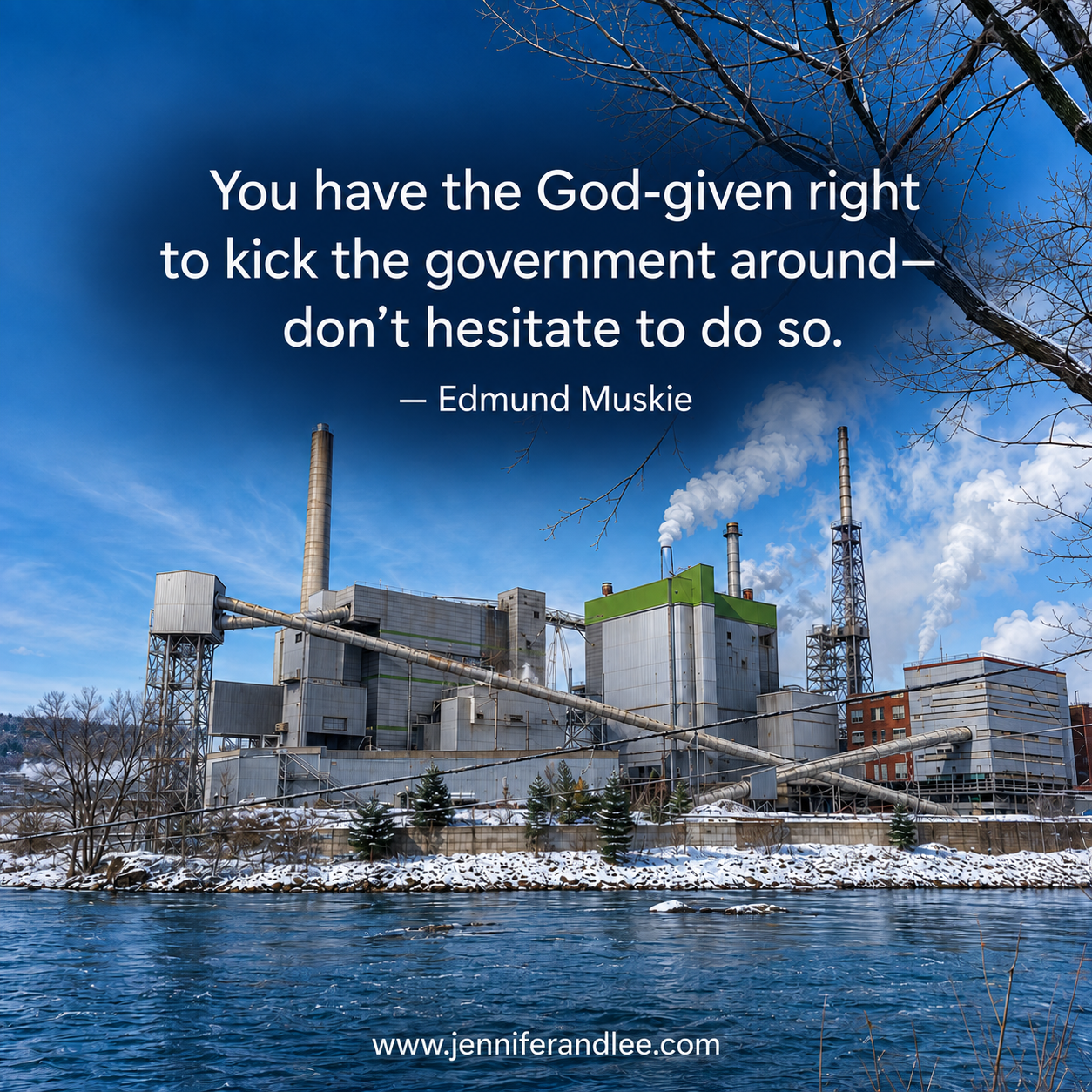
“You have the God-given right to kick the government around—don’t hesitate to do so.” —Edmund S. Muskie
Of all people to say this—Edmund Muskie. That hits differently for me.
Muskie was born in Rumford, Maine, in 1914—the Oxford County town Lee and I finally escaped, a place that sometimes felt like it came straight out of a Stephen King novel.
From that small Maine mill town, Muskie built an extraordinary career in public service. He served in the Maine House of Representatives, became governor of Maine, represented the state in the United States Senate for more than two decades, ran as the Democratic nominee for vice president in 1968, and later served as secretary of state under President Jimmy Carter.
But the part of his legacy that speaks most deeply to me is his environmental work.
Muskie grew up beside the Androscoggin River when it was being used as an industrial sewer. He knew firsthand what happened when communities were expected to accept polluted air, poisoned water, and unbearable odors as the price of having jobs. That experience helped shape him into the principal architect of the landmark Clean Air Act of 1970 and Clean Water Act of 1972.
His name would eventually become part of another public-service legacy. The University of Southern Maine created the Edmund S. Muskie Institute of Public Affairs in 1990. As its academic and applied-policy work grew, it became the Edmund S. Muskie School of Public Service in 1997—a school dedicated to educating public servants, informing policy, conducting research, and improving the lives of people throughout Maine and beyond.
While serving in the Air Force, I earned my master’s degree from the Edmund S. Muskie School of Public Service.
At the time, I don’t think I fully understood how deeply Muskie’s story would eventually intersect with my own. Now I understand that we had something profound in common: the environment was never “just an issue.” It was personal.
As Oxford County residents, Lee and I witnessed what environmental protections made possible as the Androscoggin was cleaned up along its course from New Hampshire into Rumford. We watched a river once sacrificed to industry begin coming back to life. 🌊
That recovery is proof that environmental laws matter—but it is not permission to stop asking questions.
Today, the Rumford mill is operated by ND Paper, a wholly owned subsidiary of China-based Nine Dragons Paper Holdings. Its discharges are regulated through environmental permits and monitoring requirements. But how many residents can clearly explain what is entering the river, in what amounts, how those pollutants may interact, or what their cumulative effects could be over decades?
Reports buried in complicated government systems are not the same as meaningful public transparency.
This issue is about accountability. Whether a corporation is foreign or domestic, the people living beside its operations deserve clear, accessible answers about their air and water.
That is especially important in a place with Rumford’s history.
Rumford and neighboring Mexico have long carried the grim nickname “Cancer Valley,” a name that gained national attention amid reports of rare cancers and community fears about industrial pollution. The nickname does not prove that every illness had one cause. It does, however, tell us something important: generations of residents felt they were living beside environmental risks that no institution could—or would—fully explain.
That history is one reason clean air and clean water matter so much to me.
Rumford taught me how a community can depend economically on an industry while quietly fearing what that industry may be doing to people’s bodies. Joint Base Cape Cod taught me the same lesson in a different setting. I served on a military installation that had already been listed as a federal Superfund site because decades of military activity contaminated groundwater and created multiple pollution plumes.
The setting changed from a paper mill to a military base, but the pattern felt painfully familiar: contamination, institutional secrecy, complicated government reports, and ordinary people left trying to determine what they were exposed to and what it might mean for their health.
For me, environmental protection is not an academic discussion. It is connected to where I grew up, where I served, what happened to my health, and why Lee and I continue demanding answers.
Muskie was right: citizens have the God-given right to kick the government around. We also have every right to demand accountability from corporations and military institutions using—or contaminating—our shared natural resources.
I may have escaped Rumford, but I carried Muskie’s environmental legacy with me. I earned a degree from the school bearing his name, and then I lived through the very reasons his work remains so important.
Clean air and clean water are not corporate or government property. They are not government bargaining chips, and they should never be quietly sacrificed in the name of industry or national security.
They belong to all of us. 🌎
Sources:
- King Honors Senator Ed Muskie’s Centennial Birthday — Office of Senator Angus King
- About the Muskie School of Public Service — University of Southern Maine
- About the Edmund S. Muskie Foundation — Edmund S. Muskie Foundation
- Edmund Sixtus Muskie: 58th Secretary of State — U.S. Department of State, Office of the Historian
- Memorial Tributes to Edmund S. Muskie — U.S. Government Publishing Office
Source for Muskie’s quote: “You have the God-given right to kick the government around—don’t hesitate to do so.” - Clean Water: Muskie and the Environment — Maine Memory Network
- Muskie Archives Opens Historic Androscoggin River Data to Researchers — Bates College
- Androscoggin River Total Maximum Daily Load — Maine Department of Environmental Protection
- Cleaning Up Androscoggin River Pollution — Natural Resources Council of Maine
- Growing Up in Maine’s “Cancer Valley” — Literary Hub, adapted from Kerri Arsenault’s work
- Paper Mill Chemicals Form Pall of Controversy Over “Cancer Valley” — Los Angeles Times, September 8, 1991
- Rumford Division — ND Paper
- ND Paper Honored With Award From the Maine International Trade Center — ND Paper
This source identifies ND Paper as a wholly owned subsidiary of Nine Dragons Paper Holdings and discusses its acquisition of the Rumford mill. - Public Notice: Draft Permit for ND Paper, Inc., Rumford, Maine — U.S. Environmental Protection Agency, May 14, 2026
- Status of Licensed Discharges—2025 — Maine Department of Environmental Protection
- Otis Air National Guard Base/Camp Edwards Superfund Site Profile — U.S. Environmental Protection Agency
- EPA Finalizes Cleanup Plans for Portions of Joint Base Cape Cod — U.S. Environmental Protection Agency


2 thoughts on “Edmund Muskie Was Right: Clean Air, Clean Water, and Our Right to Demand Answers (August 20, 2026)”