
Complex Trauma, Toxic Leadership, and Heavy Metals Poisoning: A Veteran’s Story (September 16, 2015)
From Hollywood to frequency hopping, from Telstar to Western Maine, and from a small-town Maine girl to Air Force combat communications—the history behind August 11 connects more of my life than I ever realized.
Copyrighted By Jennifer and Lee Norris | August 11, 2026
Sometimes you look backward at your life and discover connections you never could have seen while you were living it.
This is one of those stories.
On August 11, 1942, in the middle of World War II, Hollywood actress Hedy Lamarr and composer George Antheil were granted U.S. Patent No. 2,292,387 for what they called a “Secret Communication System.”
It was an ingenious idea intended to make radio-controlled weapons much harder for an enemy to jam.
More than eight decades later, the principles associated with frequency hopping occupy an important place in the history of secure wireless communications.
And for me, there is an unexpected personal connection to that history.
I graduated from Telstar Regional High School in Bethel, Maine—a school named after a pioneering communications satellite.
Years later, I joined the military and built a career in satellite communications for the United States Air Force.
I went from Telstar to SatCom without ever realizing just how beautifully those pieces of my life fit together.

August 11, 1942: A Hollywood Star Receives a Communications Patent
Most people remember Hedy Lamarr for her extraordinary beauty and her career during Hollywood’s Golden Age. But Lamarr had another side that history took far too long to appreciate. She was an inventor.
During World War II, Lamarr became interested in the problem of radio-controlled torpedoes. Radio guidance offered obvious military advantages, but it also created a vulnerability: if an enemy discovered the frequency being used to control a weapon, that signal could potentially be jammed.
Lamarr worked on the problem with her friend George Antheil, an avant-garde composer who had experience with automated musical systems. Their solution was remarkably creative.
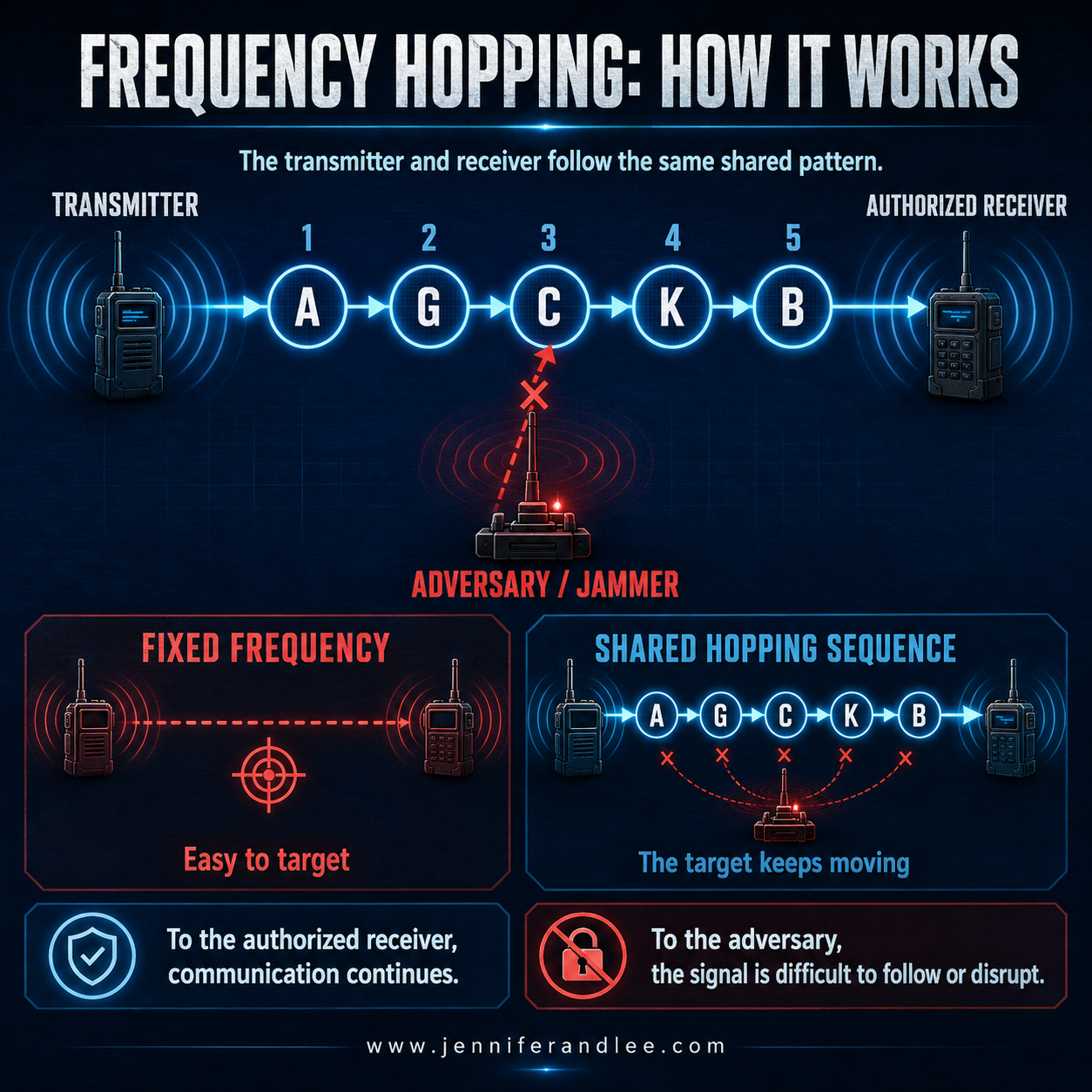
Instead of transmitting continuously on one radio frequency, the transmitter and receiver could move together through a sequence of different frequencies.
The patent described synchronized mechanisms at the transmitter and receiver that would repeatedly change their tuning. Without knowing the predetermined sequence, an adversary would have a much harder time determining which frequency carried the next control signal.
The concept became known as frequency hopping.
Their patent described using synchronized records inspired by player-piano rolls. A standard player piano had 88 keys, and their proposed system could correspondingly employ 88 carrier frequencies.
It was an extraordinary intersection of two completely different worlds: music and radio engineering.
A composer understood synchronization. An actress and inventor understood the military problem. Together, they envisioned a communications system designed to keep a signal alive in a hostile electromagnetic environment.

The Problem Was Jamming
For anyone who has worked in military communications, the fundamental problem Lamarr and Antheil were addressing is immediately recognizable. A communication link isn’t useful simply because you can transmit. The intended receiver has to be able to receive the signal reliably.
And in warfare, somebody may be actively trying to prevent that from happening.
Lamarr and Antheil explained that their invention involved using different carrier frequencies and was particularly applicable to the remote control of devices such as torpedoes. Their objective was essentially to create a communication method that was reliable for the intended users but difficult for an adversary to discover or disrupt. The transmitter and receiver needed to remain synchronized.
That concept—two distant points staying coordinated so that information can successfully cross the space between them—would eventually become very familiar to me.
Lamarr Inducted into National Inventors Hall of Fame
Lamarr became much better known for her face than for her technical imagination.
Decades later, however, she and Antheil received growing recognition for their contribution to the history of wireless communication.
Lamarr was eventually inducted into the National Inventors Hall of Fame in 2014 for the frequency-hopping communication system. The National Inventors Hall of Fame describes their work as an important development in wireless communication, and frequency-hopping techniques would eventually find applications in modern radio systems.
She died in 2000 and the recognition came too late.
There is something important about that.
Sometimes a person can be capable of far more than the world has decided they are capable of.
What Frequency Hopping Actually Does
The basic idea can be understood without being an engineer.
Imagine that two people need to communicate while a third person is trying to interfere with their conversation. If the transmitter always operates on the same frequency, the adversary can concentrate interference there. But imagine the transmitter and receiver share a predetermined pattern:
Frequency A. Then frequency G. Then frequency C. Then frequency K. Then frequency B. Both sides move together.
To an authorized receiver that knows the sequence, communication continues. To someone trying to interfere without knowing the sequence, the target keeps moving.
Modern spread-spectrum systems are far more sophisticated than the mechanical system Lamarr and Antheil proposed, and the history of spread-spectrum radio involves many inventors and developments. Their 1942 patent should therefore not be described as literally “inventing Wi-Fi.” But their frequency-hopping system became an important landmark in the development of secure wireless communications.
And that brings me to another famous communications breakthrough.
One with a name that followed me long before I understood what it meant.
The TELSTAR Satellite Inspired a High School Name
I grew up in Western Maine and graduated from Telstar Regional High School. For most students, the name of their high school is simply the name of their high school. Mine happened to be named after a technological revolution.
Telstar Regional High School’s own school profile explains that the school was:
“Named for one of the first communication satellites whose earth station was located in Andover.”
That earth station was only about 25 miles from Bethel. And the original Telstar was extraordinary.
Launched on July 10, 1962, Telstar 1 became the world’s first active communications satellite capable of relaying television, telephone and data signals across the Atlantic. Unlike today’s geostationary communications satellites, Telstar moved rapidly across the sky. Ground stations could communicate through it only during relatively short windows when the satellite was visible.
One of the most important stations was located in Andover, Maine.
On Telstar’s first day in orbit, the Andover station acquired the satellite, established tracking and began communicating through it.
NASA’s historical documentation records that Andover received the first video signal from Telstar and participated in an early telephone conversation involving AT&T Chairman Frederick Kappel and Vice President Lyndon Johnson.
Western Maine was suddenly connected to space.

A Giant Radome in the Maine Woods
Think about how remarkable that must have seemed in 1962.
In rural Western Maine—surrounded by mountains, forests, small towns and winding roads—engineers constructed an enormous satellite communications facility capable of communicating with an object orbiting Earth.
Signals traveled upward from Maine. A spacecraft received them. The spacecraft amplified them.
Then it transmitted them back toward another part of Earth. Today that sounds ordinary. In 1962, it bordered on science fiction.
And when the regional high school serving Andover, Bethel, Greenwood, Newry and Woodstock was established several years later, the community chose a name reflecting that technological achievement: Telstar. The school’s teams were originally called the Telstar Rebels; now they are referred to as the Telstar Satellites.
And then one of those students graduated in 1990 and eventually went into satellite communications herself. Me.
From Telstar Regional High School to College to Air Force SatCom
I certainly wasn’t standing at my high school graduation in 1990 thinking:
I’m graduating from a school named after a communications satellite, so obviously I’m going to spend part of my military career talking through satellites.
Life doesn’t usually reveal its themes while we’re living them.
Years later, however, I entered the satellite communications career field in the Air Force. It was technical work. We had to understand our equipment. We had to know how to set it up, operate it, maintain it and troubleshoot it.
Eventually I became a Team Chief at the 267th Combat Communications Squadron in Massachusetts. I spent ten years working in the career field.
During exercises and operations, I could set up and operate our satellite communications system with my team. And the purpose behind all of that expensive equipment ultimately came down to something surprisingly similar to the communications problems engineers had been wrestling with for generations:
Get information from Point A to Point B.
Do it reliably. Keep the equipment operating. Maintain the link. Understand the frequencies. Understand the signal. Understand what can interfere with it. And make damn sure the people depending on that communications link can communicate.
Combat Communications Is Different
Military satellite communications isn’t simply about technology. It is about mission support. A satellite link can carry information across enormous distances without requiring terrestrial communications infrastructure between the two points.
That becomes particularly valuable when military forces deploy somewhere that doesn’t have the infrastructure they need—or when existing infrastructure has been damaged, compromised or simply isn’t available.
Combat Communications Squadrons bring communications capability with them.
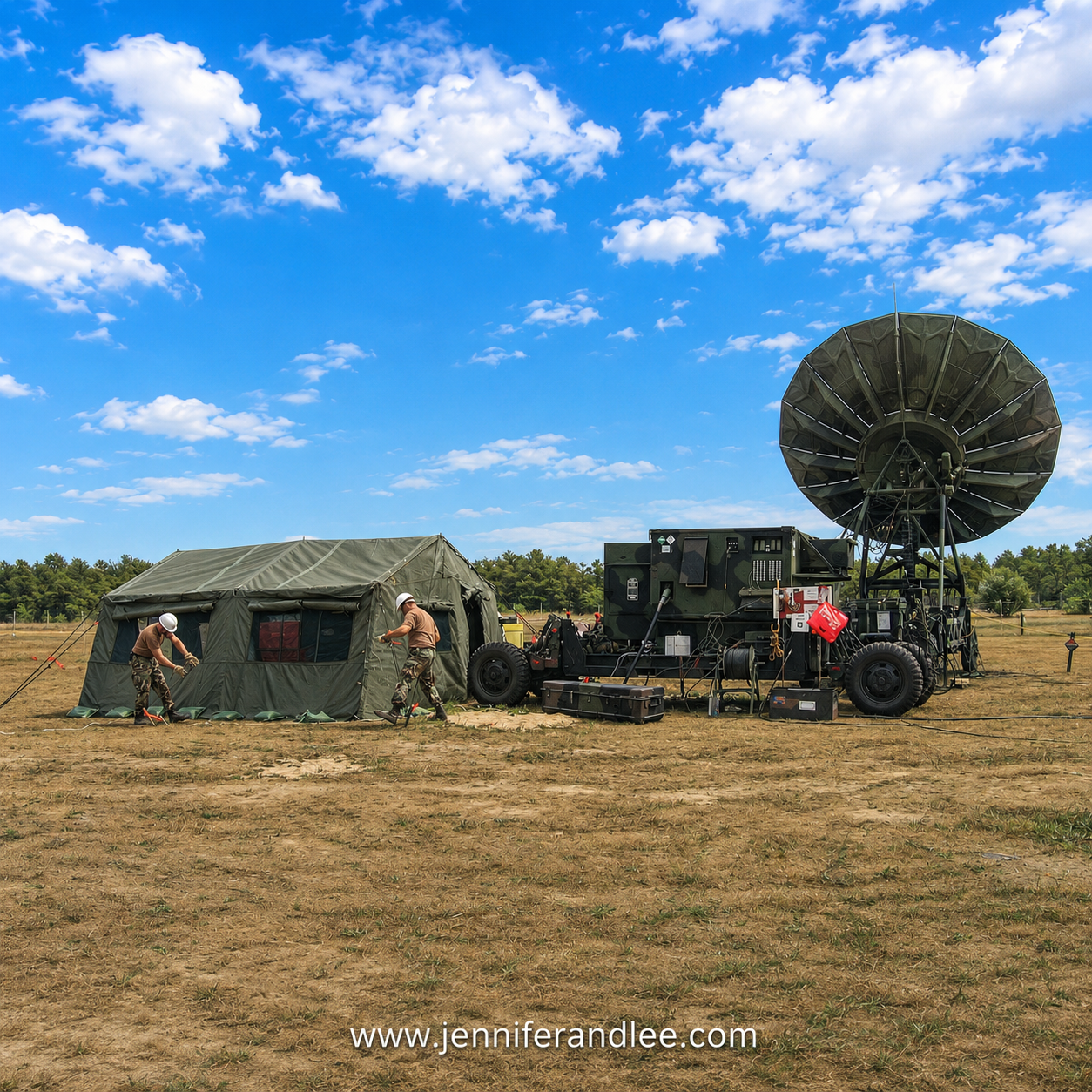
You arrive. You establish the site. You set up the equipment. You acquire the satellite. You establish the link. And suddenly people separated by hundreds or thousands of miles can communicate.
There is something almost magical about watching that happen. Except it isn’t magic. It’s physics.
Radio-frequency engineering. Orbital mechanics. Electronics. Antennas. Amplifiers. Transmitters. Receivers. Modulation. Timing. Troubleshooting.
And a lot of very tired communications troops making everything work.
The Giant Satellite Dish
Some of my strongest memories from that career involve the Army’s 93 Bravo and the TSC-100A satellite communications system and its enormous approximately 20-foot antenna.
There was nothing subtle about it. When deployed, the dish made the mission visible.
You could stand beneath this enormous piece of communications equipment and understand that somewhere far above you was another machine moving through—or positioned in—space, receiving the signal we transmitted.
We couldn’t see the satellite with our eyes. But our equipment could find it. Our receiver could hear it. And once the link was established, information could travel through space.
For a girl who graduated from a school called Telstar, there is something pretty incredible about that.
From Hedy Lamarr’s Torpedo to a Satellite Link
Obviously, Hedy Lamarr’s 1942 invention and the satellite communications systems I operated decades later are not the same technology. But they belong to the same much larger technological story.
Human beings learned how to manipulate electromagnetic energy so information could travel invisibly through space. Then we learned how to make those communications more reliable.
More secure. More resistant to interference. More mobile. More precise. And capable of traveling farther. Radio communication eventually reached beyond the horizon. Then beyond continents. Then beyond Earth itself.
Lamarr and Antheil were thinking about protecting a radio link from interference.
The engineers behind Telstar were thinking about relaying communications through an orbiting spacecraft.
Military communications engineers continued developing ways to make communications more survivable, secure and dependable under hostile conditions. Different systems. Different generations. But the same fundamental challenge:
How do we keep people connected across distance?

The Woman Behind the Movie-Star Image
There is another reason Hedy Lamarr’s story resonates with me. People looked at her and saw one thing. A beautiful woman. Hollywood royalty. A movie star.
The technical mind apparently didn’t fit the image people had already created for her. Her appearance became the headline. Her intelligence became a footnote.
For decades, millions of people knew Hedy Lamarr’s face without knowing that her name appeared on a U.S. patent for a sophisticated communication system.
I think there is a lesson there—especially for women who entered technical fields traditionally dominated by men. Never assume you know someone’s capabilities because of what they look like. Never confuse beauty with a lack of intelligence. Never confuse quietness with incompetence.
And never underestimate the person standing in front of you because they don’t fit your mental picture of what an engineer, technician, inventor, leader or communicator is supposed to look like.
I Know Something About Having My Technical Ability Questioned
My own career in satellite communications wasn’t always easy. As I have written previously, I worked extremely hard to master my equipment and become technically proficient.
I trained new troops. I led operations. I became a Team Chief. Yet I also experienced an environment where my competence and leadership were repeatedly questioned. At one point I was threatened with losing my Technical Sergeant stripe over false allegations concerning my technical performance.
I fought back. Ultimately, I kept my stripe. But eventually I left the satellite communications career field I loved. Hundreds of thousands of dollars had been invested in my technical training. Walking away from that career was painful.
The technology wasn’t what drove me away. The environment did. That history makes Hedy Lamarr’s story hit a little differently for me.
Different woman. Different generation. Completely different circumstances.
But there is something familiar about watching a technically capable woman contribute while other people underestimate what is going on inside her head.

And Then There Is My Dad
There’s another connection buried in all of this.
My father used to call me his “beautiful, genius daughter.”
Those words became especially meaningful after he died.
At times when other people were tearing me down or making me question my abilities, I remembered the person who had always built me back up.
That’s part of why Hedy Lamarr’s story catches my attention.
History remembered her beauty first.
Eventually, it remembered the genius too.
Maybe those things never had to be mutually exclusive.
The Timeline Still Blows My Mind
Consider this progression:
August 11, 1942
Hedy Lamarr and George Antheil receive U.S. Patent No. 2,292,387 for their Secret Communication System.
July 10, 1962
Telstar 1 launches into orbit and helps usher in a new era of satellite communications.
1960s
A high school in Western Maine is named Telstar Regional High School, honoring the communications satellite and the nearby Andover earth station.
1990
I graduate from Telstar Regional High School.
1996 – 2005
I enter the United States Air Force satellite communications career field.
Eventually, I’m standing beside military satellite communications equipment helping establish communications links of my own.
I couldn’t have planned that story if I tried.
Sometimes You Don’t Recognize the Thread Until You Look Back
When I graduated from Telstar in 1990, I had no idea where my life would take me. I certainly didn’t know that satellite communications would become part of my identity. I didn’t know I would someday understand antennas, communications systems and military operations.
I didn’t know I would become a Team Chief. And I definitely didn’t know that decades later I would sit down on August 11 and discover that this date marks another important chapter in the long history of wireless communications.
But now I can see the thread.
Hedy Lamarr looked at a radio signal and imagined how it could move. Engineers looked toward space and imagined how a satellite could relay communications around the planet. A community in Western Maine looked at that achievement and named its high school Telstar.
A girl graduated from that school in 1990. And eventually she became an Air Force satellite communications technician. Sometimes life has a strange way of completing the circuit.
From frequency hopping in 1942…
to Telstar orbiting Earth in 1962…
to Telstar Regional High School…
to an Air Force satellite communications dish a few years later.
For me, this isn’t simply a technology story. It’s part of my story.
And on August 11, I think Hedy Lamarr deserves to be remembered not simply as one of the most beautiful women in Hollywood—but as a woman who looked at a difficult communications problem and had the audacity to believe she could solve it.
History eventually discovered there was a brilliant mind behind that famous face.
Maybe that’s the most important signal she ever sent.
Sources & Further Reading
- U.S. Patent No. 2,292,387 — “Secret Communication System,” Hedy Kiesler Markey and George Antheil
Google Patents. Filed June 10, 1941; granted August 11, 1942. - National Inventors Hall of Fame — Hedy Lamarr: Frequency Hopping Communication System
Biographical and technical history of Lamarr and Antheil’s invention and Lamarr’s 2014 induction. - Smithsonian Institution, National Museum of American History — Hedy Lamarr and George Antheil Invention Papers
Archival collection documenting their work on the Secret Communication System. - National Archives — “The World War II-Era Actress Who Invented Wi-Fi: Hedy Lamarr”
Historical discussion of Lamarr’s wartime invention and Patent No. 2,292,387. - NASA — Results of the Telstar System Communications Tests
Technical history and documentation of Telstar’s early communications experiments, including operations at Andover, Maine. - Telstar Regional High School — School Profile
School history identifying Telstar Regional High School as being named for the communications satellite associated with the earth station at Andover, Maine. - Jennifer and Lee — “Complex Trauma, Toxic Leadership, and Heavy Metals Poisoning: An Air Force Veteran’s Story (September 16, 2015)”
Jennifer’s account of her satellite communications career, service with the 267th Combat Communications Squadron, technical training and experience as a Team Chief.

 Jennifer and Lee
One thought on “From Hedy Lamarr to Telstar to the U.S. Air Force: The Strange Connection Between an August 11, 1942 Patent and My Career in Satellite Communications”