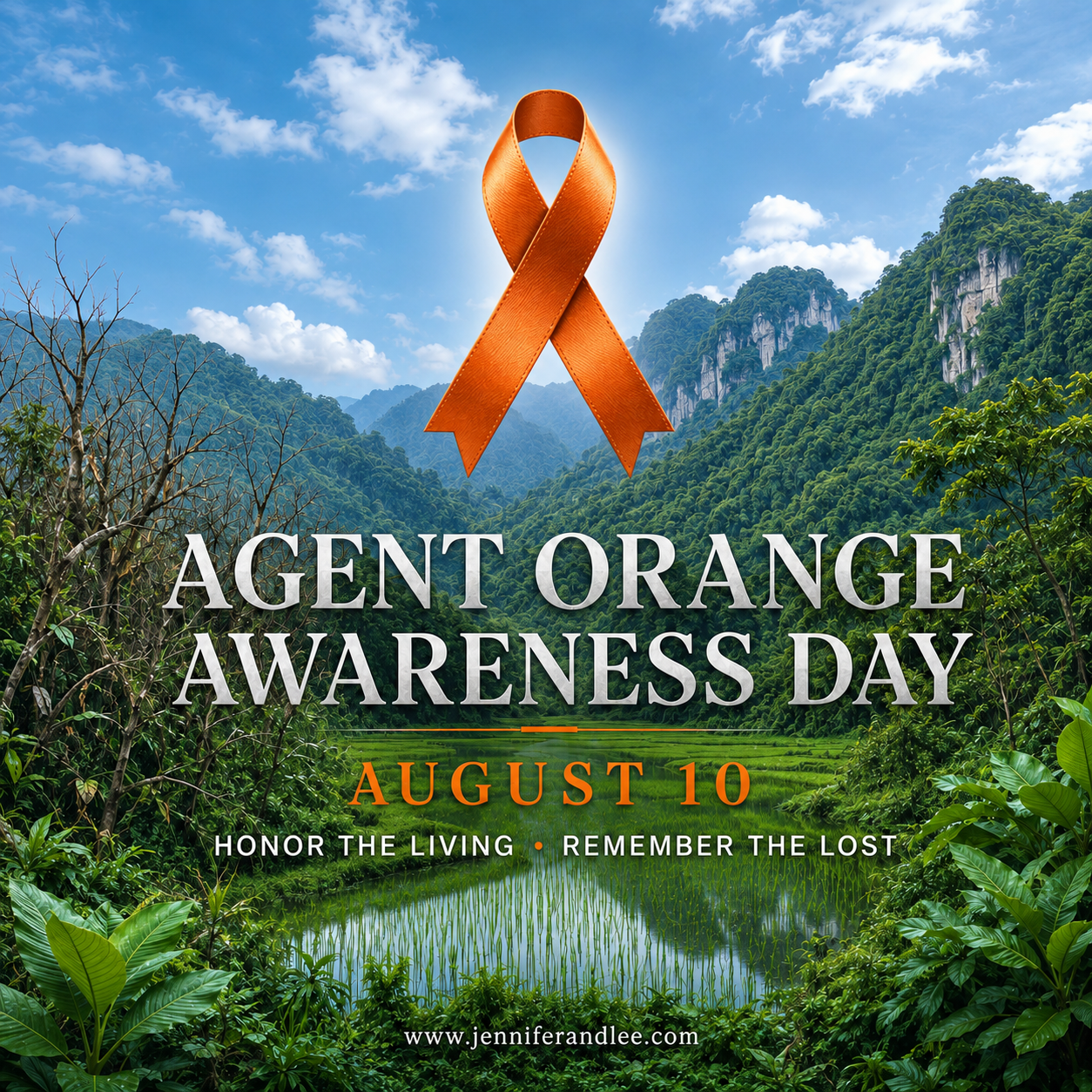
From Vietnam to the burn pits of Iraq to contaminated military installations here at home, toxic exposure is a debt our nation still has not fully paid.
Copyrighted By Jennifer and Lee Norris | August 10, 2026
Every August 10, we honor Agent Orange Awareness Day—and in Vietnam, the Day for Victims of Agent Orange/Dioxin. We remember American veterans who returned home carrying illnesses they could not explain. Just as importantly, we must center the Vietnamese people who never left the contaminated land: the civilians, farmers, families, caregivers, and children whose lives were altered by a chemical war they did not choose.
This day should not be reduced to a flag, a ribbon, or a passing acknowledgment. It should make us stop and face a painful truth: the war ended, but the exposure did not. The chemicals entered bodies, soil, water, food chains, families, and future generations. The consequences outlived the military mission.
As Americans, we can love our country while telling the truth about what our country did. In fact, love without truth is not accountability. It is avoidance.
The date directly associated with Agent Orange remembrance in Vietnam is August 10.
Vietnam recognizes August 10 as the Day for Victims of Agent Orange/Dioxin because it marks the beginning of the herbicide disaster in 1961. In 2026, Vietnam is observing its 65th anniversary.
The rights to life, health, dignity, truth, and an effective remedy do not disappear when a war ends.
What Is Agent Orange? | History
The Day the Poison Entered History
Between 1961 and 1971, the U.S. military sprayed enormous quantities of tactical herbicides across southern Vietnam to strip leaves from forests, destroy crops, and remove vegetation that could provide cover. Agent Orange was the most widely used of the so-called “rainbow herbicides.” It was a mixture of 2,4-D and 2,4,5-T; the latter was contaminated during manufacturing with TCDD, a particularly toxic form of dioxin.
The National Academies has reported that the U.S. Air Force sprayed nearly 19 million gallons of herbicides during Operation Ranch Hand, including at least 11 million gallons of Agent Orange. Additional herbicides were applied from helicopters, trucks, boats, and backpack equipment.
Dioxin is not an ordinary battlefield residue. The Environmental Protection Agency describes dioxins as persistent pollutants that break down very slowly, accumulate in food chains, and can cause cancer, reproductive and developmental problems, immune-system damage, and hormonal disruption.
Vietnamese estimates place the number of people exposed at approximately 4.8 million. Millions are still living with illnesses, congenital disabilities, and long-lasting effects attributed to the contamination. Estimates and individual medical conclusions can vary, but the scale of the spraying, the persistence and toxicity of dioxin, and the suffering of affected communities are not matters we can morally wave away.
Behind every statistic is a person.
A mother caring for a child with profound disabilities. A farmer whose land and food supply were contaminated. A veteran who developed disease decades after coming home. A family still searching for recognition while carrying medical, emotional, and financial burdens across a lifetime.
They are not collateral history. They are human beings.
The Toxic Impact of Agent Orange: Child Victims of the US Chemical Warfare in Vietnam | Documentary
Vietnam’s People Deserve More Than Our Sympathy
On Agent Orange Awareness Day, Americans often—and rightly—honor U.S. Vietnam veterans. Their government took far too long to recognize illnesses connected to herbicide exposure. Many died before the country acknowledged what had happened to them.
But our compassion cannot stop at the American shoreline.
Vietnamese civilians were exposed where they lived, farmed, gathered food, raised children, and built communities. They did not return from the battlefield because the battlefield was their home. Some former air bases remain dioxin hot spots. Families and caregivers continue to live with the human consequences.
The United States has funded important remediation and disability-assistance work in Vietnam, including cleanup projects at Da Nang and Bien Hoa. Those efforts matter. They should be recognized and continued. But cleanup and humanitarian assistance that began decades after the spraying are not the same as a complete reckoning, comprehensive care, or full repair.
We should be capable of holding two truths at once: progress has been made, and the response is still not equal to the harm.
The people of Vietnam deserve more than pity. They deserve sustained cleanup, health care, rehabilitation, support for caregivers, independent research, transparency, and a lasting American commitment that does not change with political convenience. Above all, they deserve to be spoken about with love and human dignity—not as an uncomfortable footnote to an American war story.
The Dark Shadow of Agent Orange | Retro Report | The New York Times
The Veterans Who Carried Vietnam Home
For years, Vietnam veterans reported cancers, diabetes, Parkinson’s disease, heart disease, neuropathy, reproductive concerns, and other illnesses while facing a system that demanded proof many could not provide. The exposure records had not been designed around their future health. The science developed slowly. Government recognition came later still.
Today, the Department of Veterans Affairs recognizes more than twenty presumptive conditions associated with Agent Orange and other tactical herbicides. The PACT Act added hypertension and monoclonal gammopathy of undetermined significance and expanded qualifying locations and access to care.
Those changes are meaningful. Presumptions matter because they shift an impossible burden away from a sick veteran. A person who served in a qualifying place and later developed a recognized illness should not have to reconstruct every breath, meal, water source, duty location, and chemical contact from decades earlier.
But we should remember why presumptions became necessary: exposure monitoring and recordkeeping were inadequate when they mattered most.
From Agent Orange to the Burn Pits of Iraq
Agent Orange and burn-pit smoke are not the same exposure, and we should not pretend they are. Agent Orange was a tactical herbicide contaminated with dioxin. Burn pits created complex airborne mixtures by openly burning solid waste, medical waste, hazardous materials, plastics, fuel, and other refuse.
The common thread is institutional—not chemical.
In Iraq and Afghanistan, service members lived and worked near open-air pits used to dispose of waste by fire. Smoke drifted through living quarters and work areas. Many veterans later reported breathing problems, cancers, headaches, fatigue, and other chronic conditions. Again, people struggled to document the dose they had received. Again, the absence of perfect exposure data was too often treated as evidence that the exposure did not matter.
A large VA-led study of more than 459,000 Army and Air Force veterans who deployed to Iraq or Afghanistan found that longer burn-pit exposure was associated with increased risks of asthma, chronic obstructive pulmonary disease, ischemic stroke, and high blood pressure. For every 100 days of documented exposure, researchers found a 1% higher risk of asthma, a 4% higher risk of COPD, and a 5% higher risk of ischemic stroke.
The PACT Act of 2022 was a landmark response. It expanded VA health care, established additional presumptive conditions, and connected the experiences of Vietnam, Gulf War, and post-9/11 veterans within a broader toxic-exposure framework.
There is painful symbolism in the date: the PACT Act was signed into law on August 10, 2022—the same day on which Vietnam remembers the beginning of the Agent Orange disaster. Sixty-one years after the first spraying, the United States enacted its broadest toxic-exposure veterans law. That is progress, but the time between those two August 10 dates shows how long poisoned communities can be forced to wait.
That law is an achievement born from years of advocacy by sick veterans, surviving families, and people who refused to be dismissed. Yet benefits after illness are not a substitute for preventing exposure, documenting it in real time, warning service members promptly, or providing early medical evaluation.
Vietnam should have taught us that. Iraq proved we had not fully learned it.
How “burn pits” in Iraq and Afghanistan may have put veterans at risk
Toxic Exposure Does Not Require a Foreign Battlefield
The same pattern can appear here in the United States, at the installations where people train, work, sleep, eat, and drink the water.
This is where Agent Orange Awareness Day becomes deeply personal for me.
I served from 2001 through 2005 with the 267th Combat Communications Squadron at Joint Base Cape Cod, formerly known as the Massachusetts Military Reservation. I arrived believing what most service members believe: that the installation supporting our mission was also protecting the people assigned there.
Instead, my life changed.
During and after my service, I developed a complicated combination of neurological and physical symptoms that took more than two decades to understand. My military career ended prematurely. I lived with chronic illness, cognitive impairment, brain inflammation, pain, weakness, and symptoms that were repeatedly misunderstood. Too often, the existence of PTSD or trauma became an easy explanation for physical problems that deserved a much deeper investigation.
Specialized testing later identified chronic toxic-metal exposure involving lead, antimony, and uranium. Those findings finally gave me part of the medical picture that had been missing while my health deteriorated.
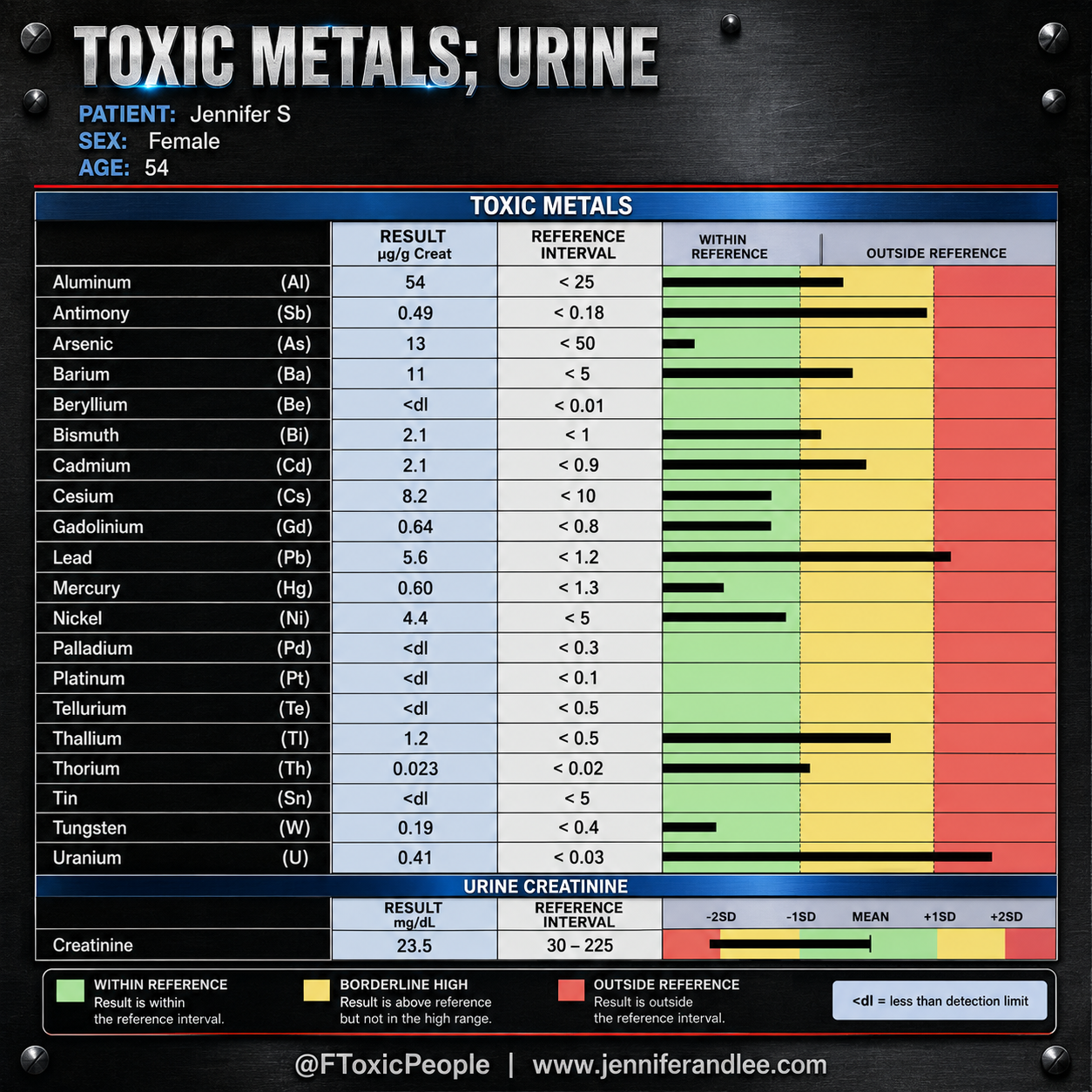
The government’s own environmental record confirms that Joint Base Cape Cod has an extensive contamination history. The EPA says the 22,000-acre installation sits over a sole-source aquifer that supplies drinking water to Cape Cod. Fuel spills, military training, disposal practices, landfills, fire-training activities, munitions, and other past operations contaminated portions of the groundwater and soil. Otis Air National Guard Base was added to the Superfund National Priorities List in 1989. Cleanup and groundwater treatment continue today.
EPA’s response at Camp Edwards was extraordinary. In 1997, the agency halted most military training—including the use of live explosives, propellants, flares, and lead bullets—because of environmental and public-health concerns. EPA later described evidence of serious soil and groundwater contamination involving military munitions and hazardous materials.
The public record establishes the contamination history. It does not reconstruct every route, dose, or moment of my individual exposure—and that missing information is part of the problem. Service members should never have to solve a decades-old environmental mystery after they become sick. Our exposures should have been monitored when we served. Our symptoms should have been taken seriously when we first reported them.
I wrote more about this history and my service in The History of Camp Edwards and Otis Air Force Base: From World War II Training to Joint Base Cape Cod.
My experience is not identical to that of a Vietnamese civilian, a Vietnam veteran, or an Iraq veteran exposed to burn-pit smoke. I would never erase those differences. But I recognize the institutional pattern: exposure first, illness later, uncertainty used against the sick, and acknowledgment arriving only after years of human suffering.
If Agent Orange Awareness Day is to mean something, remembrance must lead to action.
What Real Accountability Would Look Like
Real accountability would include:
- Completing and sustaining dioxin cleanup in Vietnam while expanding health, rehabilitation, caregiver, and disability assistance for affected communities.
- Preserving strong presumptive benefits and accessible health care for U.S. Vietnam veterans, post-9/11 veterans, survivors, and eligible family members.
- Creating lifelong exposure records for every service member, including duty locations, known contaminants, monitoring data, and potential pathways of exposure.
- Testing military installations proactively and disclosing hazards quickly to service members, civilian workers, veterans, families, and surrounding communities.
- Funding independent long-term research rather than waiting for sick people to produce impossible proof on their own.
- Training clinicians to consider toxic exposure alongside PTSD, traumatic brain injury, and other diagnoses instead of allowing one condition to eclipse every other possibility.
- Treating uncertainty as a reason to investigate and protect—not as permission to dismiss.
- Making the polluter and the institution responsible for the evidence, cleanup, care, and follow-through.
How Agent Orange Terrified U.S. Soldiers in the Vietnam War…
A Promise on Agent Orange Awareness Day
Today, I am thinking about the people of Vietnam with love.
I am thinking about elders who have carried pain for more than six decades, children and adults living with profound disabilities, families providing care with limited resources, and advocates who continue asking the world not to look away.
I am thinking about American Vietnam veterans who came home to a country unprepared—or unwilling—to understand what had followed them home. I am thinking about the Iraq and Afghanistan veterans who breathed burn-pit smoke and then had to fight for recognition. I am thinking about those of us exposed at military installations inside the United States, where danger was easier to overlook because it’s invisible and we were not standing on a foreign battlefield.
None of these communities should have to compete for compassion.
We want America to become worthy of the people who served it—and responsible to the civilians harmed by its decisions.
The most patriotic response to a preventable tragedy is not silence. It is truth, repair, and a promise that we will stop repeating the same pattern under a different name.
On Agent Orange Awareness Day, may we honor the dead, care for the living, listen to the sick, and stand with the Vietnamese people whose suffering has lasted far too long.
The war ended.
The responsibility did not.
The People vs Agent Orange | Official Trailer | Independent Lens | PBS
Sources
- 65 Years Since Agent Orange Disaster in Việt Nam: From Pain to Solidarity — Viet Nam News, August 4, 2026.
- The U.S. Military and the Herbicide Program in Vietnam — National Academies/Institute of Medicine historical review of Operation Ranch Hand and herbicide use.
- Veterans and Agent Orange: Update 11 (2018) — National Academies of Sciences, Engineering, and Medicine.
- Learn About Dioxin — U.S. Environmental Protection Agency.
- Veterans’ Diseases Associated With Agent Orange — U.S. Department of Veterans Affairs.
- The PACT Act and Your VA Benefits — U.S. Department of Veterans Affairs.
- VA Study Documents Health Risks for Burn Pit Exposures — U.S. Department of Veterans Affairs, May 31, 2024.
- Object 100: Iraq Burn Pit — U.S. Department of Veterans Affairs History Office; includes the history of the burn-pit advocacy movement and the August 10, 2022, signing of the PACT Act.
- Otis Air National Guard Base/Camp Edwards Superfund Site Profile — U.S. Environmental Protection Agency.
- U.S. Agent Orange/Dioxin Assistance to Vietnam — Congressional Research Service, May 10, 2017.
- The History of Camp Edwards and Otis Air Force Base: From World War II Training to Joint Base Cape Cod — Jennifer and Lee, July 10, 2026.


One thought on “August 10: Honoring the Victims of Agent Orange and Confronting Institutional Failure (August 10, 2026)”