
Camp Edwards and Otis Air Force Base by Donald J Cann and John J Galluzzo
Images of America: Camp Edwards and Otis Air Force Base in Cape Cod, Massachusetts by Donald J. Cann and John J. Galluzzo (2010)
Book Description:
When land started to run out in central Massachusetts, the state’s National Guard units began to search for sufficient space on which to hold their annual training. They found what they needed on Cape Cod. This land would become Camp Edwards and later the Massachusetts Military Reservation and the Otis Air National Guard Base. When World War II loomed, the reservation became a significant training area for units heading overseas, a proving ground for amphibious operations landing vehicles and equipment, and a major duty station in the lives of thousands of America’s military men and women.
Book Review:
During World War II, what is now Camp Edwards and Otis Field (later Otis Air Force Base) became one of the largest military training centers on the East Coast. Together, the Army and the Army Air Forces trained tens of thousands of personnel before they deployed to Europe and the Pacific.
U.S. Army Training at Camp Edwards
The Army used Camp Edwards to prepare soldiers for nearly every aspect of combat, including:
- Infantry combat training – Basic soldiering, field exercises, weapons qualification, tactical maneuvers, and preparing divisions for overseas deployment.
- Amphibious warfare training – The newly created Engineer Amphibian Command trained soldiers to conduct beach landings using landing craft, rehearsing operations that would later become critical in campaigns such as Normandy and Pacific island assaults.
- Anti-aircraft artillery training – The Anti-Aircraft Artillery Training Center trained more than 40 battalions to defend against enemy aircraft. Soldiers learned to:
- Fire heavy anti-aircraft guns
- Track moving aircraft
- Operate searchlights during nighttime air attacks
- Coordinate air defense operations
- Urban combat training – Camp Edwards built one of the Army’s first mock German villages, allowing troops to practice fighting in streets and buildings before deploying overseas.
- Medical training – The installation operated a large convalescent hospital where wounded soldiers recovered, while more than 2,500 Army nurses received training before serving overseas.
Army Air Forces Training at Otis Field
Before the U.S. Air Force became a separate service in 1947, the U.S. Army Air Forces operated from nearby Otis Field.
Their wartime mission focused primarily on coastal defense and reconnaissance, including:
- Anti-submarine patrols over the Atlantic Ocean searching for German U-boats threatening Allied shipping.
- Aerial reconnaissance missions gathering intelligence along the East Coast.
- Observation squadron operations, where crews practiced aerial surveillance, navigation, communications, and coordination with ground forces.
- Expansion of runways and facilities to support increasingly larger and more advanced military aircraft as the war progressed.
Additional Wartime Roles
Beyond training, the installation also served several other important functions:
- Processing soldiers before deployment overseas.
- Housing German prisoners of war, many captured during the North African campaign.
- Operating one of the Army’s largest East Coast personnel processing centers.
- Serving as a major hospital and rehabilitation center for wounded service members.
Why Camp Edwards Was Important

AI Recreation of Camp Edwards during WWII (Original courtesy of Joint Base Cape Cod)
Camp Edwards was essentially a full-scale rehearsal ground for World War II.
Soldiers practiced:
- Beach invasions
- Anti-aircraft defense
- Urban combat
- Infantry tactics
- Coastal surveillance
- Reconnaissance operations
- Large-scale combined-arms exercises
Many of the techniques perfected there were later used during major Allied operations in Europe and the Pacific. By the end of the war, the installation had become one of the Army’s premier training centers before transitioning into the Cold War missions that eventually defined Otis Air Force Base.
During World War II, live ammunition was routinely fired at Camp Edwards, and there is evidence that explosives and ordnance were used extensively on the installation.
Live-fire weapons training
The Army conducted extensive live-fire training, including:
- Rifles and machine guns
- Pistols
- Mortars
- Artillery
- 90 mm anti-aircraft guns
- 40 mm anti-aircraft guns
- Searchlight and anti-aircraft firing exercises
Anti-aircraft units actually fired at targets towed behind aircraft to simulate attacking enemy planes.
Artillery and explosives
The base’s Central Impact Area was used as the primary target area for:
- Artillery shells
- Mortar rounds
- Hand grenades
- Rockets
- Small-arms ammunition
Military environmental investigations later documented that these decades of firing left residues of explosive compounds such as RDX, HMX, and perchlorate in soil and groundwater, requiring extensive cleanup efforts.
Why this matters today
This history is important because decades of military training left behind contaminants. Environmental investigations at the base have documented contamination associated with historical military activities, including:
- Explosive residues (RDX, HMX, perchlorate)
- Metals associated with ammunition and munitions
- Unexploded ordnance in some training areas
These findings led to the installation being the focus of long-term environmental investigation and cleanup.
Timeline of Military Training at Camp Edwards & Otis Field (Joint Base Cape Cod)

AI Recreation of an inspection at Otis Field, Camp Edwards, Massachusetts during World War II (NARA)
1935–1940: Building the Installation
- Massachusetts acquires approximately 22,000 acres for a new military reservation.
- Massive construction project creates Camp Edwards and Otis Field.
- Runways, barracks, roads, warehouses, motor pools, and firing ranges are built in preparation for World War II.
1941: America Prepares for War
Army
- 26th “Yankee” Infantry Division begins training.
- Infantry field exercises.
- Rifle qualification.
- Machine gun training.
- Mortar instruction.
- Field maneuvers.
Army Air Forces
- 101st Observation Squadron moves to Otis Field.
- Coastal reconnaissance begins.
- Aircraft navigation and surveillance training.
December 1941
Pearl Harbor
Training accelerates dramatically.
Thousands of soldiers preparing for deployment rotate through Camp Edwards.
1942: The Base Reaches Full Wartime Operations
Infantry Training
Soldiers train with:
- M1 Garand rifles
- Thompson submachine guns
- Browning Automatic Rifles (BAR)
- .30 and .50 caliber machine guns
- Hand grenades
- Mortars
Live ammunition is routinely fired.
Artillery Training
Large firing ranges are established.
Training includes:
- Field artillery
- Mortars
- Anti-aircraft guns
- Heavy weapons
Thousands of live rounds are fired.
Anti-Aircraft Artillery School
One of the busiest training centers in America.
More than 42 anti-aircraft battalions train here.
Weapons include:
- 40 mm Bofors guns
- 90 mm anti-aircraft guns
- Searchlights
- Radar-assisted targeting
Crews fire live ammunition at targets being towed behind aircraft.
Amphibious Warfare School
Camp Edwards becomes one of America’s first amphibious warfare schools.
Troops practice:
- Beach landings
- Landing craft operations
- Loading tanks
- Ship-to-shore assaults
Exercises occur on Cape Cod beaches and Martha’s Vineyard.
Many soldiers later participate in:
- Sicily
- Salerno
- Normandy
- Pacific Island campaigns
Urban Combat
The Army builds one of its first mock German villages.
Troops practice:
- Clearing buildings
- Street fighting
- Urban assault tactics
1942–1943
Army Air Forces Mission
Otis Field supports:
- Anti-submarine patrols
- Atlantic convoy protection
- Reconnaissance flights
- Aircraft gunnery practice
- Coastal surveillance
The 14th Anti-Submarine Squadron flies patrols searching for German U-boats off the Atlantic coast.
1942–1944
Medical Mission
Camp Edwards becomes home to:
- Large convalescent hospital
- Wounded soldier rehabilitation
- Army nurse training
More than 2,500 nurses train before deployment.
1943–1945
German Prisoner of War Camp
German POWs from North Africa are housed on the installation.
Many work:
- Farms
- Cranberry bogs
- Lumber operations
- Base maintenance
1944
The anti-aircraft school relocates.
Camp Edwards remains active as:
- Hospital
- Processing center
- Training installation
By this time, the installation covers more than 21,000 acres.
After World War II
Korean War (1950–1952)
Training resumes at levels approaching WWII.
Live-fire exercises continue.
Cold War (1950s–1980s)
Training expands to include:
- Tanks
- Rockets
- Demolition ranges
- Mortars
- Artillery
- Machine guns
- Helicopters
- Chemical training
- Engineer demolitions
Environmental investigations later identified contamination associated with historical training, including former gun and mortar firing positions, the Central Impact Area, demolition areas, and residues from explosives such as RDX, HMX, TNT, and perchlorate.
Long-Term Environmental Legacy
More than four decades of military training left contaminants associated with ammunition, explosives, fuels, and industrial activities. Investigations at what is now Joint Base Cape Cod have documented concerns involving:
- Heavy metals from munitions
- Lead from bullets and primers
- Antimony used in ammunition
- Copper and zinc from bullet jackets and cartridge cases
- Explosive compounds (RDX, HMX, TNT)
- Perchlorate from propellants
- Petroleum products and solvents
- Unexploded ordnance in some former training areas
These findings prompted one of the nation’s largest long-term military environmental investigation and cleanup programs.
Summary
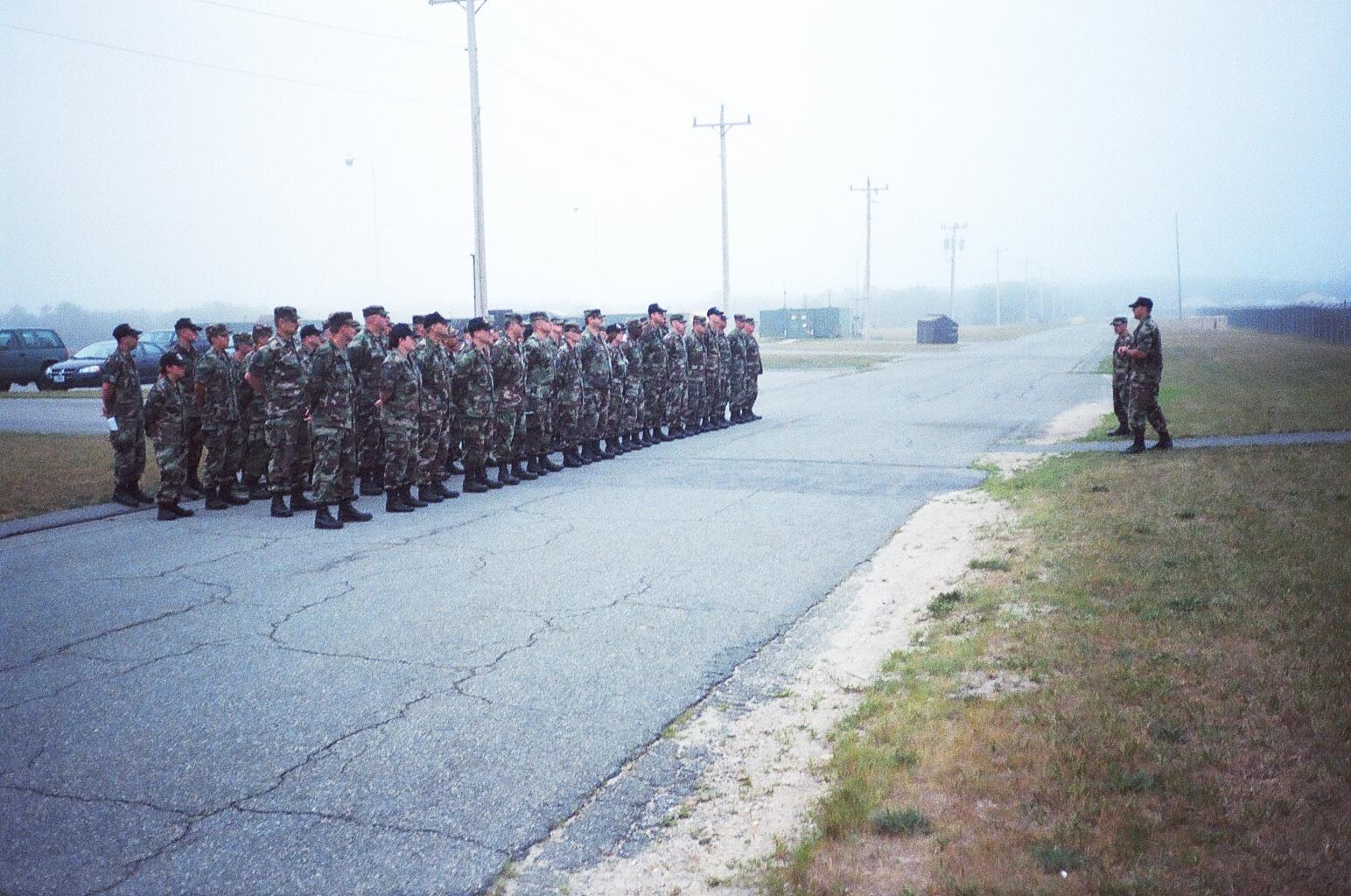
267th Combat Communications Squadron formation, Joint Base Cape Cod (2005)
History of Camp Edwards and Otis Air Force Base in Cape Cod, Massachusetts by Donald J. Cann and John J. Galluzzo chronicles the evolution of one of New England’s most significant military installations. Beginning with its origins as Camp Edwards in the 1930s, the book follows its expansion during World War II, its transformation into Otis Air Force Base during the Cold War, and its eventual evolution into what is now known as Joint Base Cape Cod. Over the decades, the installation has trained hundreds of thousands of service members while supporting missions critical to the defense of the United States.
For me, this history is deeply personal.
I served at Joint Base Cape Cod from 2001 through 2005 as a member of the 267th Combat Communications Squadron. Like thousands of other Airmen, I reported for duty believing I was serving my country at a military installation dedicated to readiness, teamwork, and national defense.
Instead, my life changed forever.
During and after my service, I developed a complex combination of neurological and physical symptoms that would take more than two decades to fully understand. I was eventually found to have chronic toxic metal exposure involving lead, antimony, and uranium, along with other environmental health issues that contributed to brain inflammation and long-term illness. For years, I searched for answers while my health deteriorated, unaware that toxic exposures could be contributing to what I was experiencing.
The consequences extended far beyond my physical health. My military career ended prematurely, and I spent years navigating chronic illness, cognitive impairment, PTSD, and the frustration of trying to identify the cause of symptoms that many people did not understand.
Today, as my health continues to improve through specialized medical treatment, I have dedicated my work to educating others about military toxic exposures, institutional betrayal, and the importance of recognizing environmental hazards that can affect service members long after they leave the military.
The history of Camp Edwards and Otis Air Force Base is not only a story of military service and national defense—it is also part of the history of the men and women who trained and served there. My experience is one chapter in that continuing story, and I hope that by sharing it, future generations of service members will receive earlier recognition, better healthcare, and greater accountability when environmental hazards threaten the health of those who volunteer to serve.
Sources
- Camp Edwards History (Published July 2026)
Massachusetts Army National Guard. Comprehensive history of Camp Edwards, including WWII mobilization, anti-aircraft training, amphibious warfare, the convalescent hospital, POW camp, and processing center. - Camp Edwards Training Site – About Us – History (Accessed July 2026)
Official Camp Edwards history page maintained by the Massachusetts Army National Guard. - An Overview of Joint Base Cape Cod (Accessed July 2026)
Overview of the installation’s history, military missions, environmental stewardship, and current operations. - A Brief History of Joint Base Cape Cod (Accessed July 2026)
Historical timeline of Camp Edwards, Otis Field, and Joint Base Cape Cod from the 1930s through the present. - Camp Edwards (Wikipedia) (Accessed July 2026)
Background reference summarizing Camp Edwards’ history and providing links to additional primary sources.
Environmental Resources
- EPA Superfund Program
- EPA Superfund Site Search
- Department of Defense Environmental Restoration Program (DERP)
- U.S. Army Corps of Engineers Formerly Used Defense Sites (FUDS) Program
- Joint Base Cape Cod Impact Area Groundwater Study Program
Related Links:
New York Times: The Army Thought He Was Faking His Health Issues. Turns Out He Had Chronic Lead Poisoning. (April 3, 2019)
Why Are Military Women Affected by Toxic Exposure More than Men? – Women’s eNews (April 14, 2022)
After Lead Poisoning Symptoms Dismissed by PTSD Diagnosis, It Results in Brain Inflammation, Fatigue, Muscle Weakness, Digestion Issues & Chronic Pain (2024)
I Watched My Father Die From a Brutal & Painful Battle with Terminal Bone Cancer… And My Toxic Military Leadership Kicked Me While I Was Down (2024)
NBC News: Veterans Wait 30 Years on Average for the U.S. to Acknowledge Toxic Exposures (September 18, 2024)
Dear Mass Air National Guard, You Poisoned Me With Lead… But You Already Knew That (2025)
From Weapons to Wounds: The Toxic Legacy of World War II’s Strategic Metals Behind Every Bullet, Tank, and Bomber (June 28, 2026)


