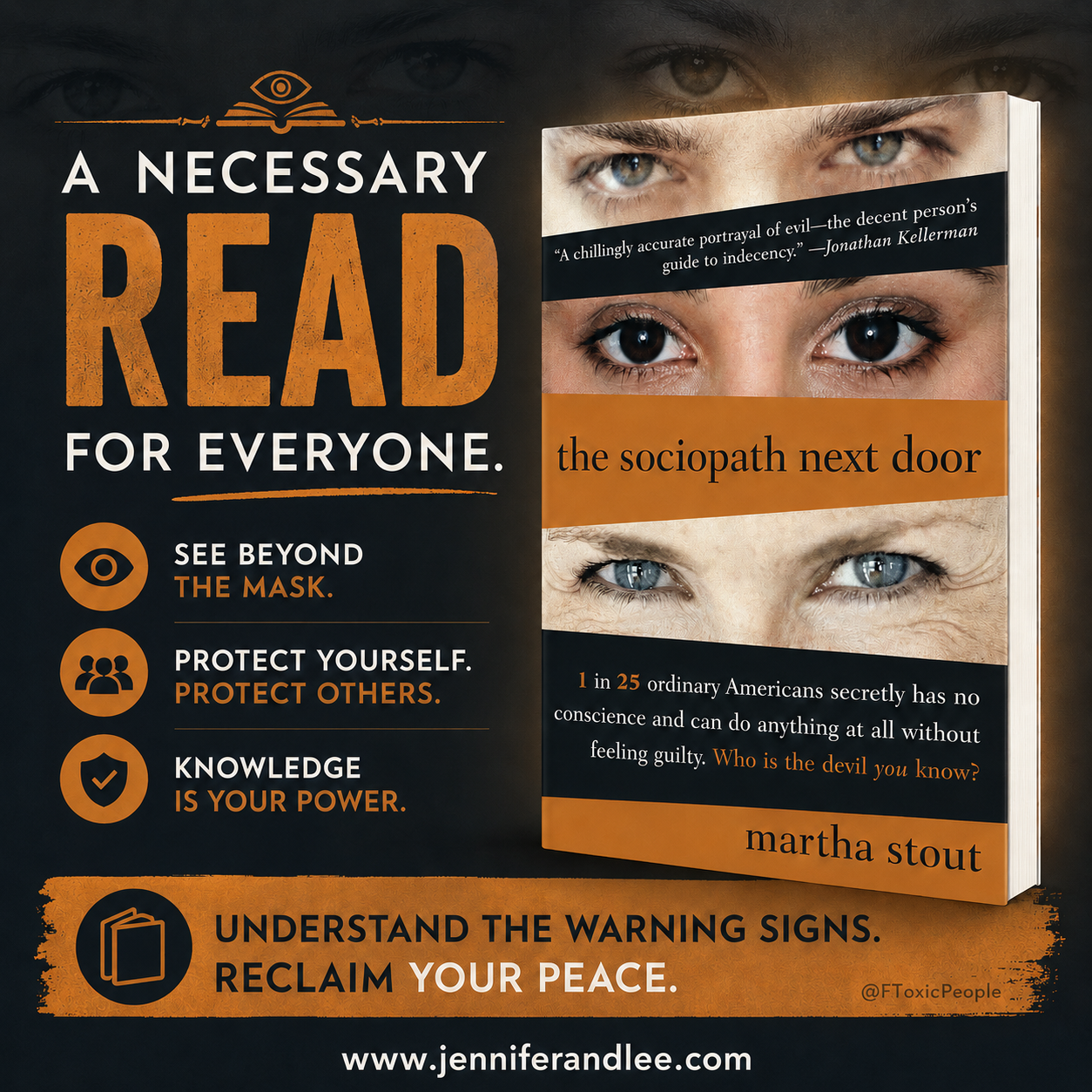
Order here: The Sociopath Next Door by Martha Stout, Ph.D.
Book: The Sociopath Next Door
Author: Martha Stout, Ph.D.
Originally published: 2005
Genre: Psychology, human behavior, personal safety
Summary of Amazon Book Description: In The Sociopath Next Door, Martha Stout explains how sociopaths can hide behind charm, intelligence, charisma, and apparent sincerity while exploiting others without empathy, guilt, or remorse. Through compelling character portraits, she reveals common warning signs of antisocial personality disorder and offers 13 practical rules for self-protection, including the “rule of threes” for recognizing habitual deception. Ultimately, Stout argues that although sociopaths may achieve status or material success, their lives lack the genuine love, joy, and meaningful connection that make life worthwhile.
The Ruthless Versus the Rest of Us
We have been taught to look for predators in dark alleys, criminal records, and disturbing news reports. We expect dangerous people to look dangerous.
But what if the predator is already inside the circle?
What if they are standing beside us at the neighborhood barbecue, telling funny stories, charming our friends, complimenting the children, and quietly collecting information about everyone’s vulnerabilities?
That is the disturbing—and necessary—warning at the center of Martha Stout’s The Sociopath Next Door. The book challenges one of our most comforting assumptions: that everyone has a conscience somewhere inside them.
According to Stout, some people do not.
The Most Dangerous People May Look Completely Ordinary
Stout, a clinical psychologist and former Harvard Medical School instructor, does not focus primarily on serial killers or visibly violent criminals. Instead, she examines people who move through ordinary life appearing charming, respectable, helpful, or even admirable.
They may be coworkers, supervisors, spouses, neighbors, volunteers, community leaders, authority figures, or members of our own families.
That is what makes the book so unsettling. The danger is not necessarily hiding in the shadows. It may be wearing a uniform, carrying an impressive title, hosting the party, leading the organization, or convincing everyone they are the victim.
In an interview about the book, Stout explained that the typical person she describes is not physically violent and does not resemble a recognizable villain. Such people often look entirely normal and may be unusually skilled at appearing charismatic, exciting, competent, or trustworthy.
This is where the predator at the barbecue thrives: not outside the group, but safely inside it.
The Book’s Central Warning: Some People Do Not Play by Our Moral Rules
Most conscientious people assume that others experience guilt, attachment, empathy, and remorse in roughly the same way they do.
We project our own humanity onto other people.
When someone hurts us, we search for an explanation that preserves our belief in their goodness. Perhaps they were stressed. Perhaps they misunderstood. Perhaps they had a difficult childhood. Perhaps we did something to provoke them. Perhaps they will understand the damage if we explain it one more time.
Stout’s book warns that this instinct can become a trap.
A person who feels no meaningful remorse does not interpret forgiveness as an invitation to change. They may interpret it as proof that the same person can be exploited again. Compassion becomes access. Loyalty becomes leverage. Privacy becomes intelligence. Second chances become additional opportunities.
This does not mean kindness is foolish. It means kindness without boundaries can be dangerous when it is offered to someone who repeatedly weaponizes it.
11 Signs Of A Sneaky Sociopath
Why Charming Predators Are So Difficult to Recognize
Our article, “11 Signs of a Sociopath: How to Spot the Red Flags,” identifies behaviors that can appear in exploitive personalities:
- Superficial charm
- Chronic or strategic lying
- Manipulation
- Shallow emotional displays
- Lack of empathy
- Absence of remorse
- Impulsivity
- Risk-taking
- Aggression or hostility
- A constant need for stimulation
- Relationships built around personal gain
No single behavior proves that someone has a personality disorder. Plenty of ordinary people can be selfish, dishonest, impulsive, or emotionally immature at times. The warning appears in the persistent pattern—especially when charm, deception, exploitation, and lack of remorse repeatedly occur together.
The most revealing question is not simply, “Is this person charming?”
It is: What consistently happens to the people who trust them?
Do relationships leave behind confusion, humiliation, financial loss, damaged reputations, fractured families, or exhausted people questioning their own reality? Does the individual repeatedly emerge untouched while everyone else carries the consequences? Do apologies lead to changed behavior, or merely reset the cycle?
Patterns tell us far more than promises.
The Pity Play: Turning Our Compassion Against Us
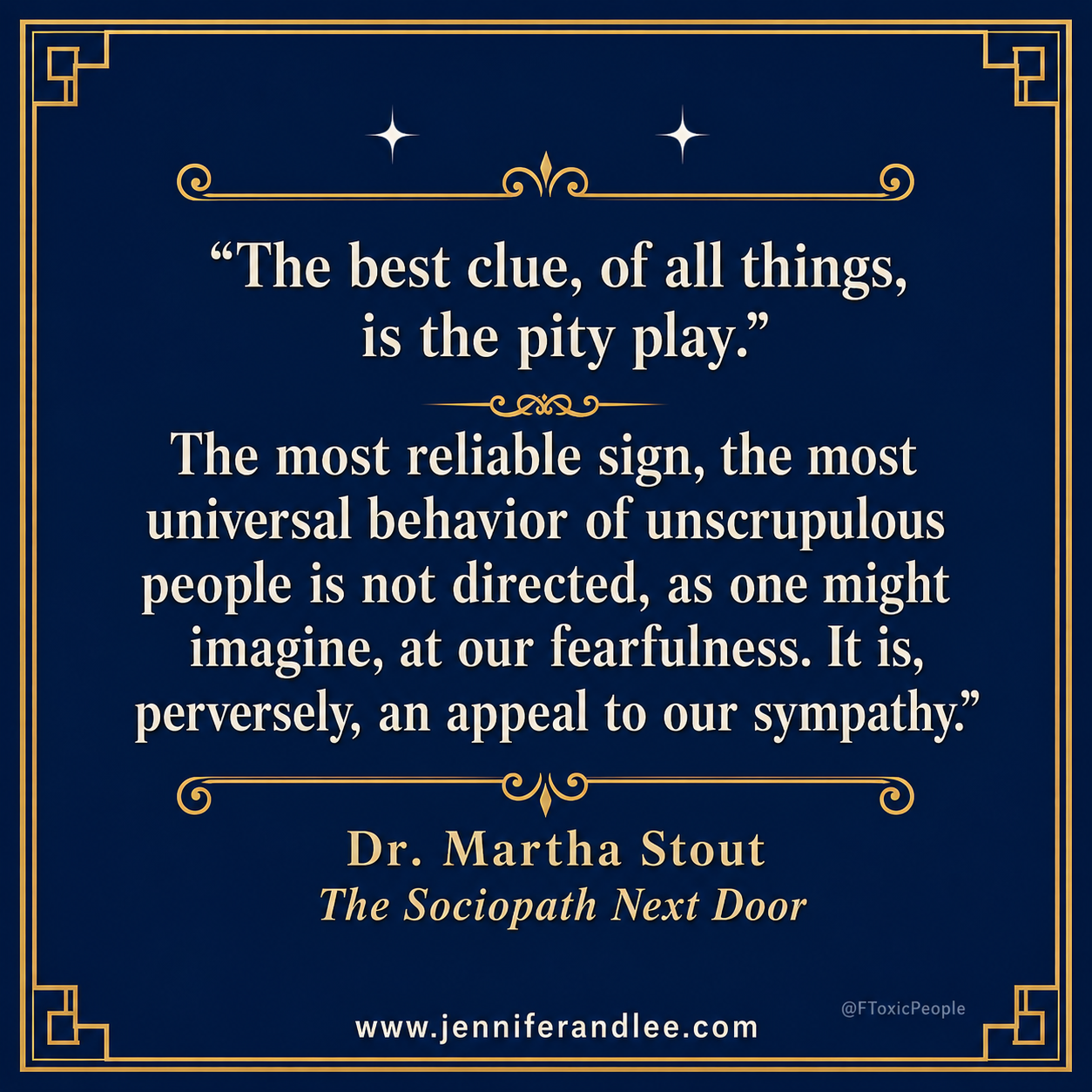
One of Stout’s most important insights concerns what she calls the pity play.
We often imagine that predatory people control others through intimidation. Some do. But others discover that sympathy is an even more effective weapon.
They present themselves as misunderstood, persecuted, mistreated, abandoned, jealous of no one, and responsible for nothing. When confronted about the harm they caused, they quickly introduce their own suffering. The conversation shifts away from their conduct and toward the unfairness they supposedly endured.
Soon, the injured person is comforting the person who injured them.
This tactic is especially effective against conscientious people because they do not want to be cruel. They fear misjudging someone, abandoning someone in pain, or becoming like the person who hurt them.
Stout’s warning is not that we should stop feeling compassion. It is that we must examine whether someone is repeatedly using our compassion to avoid responsibility.
Real suffering does not give anyone permission to continually harm other people.
Why Good, Loyal People Can Become Preferred Targets
Stout also makes an observation that many survivors need to hear: being manipulated does not mean someone was unintelligent or weak.
In her interview, she explained that capable, loyal, and principled people can be attractive targets because they possess resources, credibility, persistence, and a strong desire to do the right thing. Their loyalty may keep them invested long after the evidence says they should leave.
Predators do not only look for gullible people. They often look for useful people.
They search for the person who will work harder, forgive longer, defend them publicly, share contacts, provide money, lend credibility, protect their secrets, or keep trying to solve a relationship that was never operating in good faith.
That is one reason this book is so important for advocates, veterans, public servants, volunteers, trauma survivors, and anyone whose identity is built around loyalty and helping others. Those qualities are strengths—but they require gates.
The Book’s Practical Value
The Sociopath Next Door does more than describe destructive behavior. It encourages readers to accept several uncomfortable but protective truths:
- Titles, uniforms, credentials, popularity, and moral language do not prove that someone has integrity.
- Repeated lying is meaningful evidence.
- Charm should never outweigh conduct.
- Sympathy should not erase accountability.
- We do not have to participate in every conflict or psychological game someone creates.
- Distance is sometimes more effective than confrontation.
- We do not need a clinical diagnosis before protecting ourselves.
This last point matters. You may never know whether a destructive person meets the criteria for a particular disorder. You do not need to know.
If someone repeatedly lies, violates boundaries, exploits vulnerabilities, retaliates against accountability, and harms people without meaningful remorse, that behavior is enough to justify caution.
An Important Clinical Clarification
The book’s language should be read with some care.
“Sociopath” and “psychopath” are widely used cultural and psychological terms, but they are not independent medical diagnoses. The recognized diagnosis is antisocial personality disorder, or ASPD, and it requires a professional evaluation of a longstanding behavioral history.
Stout popularized the estimate that approximately four percent of people—or one in twenty-five—may be sociopathic… but the exact number is unknown and quite frankly could be higher. In the end, Dr. Stout’s book does not teach you to be scared of everyone, it teaches you how to be more responsible: recognize behavioral patterns, protect yourself, and disappear if you think someone is suspect.
Where the Book Needs Some Caution
A fair review should acknowledge that the book can make readers suspicious of nearly everyone.
Publishers Weekly cautioned that its composite cases and survival guidance may sometimes encourage paranoia, while Kirkus Reviews praised its attention to the everyday, seemingly ordinary people who inflict persistent psychological harm.
The correct response is neither denial nor hypervigilance.
We should not label every selfish ex, dishonest coworker, controlling parent, or arrogant supervisor a sociopath. We should also stop dismissing sustained patterns of calculated harm simply because the responsible person is charming, respected, successful, or surrounded by supporters.
The goal is discernment—not paranoia.
Final Verdict
The Sociopath Next Door remains an important and highly readable warning about the limits of empathy when empathy is offered to people who repeatedly exploit it.
Its greatest contribution is not teaching readers how to diagnose strangers. It is teaching good people to stop assuming that everyone is motivated by love, guilt, fairness, or the desire to repair harm.
Some people want connection. Others want control.
Some people enter relationships to build something together. Others enter them to acquire access, status, protection, entertainment, resources, or power.
The predator may not be lurking outside your home. They may already be at the barbecue, laughing with your friends and presenting themselves as the most helpful person in the yard.
Waking up does not mean becoming cold or suspicious of everyone. It means watching patterns, honoring your instincts, setting boundaries, documenting serious misconduct, and refusing to let charm erase evidence.
Keep your compassion.
Just stop handing it to people who repeatedly use it as a weapon against you.
Recommended reading: ★★★★½
Check out The Sociopath Next Door on Amazon.
Why This Book Hit Home for Us
Stout’s warning is not theoretical for us. We encountered people in leadership, advocacy, and authority positions whose behavior reflected many of the patterns described in this book: charm, deception, manipulation, manufactured victimhood, retaliation, and an alarming lack of remorse.
At the time, we were medically retired, disabled Air Force veterans struggling with untreated brain injuries, trauma, and chronic illness. Instead of helping two vulnerable people, certain individuals exploited our condition, controlled the narrative, recruited others, and used their credibility to make us the scapegoats.
We are not clinically diagnosing everyone who harmed us. We are recognizing observable patterns and acknowledging one of our hardest lessons: authority does not equal integrity. A title, uniform, public platform, or reputation cannot create a conscience.
Our experience shows what can happen when predatory behavior is strengthened by institutional power—and why learning to recognize these patterns matters.
One Final Thought:

Related Links:
- The Sociopath Next Door by Martha Stout, P.h.D
- When Image Matters More Than Truth: How Toxic People Control the Narrative and Create Scapegoats to Avoid Accountability (August 5, 2026)
- Lessons We Learned After Being Scapegoated by Toxic Leaders, Authorities and Public Figures (August 6, 2026)
- The Masks Trauma Made Us Wear: How Treatment Helped Us Find Our Confidence Again (August 8, 2026)


