Defense Department struggles to deal with sexual assaults (Government Executive, September 18, 2012)
Editor’s Note
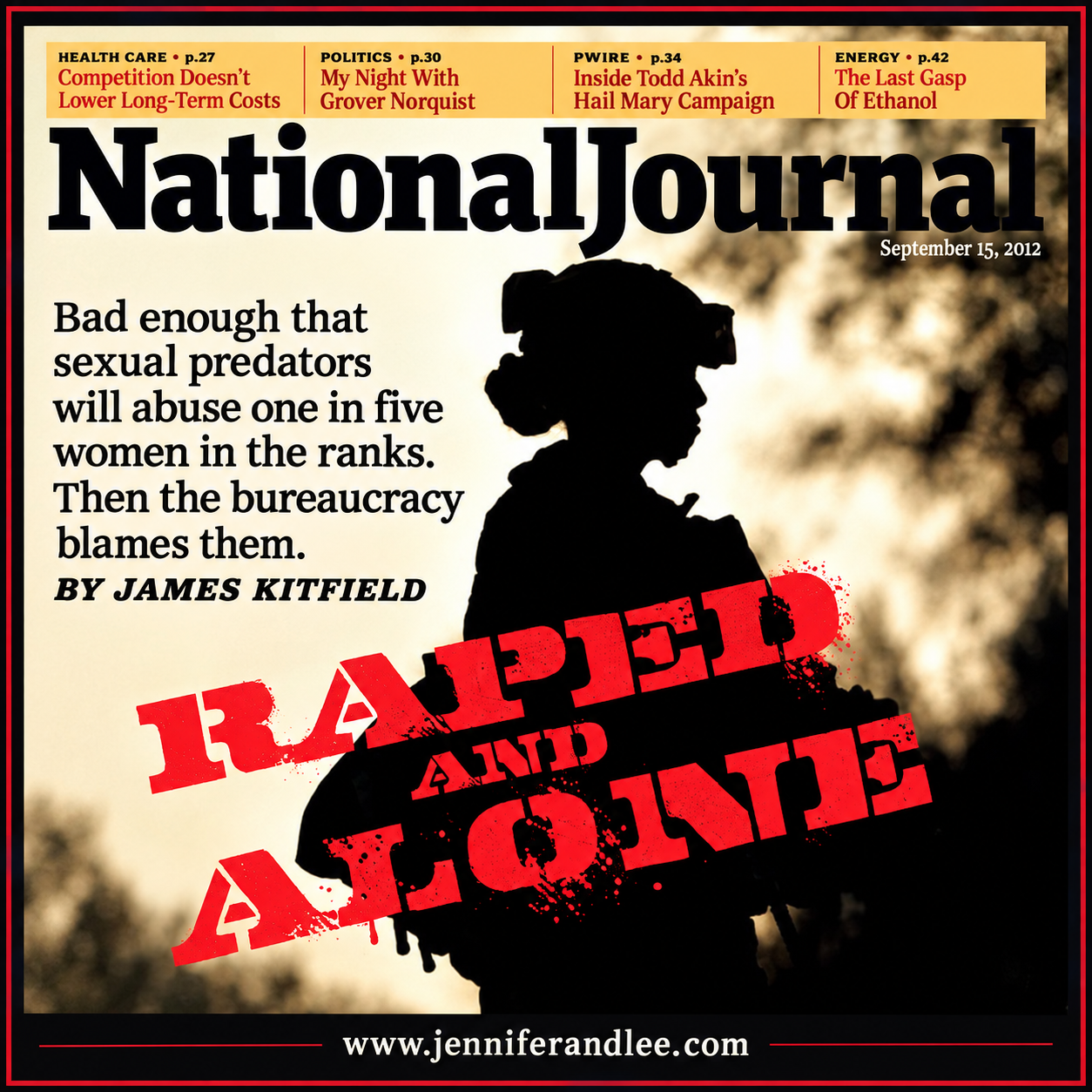
Although National Journal’s reporting examined sexual violence perpetrated against both women and men—and included the experiences of Jennifer Norris and Brian Lewis—the magazine cover framed the crisis exclusively around women. Its cover text declared that sexual predators would abuse “one in five women in the ranks,” leaving male survivors entirely outside the public-facing narrative.
That editorial choice effectively erased Brian from the conversation and reinforced the damaging misconception that military sexual assault is exclusively a women’s issue. Male survivors already face profound barriers to reporting, including shame, disbelief, stigma, and the false belief that men cannot be raped. Excluding them from the cover only helped deepen that silence.
Recognizing the disproportionate risk faced by military women does not require making male survivors invisible. Jennifer’s and Brian’s experiences deserve to be presented together because both reveal the same institutional pattern: sexual offenses followed by disbelief, retaliation, damaging labels, and career consequences.
This article intentionally restores Brian Lewis to the conversation alongside Jennifer Norris. Every survivor deserves to be seen, believed, and included—regardless of gender.
The Enemy Within, National Journal
In September 2012, National Journal placed a stark image of a uniformed service member on its cover beneath three words: “Raped and Alone.”
The article inside, “The Enemy Within” by James Kitfield, examined the military’s sexual-assault crisis through the experiences of survivors, including Air Force veteran Jennifer Norris and Navy veteran Brian Lewis.
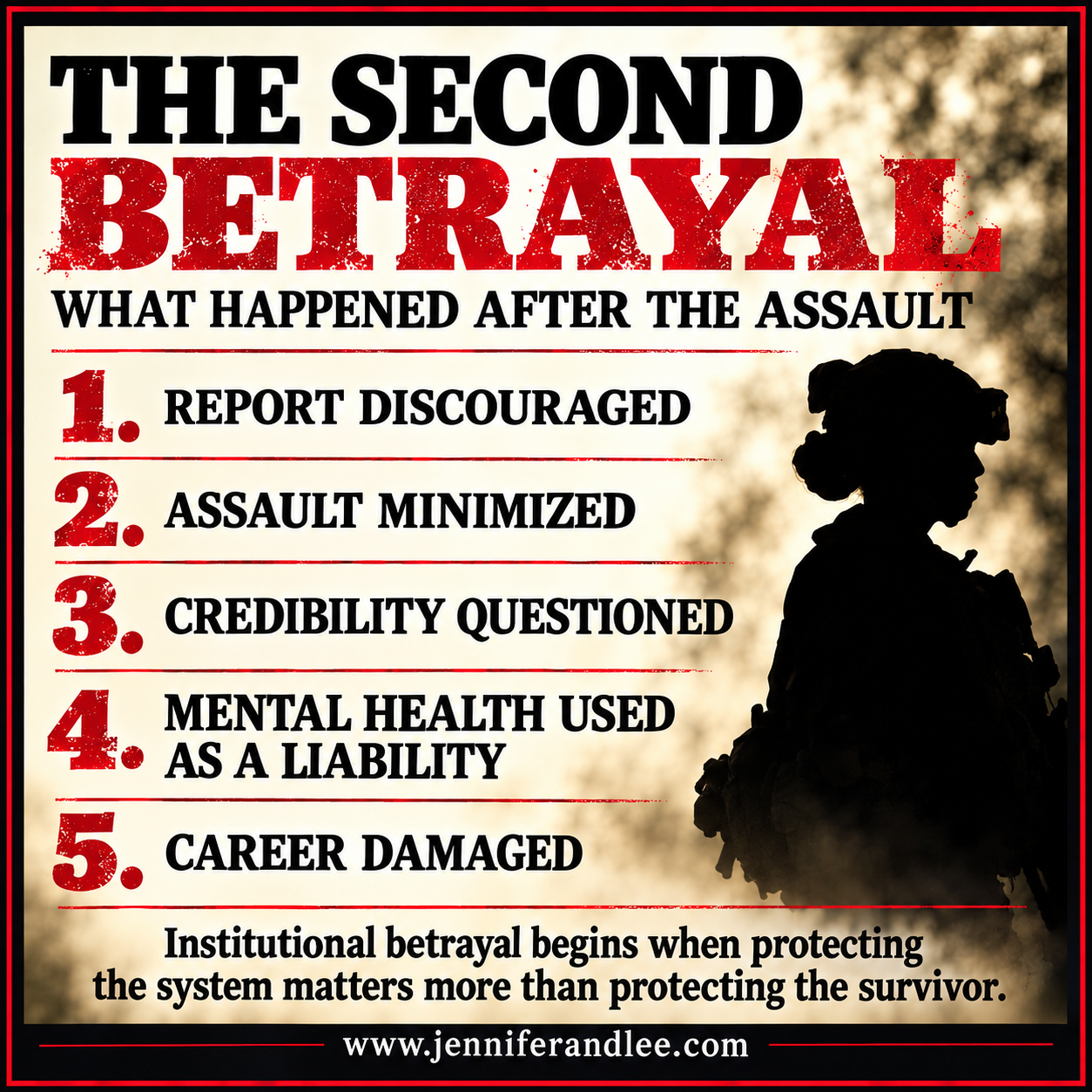
Their experiences revealed a devastating pattern: the sexual assault was only the first betrayal. Afterward, the military institutions responsible for protecting them subjected them to disbelief, retaliation, damaging labels, and professional consequences.
At the time, the Department of Defense estimated that more than 19,000 service members experienced sexual assault in a single year. Most never reported what happened. The article described a military culture in which sexual-assault allegations were frequently treated as threats to unit cohesion, while survivors were viewed as the source of disruption.
Jennifer Norris: When Seeking Help Threatened Her Career
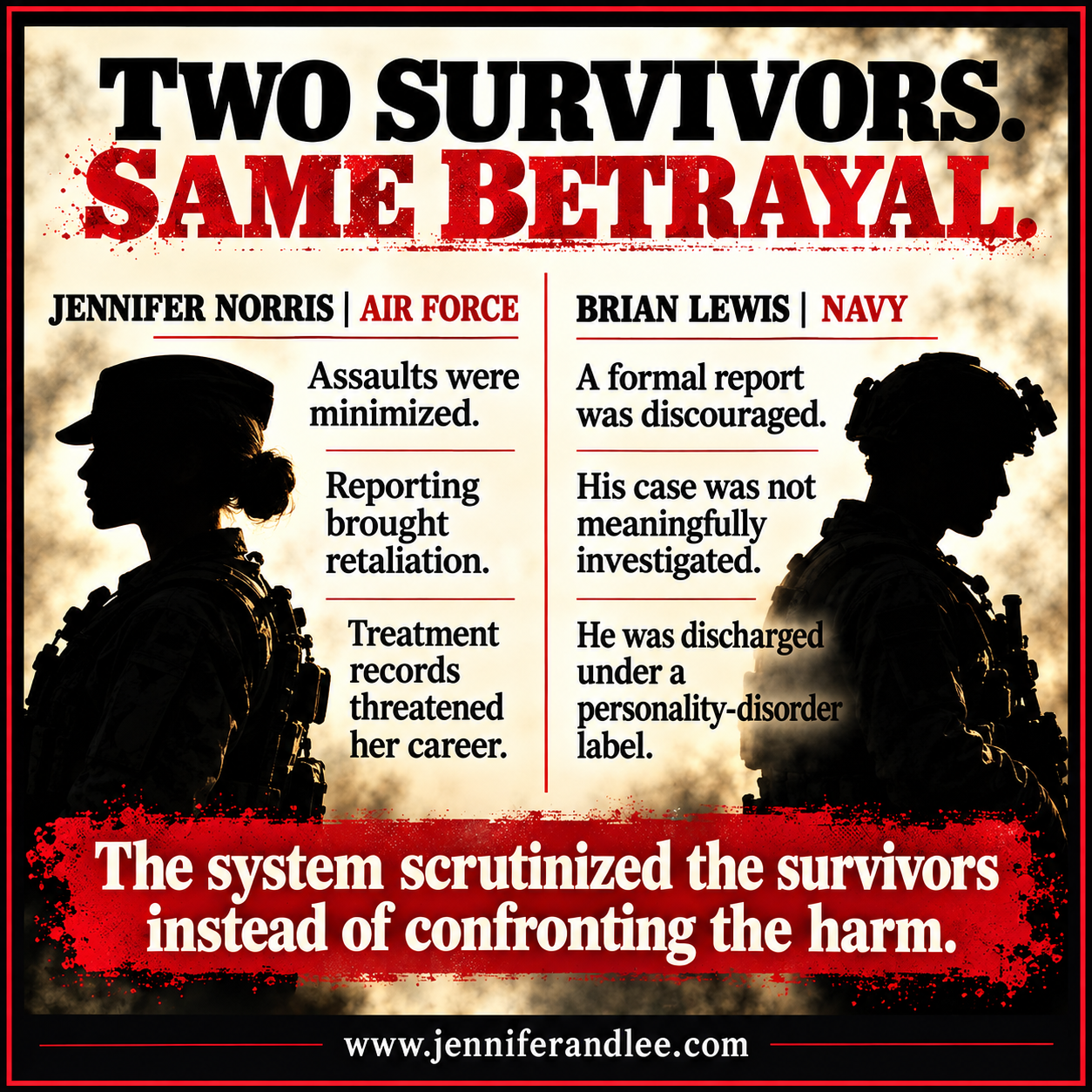
Jennifer Norris entered the Air Force at 24, hoping to serve her country and build a meaningful military career. Instead, she encountered sexual assault beginning with an Air Force recruiter who drugged and raped her. She later reported being sexually assaulted by an instructor and other high ranking military personnel including her immediate supervisor.
For two years, Jennifer remained silent. She had already witnessed how the military treated people who challenged those in authority. Survivors could lose their reputations, careers, and support systems, while the people accused of harming them continued serving.
Her silence was not evidence that the assaults had not occurred. It reflected the danger survivors faced when reporting someone with greater rank, credibility, and institutional protection.
When Jennifer eventually reported four perpetrators, her commander initially questioned her account. After she presented supporting evidence, he determined that the sexual assault cases should be investigated. At a higher level, however, the cases were reduced to sexual-harassment or EEO administrative matters.
Two of the men admitted wrongdoing during an administrative hearing, but they were still able to leave the unit with their careers and benefits largely protected. Jennifer experienced retaliation. She was treated as a troublemaker, denied leadership and training opportunities, and forced to move between units in an effort to preserve her career.
One of the most important parts of the National Journal reporting involved the way Jennifer’s mental-health treatment was later used against her.
Jennifer received counseling through the Department of Veterans Affairs for post-traumatic stress caused by military sexual assault. During a security-clearance review, investigators requested access to her private counseling records.
That placed Jennifer in an impossible position: surrender deeply personal information about her trauma or protect her privacy and risk losing the security clearance necessary to continue her career.
Jennifer revoked permission to access the records. That decision effectively ended her military career, and she was medically retired in 2010.
The process delivered a disturbing message. The assaults could be minimized or handled administratively, but Jennifer’s response to those assaults would be closely examined. The counseling intended to help her heal became another potential threat to her military future.
Brian Lewis: Assaulted, Silenced, and Labeled
Brian Lewis enlisted in the Navy in 1997. In 2000, while serving aboard the submarine tender USS Frank Cable in Guam, Brian said a superior service member raped him at knifepoint.
After the assault, Brian’s command discouraged him from filing a formal report with the Naval Criminal Investigative Service. Instead of being protected, he was returned to sea and placed back into the same environment as the man he said had attacked him.
The reported crime was never meaningfully investigated.
Brian was eventually given a general discharge attributed to a personality disorder. Rather than investigating the violence committed against him, the military effectively placed the problem inside Brian.
That label followed him into civilian life. A damaging discharge record can interfere with employment, veterans’ benefits, professional opportunities, and a survivor’s sense of identity. Brian described the record as a permanent symbol of shame—official paperwork that appeared to support the military’s rejection of him instead of acknowledging what he had survived.
Brian also confronted another powerful barrier: the false belief that men cannot be raped or that acknowledging sexual violence makes a man weak.
At the time of the article, Defense Department estimates indicated that the total number of male military sexual-assault victims may have exceeded the number of female victims, even though women faced a much greater individual risk. Brian’s willingness to speak publicly helped expose a crisis that military culture had kept largely hidden.
Different Survivors, the Same Institutional Betrayal
Jennifer and Brian experienced different forms of sexual assault, but the institutional response followed a strikingly similar pattern.
Their alleged perpetrators benefited from rank, credibility, and a military structure inclined to protect itself. Jennifer and Brian were scrutinized, professionally marginalized, and burdened with mental-health labels connected to the trauma they had endured.
Jennifer’s treatment records became an obstacle during a security-clearance investigation. Brian received a personality-disorder discharge after reporting that he had been raped by a superior.
In both cases, the system focused on the survivor’s mental health and ability to continue serving rather than fully confronting the alleged perpetrator’s conduct.
Contemporary reporting found that tens of thousands of service members had been separated from the military for personality disorders. The Defense Department did not adequately track how many of those discharged service members were also sexual-assault survivors.
Mental-health diagnoses could therefore become more than medical conclusions. They could be used as administrative tools to remove traumatized service members, discredit their accounts, and protect the institution from further scrutiny.
The Meaning of “Raped and Alone”
The words “Raped and Alone” described more than what happened during the assaults.
Jennifer and Brian were made alone by systems that isolated them after they came forward. Their credibility was questioned, their careers were damaged, and their trauma was treated as evidence that something was wrong with them.
The military failed to separate the interests of the institution from the pursuit of justice. Commanders could decide whether allegations moved forward even when the accused was a valued member of the unit or when an investigation threatened the command’s reputation.
Brian’s experience demonstrated what could happen when a command discouraged a survivor from filing a criminal report. Jennifer’s experience showed how an assault could be minimized administratively while the survivor’s treatment, mental health, and professional fitness received greater scrutiny.
Why Independent Accountability Matters
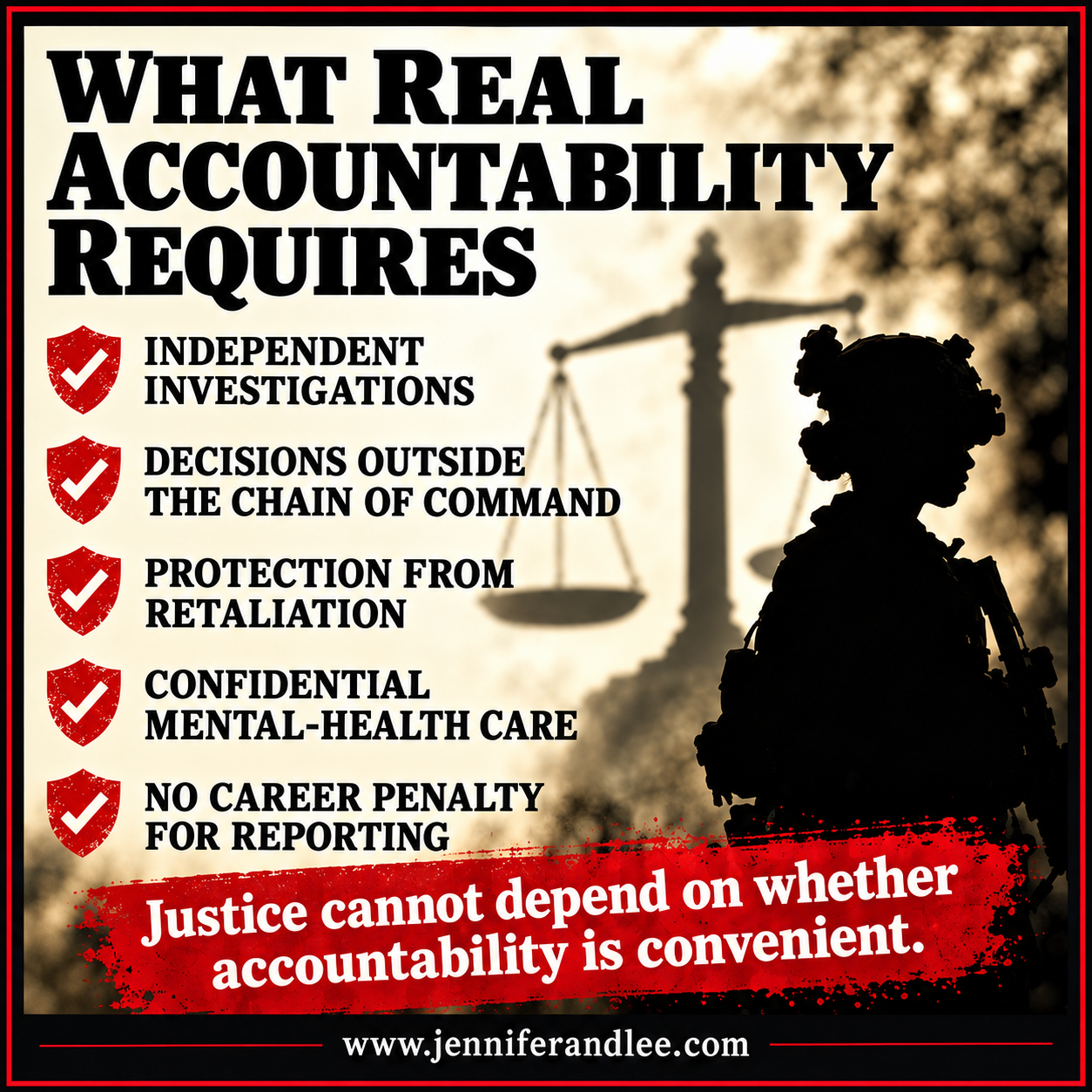
“The Enemy Within” made a structural argument for handling military sexual-assault cases outside the immediate chain of command.
Commanders may have personal or professional relationships with the people involved. They may also face pressure to protect a unit’s reputation, readiness statistics, or public image. Those conflicts can influence whether an allegation is investigated as a serious crime or quietly resolved as an administrative problem.
Training and awareness cannot correct a justice system that permits institutional loyalty, personal bias, and command discretion to determine whether a case moves forward.
Survivors need independent investigations, meaningful protection from retaliation, confidential access to mental-health care, and a process that does not force them to sacrifice their careers to report a crime.
Jennifer Norris and Brian Lewis spoke publicly because their experiences were not simply a collection of individual mistakes. Their stories exposed a military justice system that protected institutional interests while leaving survivors to bear the consequences.
The military did not only fail to protect Jennifer and Brian from the people who harmed them. It also failed to protect them from the retaliation, stigma, and institutional betrayal that followed.
Their willingness to speak helped expose the enemy within—and challenged the military to ensure that no survivor would again be raped and left alone.
Sources
- “Defense Department Struggles to Deal With Sexual Assaults,” Government Executive
- “The Military’s Rape Problem,” The National Interest
- Jennifer Norris’s House Armed Services Committee testimony
- Senate Armed Services Committee hearing on sexual assault in the military
- PBS NewsHour interview with Jennifer Norris and Brian Lewis
- U.S. Commission on Civil Rights: “Sexual Assault in the Military”


