Copyrighted By Jennifer Norris, USAF Retired
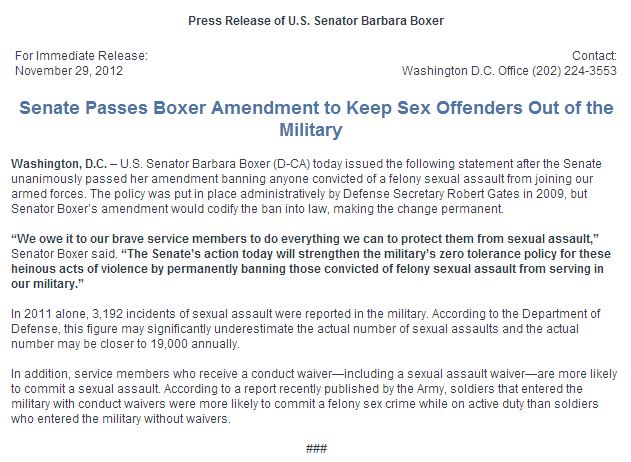
In 2012, Senator Barbara Boxer pushed Congress to do something that should never have required an act of Congress: prohibit the military from granting an enlistment or commissioning waiver to someone already convicted of a felony sexual offense.
Read that again.
Before this law, the military still had discretion to waive certain criminal histories—including felony convictions—when deciding who could enter the Armed Forces. During the wars in Iraq and Afghanistan, recruiting demands had placed enormous pressure on the services to fill the ranks. The result was a waiver system that opened the door to people who ordinarily would not have met military conduct standards.
That was the context in which Boxer introduced S. 2137 and later offered Senate Amendment 2981 to the National Defense Authorization Act for Fiscal Year 2013. Her amendment was not symbolic. It closed a real statutory gap and removed discretion where discretion never should have existed.
Wartime Recruiting Pressure Changed the Risk Calculation
The military has long used waivers to evaluate applicants whose histories would otherwise disqualify them. A waiver does not automatically mean a person is dangerous, and not every person who received one had committed a violent offense. But during the height of the post-9/11 wars, the scale of the waiver system increased dramatically.
Congressional Research Service data show that the share of non-prior-service Army recruits entering with a waiver of any type rose from 12.7 percent in fiscal year 2003 to 22 percent in fiscal year 2007. A Government Accountability Office review found that approximately 12 percent of active-Army recruits admitted in fiscal year 2008 had conduct waivers. Felony waivers represented about 13 percent of those active-Army conduct waivers, although people with felony waivers remained less than one percent of all active-Army accessions. GAO also reported that recruits with conduct waivers were more likely to be separated later for adverse reasons such as behavioral problems. (GAO; Congressional Research Service archive)
Those figures do not prove that every waiver recipient was violent, nor do they prove that the waiver program caused every later crime in the ranks. But they do establish something important: the services were using conduct waivers at scale while trying to grow and sustain the force, and felony waivers were part of that system.
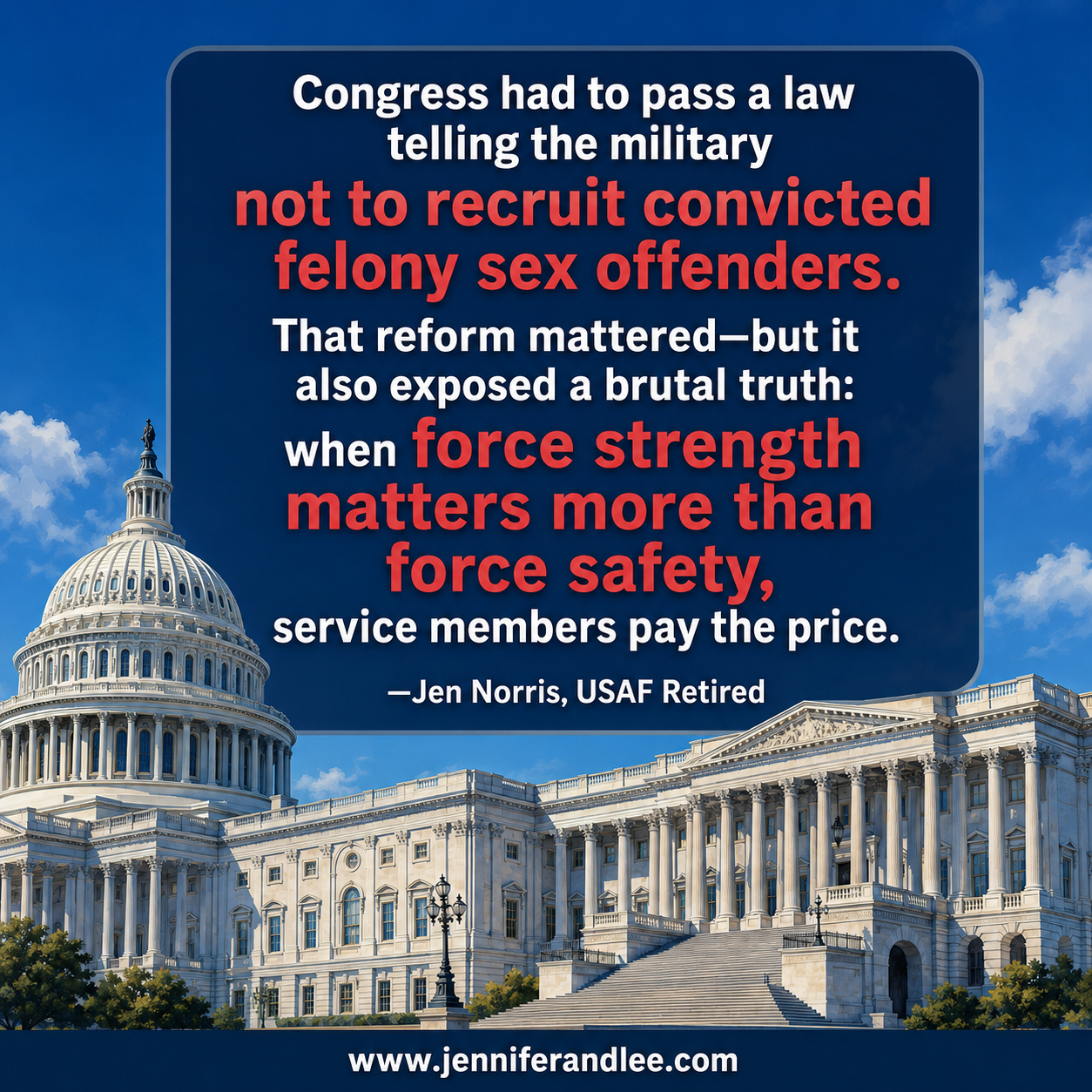
My own research found the consequences of treating force strength as more important than force safety. The military did not merely recruit some people with serious criminal histories. Commanders also acknowledged overlooking misconduct among people already serving because they were needed to deploy. When an institution lowers the barrier at the entrance and then minimizes warning signs after entry, it creates two layers of preventable risk.
Service members are ordered to live, work, train, deploy, and sometimes sleep in close quarters with people they did not choose. Young recruits cannot simply walk away from a supervisor, instructor, recruiter, or fellow service member who poses a threat. The military exercises extraordinary control over their movement and daily lives. That makes the institution’s screening obligation more—not less—important.
Boxer Testifies on Sexual Assault in the Military (March 13, 2013)
What Senator Boxer’s Law Actually Did
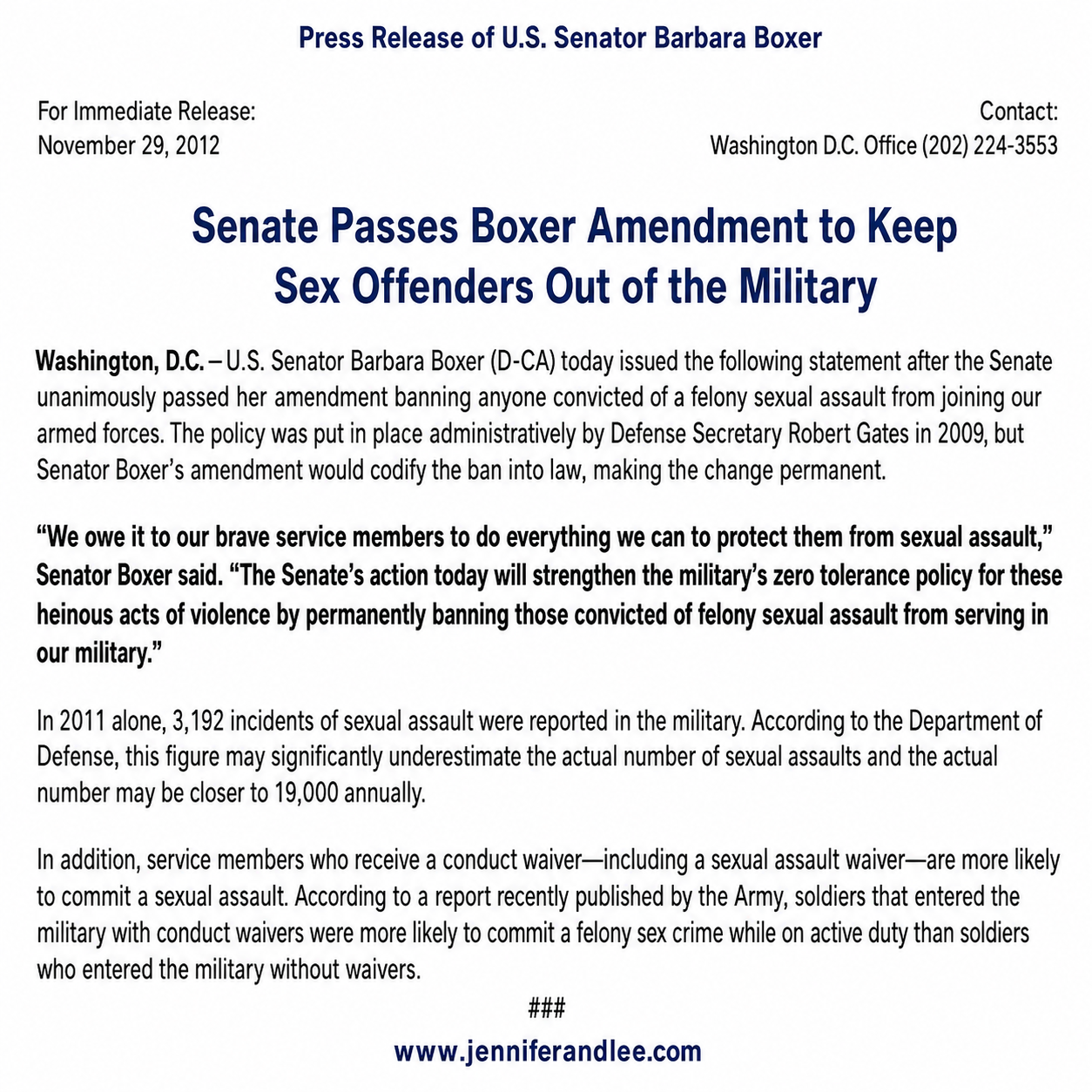
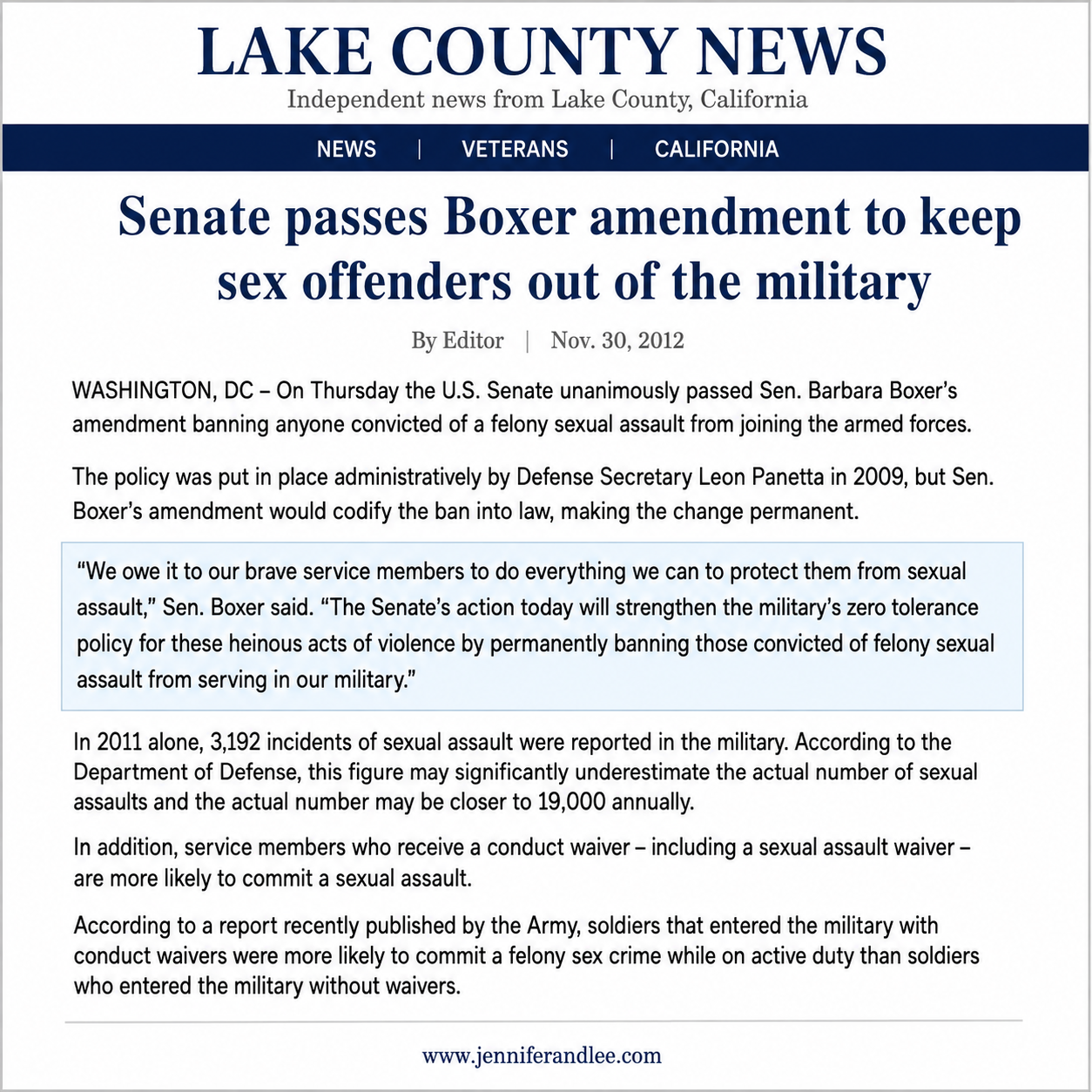
Boxer’s original bill, S. 2137, sought to prohibit waivers for commissioning or enlistment for anyone convicted of a felony sexual offense. On November 29, 2012, the Senate unanimously accepted her amendment to the FY2013 defense bill. The final provision became Section 523 of Public Law 112-239, signed on January 2, 2013.
The law stated that the military could not provide an enlistment or commissioning waiver to a person convicted under federal or state law of felony rape, sexual abuse, sexual assault, incest, or another sexual offense. (Public Law 112-239, Section 523)
The Department of Defense had reportedly adopted an administrative ban in 2009, but an internal policy could be changed by a future defense secretary or quietly weakened when recruiting pressure returned. Boxer’s amendment made the prohibition law. Congress removed the option to decide that a staffing goal, deployment schedule, or recruiting shortage mattered more than a known felony sex-offense conviction.
This was necessary because “zero tolerance” is meaningless when it depends on administrative discretion. If a person has already been convicted of felony sexual violence, the military should not give that person authority, weapons training, institutional credibility, or access to a population that may have little ability to escape.
The law was also narrow. It did not solve inadequate background investigations, misconduct that never produced a conviction, crimes committed after enlistment, retaliation against victims, command interference, or the retention of offenders already in uniform. It was an essential boundary—not a comprehensive solution.
The Invisible War Forced Washington to Look
The political timing matters. The Invisible War premiered in 2012 and forced the country to confront military sexual assault through the faces and voices of actual survivors. The film did what decades of reports, scandals, promises, and “zero tolerance” campaigns had failed to do: it made the institutional pattern impossible for lawmakers to pretend they had not seen.
The film’s outreach campaign later credited it with prompting five congressional hearings and 35 legislative provisions addressing military sexual assault. The same campaign said Boxer credited the film with helping her pass the prohibition against felony sex offenders entering the military, while Senator Kirsten Gillibrand credited it with inspiring what became the Military Justice Improvement Act. (#NotInvisible campaign history)
The film created a flurry of congressional activity. Hearings were held. Press conferences were staged. Members of Congress introduced competing bills. The Pentagon announced new initiatives. The FY2013 NDAA created special-victim capabilities, expanded record-retention requirements, and required climate assessments. Separately, the Pentagon elevated certain case-disposition decisions to more senior commanders—but kept those decisions inside the chain of command. (2013 Senate hearing record)
Those were changes. But activity is not the same thing as transformation.
Motion Is Not the Same as Reform
The congressional response produced new programs, new training, new reporting requirements, and new layers of military administration. What it did not immediately produce was the core structural reform survivors were demanding: removing serious criminal prosecution decisions from the accused person’s chain of command.
That distinction matters. In 2012, the Department of Defense estimated that approximately 26,000 service members had experienced unwanted sexual contact during the prior year. In 2021, the Department estimated that 35,875 active-duty members had experienced unwanted sexual contact. The survey methods changed, so those two estimates should not be treated as a direct apples-to-apples trend line. But the later number destroys any claim that the flood of activity after the film had solved the underlying crisis. (GAO on the 2012 estimate; Department of Defense FY2021 briefing)
The clearest measure of the delay is structural. The decision to prosecute sexual assault and several other serious crimes did not move from an accused service member’s chain of command to independent Offices of Special Trial Counsel until December 28, 2023—more than a decade after The Invisible War ignited that national debate. (Department of Defense)
So no, it would not be accurate to say that absolutely nothing changed. Boxer’s law mattered. Victims gained some important protections. Procedures improved in specific areas. But for years, Washington counted bills, hearings, trainings, and press events as proof of success while the central conflict of interest remained largely intact.
Survivors were asking for justice. Too often, institutions answered with process.
The US Military Recruited Violent Felons to Support the War Efforts
I Was There—and I Watched Survivor Advocacy Become Gatekept
I do not write this as an outside observer. I served in the Air Force. I survived military sexual assault and retaliation. I worked as a national advocate, served on the Protect Our Defenders Advocacy Board, went to Washington with other survivors, and testified before the House Armed Services Committee during its January 23, 2013, hearing on the Lackland Air Force Base abuse scandal.
At that hearing, I said the military sexual-assault crisis was perpetuated by “a culture that punishes the victim and a broken military justice system.” I asked Congress to hear directly from current Lackland victims and independent experts. I warned that the cycle of scandals, self-investigations, and ineffective reforms had to be broken. (My 2013 testimony)
At the time, I described Protect Our Defenders as a place where survivors could build community, amplify our voices, support one another, and take collective action. That was the mission I believed I was serving.
But an organization that says it amplifies survivors must never become the gate through which survivors are required to pass before Washington will hear them.
Protect Our Defenders was founded and remains chaired by Nancy Parrish. The organization’s published biography describes her background in business, public affairs, humanitarian work, and civilian human-rights advocacy; it does not identify any military service. (Protect Our Defenders leadership) Civilian allies can make meaningful contributions. Civilian leadership is not automatically disqualifying. The problem begins when a civilian-led private organization is treated as the official owner, interpreter, and distributor of military survivors’ voices.
No single nonprofit represents every survivor. No organization should be permitted to decide which survivors are credible enough, polished enough, connected enough, or useful enough to reach lawmakers and the media. When congressional offices depend on one organization for witnesses, talking points, introductions, and policy approval, that organization accumulates enormous power over a population it claims to serve.
It can choose which stories are elevated, which reforms are celebrated, which disagreements are buried, and which independent advocates are left outside the room. Lived experience becomes curated content. Survivors become evidence for an organization’s authority instead of authorities in our own right.
That is the gatekeeping I am calling out.
My criticism is not that Protect Our Defenders has never helped anyone or never contributed to reform. The public record shows that it participated in hearings, organized survivors, advocated for changes, and provided legal assistance. My criticism is that no private organization—especially one controlled by a civilian—should be allowed to claim a representational monopoly over service members and veterans who survived crimes inside an institution the organization’s leadership never served in.
I experienced this advocacy system from the inside. My conclusion is that access became centralized, survivor voices were filtered, and independent voices were stunted. That is my firsthand account. It should be heard directly, not screened, softened, or interpreted by the very organization I am criticizing.
Survivors Need Representation Without Ownership
Real survivor-centered reform would create more paths to power, not fewer. Congress should hear from multiple survivor-led organizations, independent advocates, male and female survivors, enlisted and officer survivors, active-duty personnel, veterans, family members, and people whose policy conclusions do not match the preferred position of a dominant nonprofit.
Witness selection should be transparent. Survivor advisory councils should rotate. Congress should disclose which outside organizations helped choose witnesses or draft policy. Funding should reach independent survivor-led groups rather than continually reinforcing one organization’s access. Most importantly, lawmakers should build direct relationships with survivors instead of outsourcing those relationships to professional intermediaries.
The movement cannot demand that the military surrender its monopoly over justice while tolerating a nonprofit monopoly over survivor representation.
Senate passes Boxer amendment to keep sex offenders out of the military
The Lesson of Boxer’s Law
Senator Boxer’s 2012 amendment was needed because policy, discretion, and promises were not enough. Congress had to draw a line the military could not erase when operational pressure returned: a person convicted of a felony sexual offense would not receive a waiver to enter the Armed Forces.
That law was common sense. It was also proof of a much larger institutional failure.
The military had been entrusted to screen recruits, protect service members, investigate crimes, punish offenders, and support victims. In too many cases, it failed at every stage. The Invisible War exposed that failure and forced Congress to move, but much of the movement remained incremental, procedural, and controlled by the same small circle of institutional actors and approved advocates.
Survivors did not risk our careers, health, reputations, and lives so other people could build authority by speaking for us. We spoke because we wanted the system changed—and because we expected to remain the owners of our own voices.
Barbara Boxer’s law established one necessary boundary. The next boundary must be just as clear:
No institution, politician, or nonprofit gets to claim ownership of the survivor community. We are not anyone’s talking points, fundraising story, or political property. We can speak for ourselves.
Sources
- The US Military Recruited Violent Felons to Support the War Efforts — Jennifer and Lee
- Military Personnel: Army Needs to Focus on Cost-Effective Use of Financial Incentives and Quality Standards — U.S. Government Accountability Office
- Recruiting and Retention: FY2013 and FY2014 Results — Congressional Research Service archive
- Defense: FY2013 Authorization and Appropriations — Congressional Research Service archive
- National Defense Authorization Act for Fiscal Year 2013, Public Law 112-239 — GovInfo
- Testimony on Sexual Assaults in the Military, March 13, 2013 — GovInfo
- Protect Our Defenders Testifies on the Lackland Sexual-Abuse Scandal, including Jennifer Norris’s testimony
- #NotInvisible Campaign History
- Combating Sexual Assault in the Military — U.S. Government Accountability Office
- FY2021 Annual Report Briefing — U.S. Department of Defense
- Sexual-Assault Prosecution Moves Outside the Chain of Command — U.S. Department of Defense
Photo Source: