Introduction
For over twenty years, I watched environmental exposure quietly change my life long before I connected the dots. While struggling with the unexplained illnesses, I lived with the devastating consequences of delayed recognition, inadequate testing, and institutional failures to act. My own journey with chronic heavy metal poisoning, mold exposure, and tick-borne illness taught me firsthand that environmental hazards don’t always leave immediate, visible injuries—but they can alter the course of a person’s life.
This new study from California’s Salton Sea reinforces an important reality: environmental exposure is a public health issue, a justice issue, and a human issue.
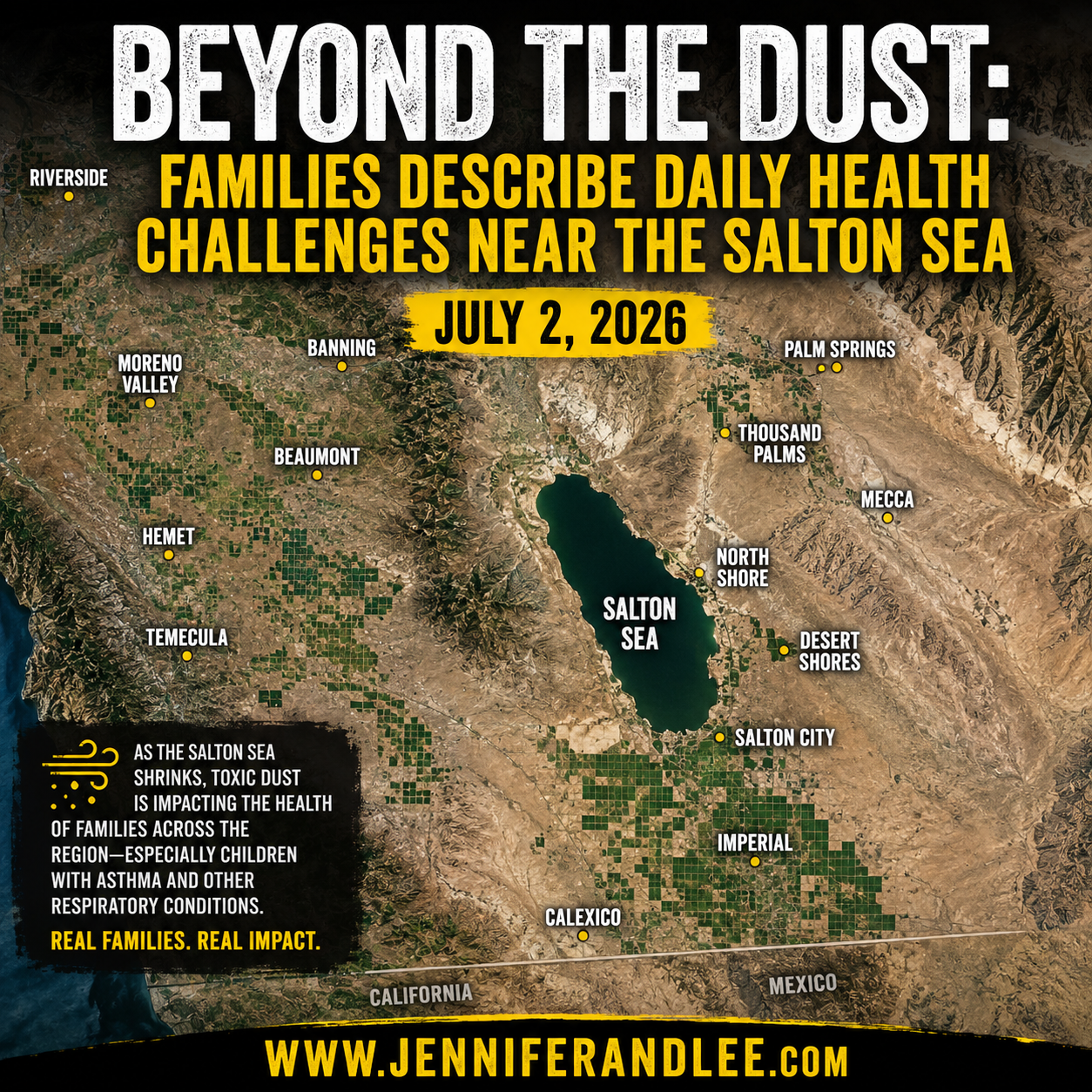
“Beyond the Dust: Families Describe Daily Health Challenges Near the Salton Sea”
by Iqbal Pittalwala, University of California – Riverside
Researchers from the University of California, Riverside studied how the shrinking Salton Sea is affecting the health of nearby families, particularly children with asthma and other respiratory illnesses.
The study focused on 15 Latina mothers caring for children with respiratory conditions. Researchers combined:
- Indoor air quality monitoring
- Personal photographs taken by families (“photovoice”)
- Interviews about their daily experiences
Key findings
- Outdoor dust storms frequently invaded homes, even through closed windows and doors.
- During major dust events, indoor particulate pollution sometimes doubled, exposing children even when families stayed inside.
- Many parents reported:
- Keeping children indoors for long periods.
- Missed school because of breathing problems.
- Missing work to care for sick children.
- Constant worry whenever winds picked up.
The bigger issue
The researchers emphasize that this isn’t simply an environmental problem.
They argue it is also an environmental justice issue because many nearby communities are:
- Lower-income
- Predominantly Latino and Indigenous Mexican
- Living in older housing that does little to keep dust out
- Already facing disproportionate environmental burdens.
Why the Salton Sea matters
The Salton Sea continues to shrink as:
- Water inflows decline.
- Temperatures rise.
- More dry lakebed becomes exposed.
That exposed lakebed creates fine airborne dust that can carry contaminants and worsen respiratory disease throughout surrounding communities. This builds on years of research showing the shrinking lake poses an increasing public health risk.
One hopeful finding
Researchers also found that simple, low-cost air filtration systems can significantly improve indoor air quality. They suggest that expanding access to better housing, air filtration, and public health resources could meaningfully reduce children’s exposure.
Summary
Researchers found that families living near the shrinking Salton Sea are experiencing significant health challenges as contaminated dust increasingly enters their homes. Even with doors and windows closed, indoor air pollution often rose during dust events, contributing to respiratory problems in children and forcing families to miss school, work, and daily activities.
The study also highlights how environmental hazards disproportionately affect communities with fewer resources and older housing, making exposure difficult to avoid. While researchers identified low-cost air filtration as one helpful solution, they emphasize that meaningful progress will require broader investments in public health, environmental restoration, and community protections.
Whether the exposure comes from contaminated dust, industrial pollution, military service, or another environmental source, the lesson is the same: people deserve to be heard, their health issues investigated thoroughly, and protected before preventable illnesses become lifelong disabilities. Every delayed response represents real families whose lives are changed by hazards they often cannot see.
Related Links:
New York Times: The Army Thought He Was Faking His Health Issues. Turns Out He Had Chronic Lead Poisoning. (April 3, 2019)
Why Are Military Women Affected by Toxic Exposure More than Men? – Women’s eNews (April 14, 2022)
After Lead Poisoning Symptoms Dismissed by PTSD Diagnosis, It Results in Brain Inflammation, Fatigue, Muscle Weakness, Digestion Issues & Chronic Pain (2024)
I Watched My Father Die From a Brutal & Painful Battle with Terminal Bone Cancer… And My Toxic Military Leadership Kicked Me While I Was Down (2024)
NBC News: Veterans Wait 30 Years on Average for the U.S. to Acknowledge Toxic Exposures (September 18, 2024)
Dear Mass Air National Guard, You Poisoned Me With Lead… But You Already Knew That (2025)
From Weapons to Wounds: The Toxic Legacy of World War II’s Strategic Metals Behind Every Bullet, Tank, and Bomber (June 28, 2026)

 Jennifer and Lee